

Editor’s note — This is the English-language version of an article originally written for a Japanese readership: specifically, karate practitioners and enthusiasts in Japan who want to understand how karate is actually practiced, taught, and sold in North America. The original intent has been preserved, so the viewpoint remains “North America as seen from Japan.” Where the source assumed knowledge familiar to Japanese readers, short explanations have been added for readers outside Japan. “KARATE” in capitals is used to signal the broad North American popular image of karate, as opposed to karate-dō as a Japanese martial art.
About this piece — This is a draft that gives a Japanese audience an overview of how karate has actually spread in North America. Drawing on the previous article, Karate as Seen from Abroad, it narrows the focus to North America’s commercial dojos, family martial-arts schools, the “McDojo” critique, and the realistic options available to Japanese karateka (karate practitioners) who want to train or open a school there.
Introduction — In North America, Karate Lives Inside the “Lessons Industry,” Not the “Dojo”
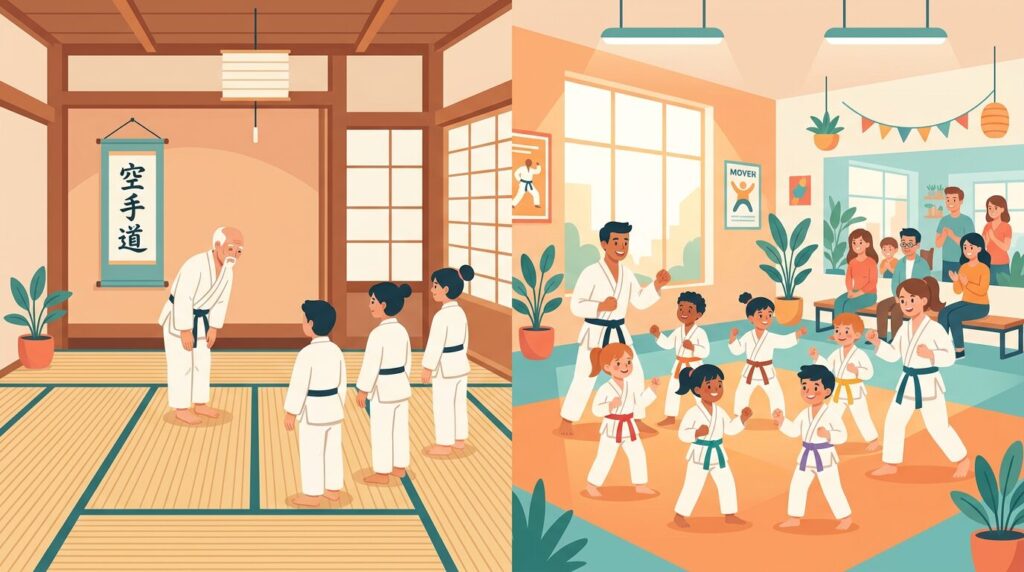
When Japanese people hear the words “karate dojo,” the picture that comes to mind is fairly clear: a school gymnasium, a neighborhood dojo, a community sports center, a university karate club, a dedicated full-contact training hall. Bound up with that picture is the vocabulary specific to Japanese karate culture — ryūha (styles or schools), shihan (master instructors), training days, grading examinations, tournaments, and reihō (formal etiquette and bowing).
Step into a place called a “karate school” or “martial arts studio” in an American or Canadian city, however, and that impression changes dramatically. Serious dojos certainly exist across North America — Shotokan, Gōjū-ryū, Shitō-ryū, and Wadō-ryū (the four major Japanese styles), along with Okinawan karate, Kyokushin-style full-contact karate, and kobudō (classical Okinawan weapons) schools. But the “karate” that an ordinary family first encounters is often a children’s and family-oriented martial-arts studio tucked into a shopping mall or a small suburban retail strip.
There, karate is sold less as a martial art than as “a lesson that builds a child’s confidence,” an after-school program, fitness, self-defense, or a family activity. Tuition is auto-debited monthly, trial lessons are free or low-cost, beginners receive a uniform (gi) and a white belt on joining, belt-promotion tests come every few months, and the school may even host summer camps and birthday parties.
You cannot understand karate in North America without confronting this “lessons industry” dimension. What a Japanese karateka imagines on hearing “karate is apparently popular overseas” and what a local family pictures when they decide to “sign our kid up for karate” are two quite different things.
1. KARATE as Entertainment
No account of the North American image of karate can ignore the decisive influence of screen entertainment.
For Japanese people, karate is tied to school physical education, club activities, neighborhood dojos, Kyokushin, the All Japan Karatedo Federation (the national governing body, often abbreviated in Japan as Zenkūren), and Okinawan culture. For the North American public, by contrast, KARATE is most often remembered first through film and television.
The landmark example is, of course, The Karate Kid (1984). The story of Daniel LaRusso and Mr. Miyagi was not merely a coming-of-age movie; it created one of the prototypes for the North American image of karate. Here karate is, before it is a fighting technique, the story of a bullied boy who recovers his self-worth, meets a mentor, and grows spiritually through physical training.
The sequels — and Cobra Kai, which began in 2018 and concluded in 2025 — rebooted that image for a modern audience. (Cobra Kai first streamed on YouTube Red / YouTube Premium before moving to Netflix.) In it, the dojo is not just a training hall but a stage where teenage identity, local community, family relationships, competitiveness, and the craving for recognition all intersect. To Japanese eyes, the invented styles and the technical depictions often look odd. But for North American viewers, KARATE is fundamentally “a physical metaphor for facing life’s hardships.”
For older generations, the memories layer on figures such as Chuck Norris, Jean-Claude Van Damme, Steven Seagal, Bruce Lee, and Jackie Chan. Their martial backgrounds are not uniform: Chuck Norris made his name in American karate competition out of a Tang Soo Do background, and Van Damme has a Shotokan karate background, whereas Steven Seagal comes from aikido, Bruce Lee from Wing Chun and his own Jeet Kune Do, and Jackie Chan from the acrobatics and Chinese-martial-arts body language he absorbed at Peking Opera school. Even so, in popular consciousness, karate, kung fu, taekwondo, and “martial arts” are frequently blurred together. The entire category of “Eastern fighting arts” ends up represented by the single word karate.
This entertainment-driven image is an important entry point for North American commercial dojos. A child sees a roundhouse kick or a board break in a movie or on YouTube and is smitten; a parent hopes for benefits like “confidence,” “focus,” “discipline,” and “anti-bullying,” and contacts the neighborhood martial-arts school. In this way, karate on screen is funneled into the suburban lessons business.
2. What a North American “Family Martial-Arts Dojo” Actually Is
Drive through suburban North America and you will repeatedly pass low-rise retail blocks known as strip malls. Alongside the pizza place, the dentist, the nail salon, the dry cleaner, the tutoring center, and the gym, you will sometimes see signs reading Karate, Taekwondo, Martial Arts, Family Martial Arts, or Self Defense.
This kind of dojo differs considerably from a Japanese neighborhood dojo. First, its target audience is explicitly the family. The core customers are preschoolers and elementary-school children — especially kids roughly aged 3 to 12 — and their parents. Even the program names — Little Ninjas, Little Champions, Kids Martial Arts, Leadership Program, Black Belt Club, After School Program, Summer Camp — are designed as educational services.
The instruction is not necessarily faithful to any Japanese karate style. Some schools call themselves Shotokan; others teach proprietary systems blending American Karate, Kenpo, Taekwondo, mixed martial arts, kickboxing, Krav Maga, and self-defense. Even when the sign says “karate,” the actual content often mixes taekwondo-style kicking, kickboxing-style pad work, Krav Maga or Brazilian Jiu-Jitsu–flavored self-defense, and school-style life-skills education.
But it would be hasty to dismiss all of this as “fake.” What North American parents want for their children is not necessarily “to learn Shotokan kata (forms) precisely.” Rather, they are after benefits like these:
- Building physical fitness
- Learning to sit still and listen
- Following the instructor’s directions
- Answering loudly and clearly
- Gaining the confidence to stand up to bullying
- Making friends outside of school
- Reducing screen time
- Getting a safe, supervised place to be after school and during long vacations
Indeed, North American dojo advertising sometimes markets itself as an “after-school program” or “summer camp” that includes school pickup, homework time, crafts and games, and day camps during vacations. Here, karate is not a single 45-minute lesson but a lifestyle service tied to after-school care and seasonal camps.
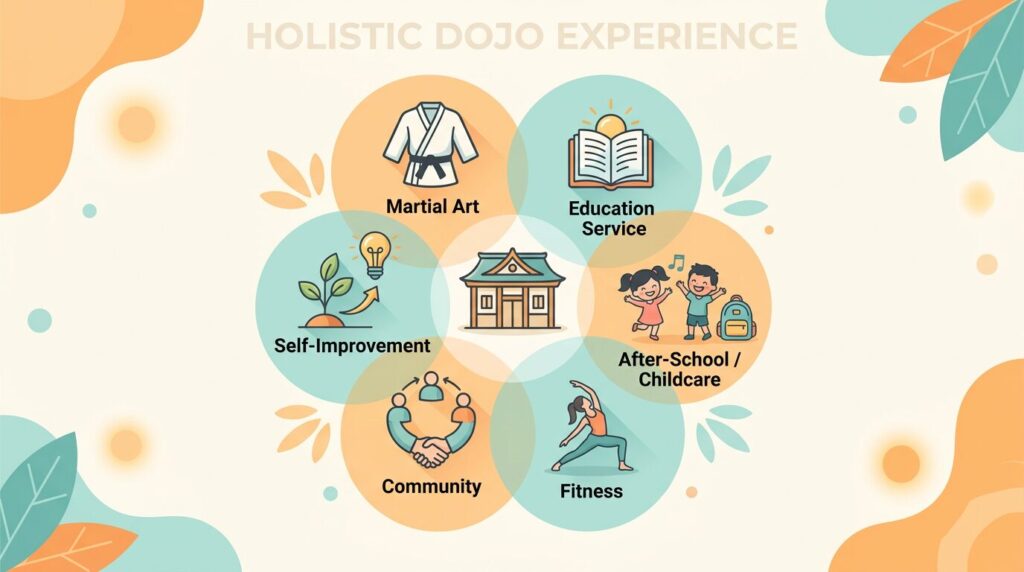
In other words, a North American family martial-arts dojo is, simultaneously, a martial-arts school and a piece of the education-services, childcare-support, fitness, community, and self-improvement industries. A Japanese karateka who evaluates a local school without grasping this structure will, more often than not, misread it.
3. What a “McDojo” Is
When discussing North American karate, one word is unavoidable: McDojo. The term fuses “McDonald’s” and “dojo” — a McDonaldized, fast-food-style martial-arts school. It is not a precise academic term or legal category; it is a derogatory, critical piece of slang used within the English-speaking martial-arts and combat-sports community.
The word does not simply mean a commercial dojo. As long as a dojo pays rent and an instructor earns a living, commerce itself is not the evil. In fact, many North American dojos are small businesses paying rent, insurance, staff wages, and advertising, and monthly tuition and contracts are nothing unusual. The problem arises when a school prioritizes membership numbers, tuition, contract length, testing fees, merchandise, and event revenue over the quality and safety of the martial art.
Typical McDojo critiques include the following points:
- Students are promoted in rank by time served and testing fees, regardless of skill
- The time to earn a black belt is abnormally short
- Black belts are handed out in bulk to children of any age
- Instructors’ credentials are vague or exaggerated
- The school advertises self-defense, yet offers almost no setting — matches, sparring, bunkai (practical application of kata), or resistance drilling — in which technique can actually be tested
- Students are locked into long contracts that are hard to cancel
- Expensive uniforms, belts, patches, protective gear, weapons, and special classes are sold one after another
- High-pressure sales tactics make people feel they will “lose out” if they don’t enroll
- A child’s self-esteem is leveraged to make parents pay extra fees
- Instructors inflate their rank, competition record, organizational affiliation, or military/police experience
- Unverifiable, supernatural “techniques” — such as knocking opponents down without touching them, or subduing them with ki (vital energy) — are marketed as martial arts
- There is little awareness of safety management, child protection, or harassment prevention
In English-language martial-arts forums, “McDojo” and “belt factory” are often used interchangeably — an objection to treating the black belt as a product to be sold rather than a checkpoint in training. More recently, McDojo criticism has expanded beyond “cheap black belts” to include false credentials, dangerous instruction, cult-like teacher–student relationships, and an industry structure that fails to screen out sexual predators and abusers.
Here, too, caution is needed. A North American dojo is not a McDojo merely because it offers robust children’s programs. Nor is a school automatically low-quality just because it is clean, its instructors are upbeat, its tuition is high, and its website is polished. On the contrary, in some areas there are excellent commercial dojos with proper safety management, age-graded curricula, attentive parent communication, and accommodation for developmental needs.
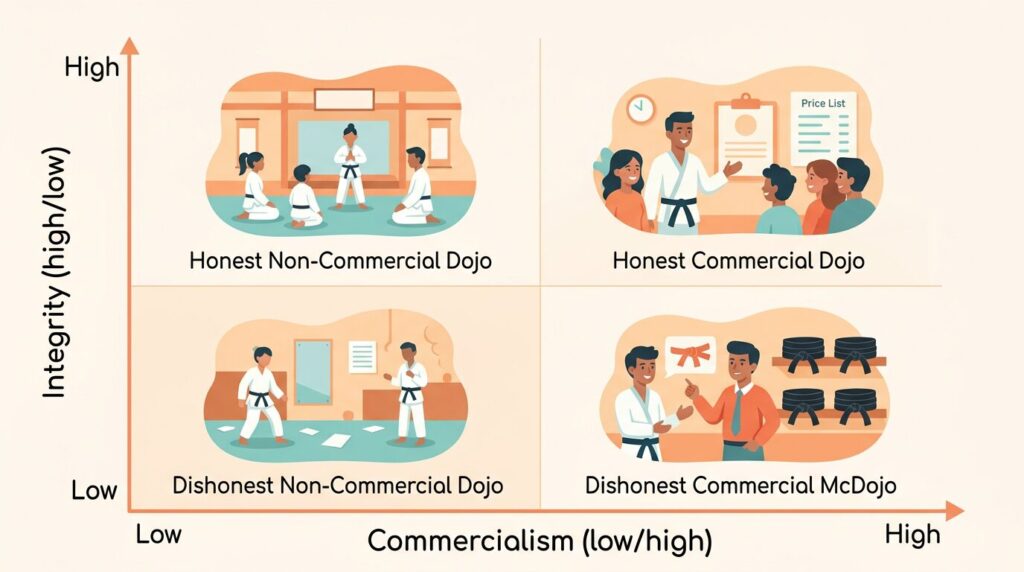
The key to judging whether a school is a McDojo is not commercialism but integrity. What is being taught? What is not being taught? How effective is it really as self-defense? At what level does it function as competition? What does the black belt mean? How much does it cost? A dojo that explains these things honestly is not necessarily a bad dojo, even if it is commercial.
4. A Typical North American Karate Lesson — A Short Family Story
Picture a family living in suburban North America. The setting is a mid-sized city in the American Midwest. The father is a project manager at an IT company; the mother is a nurse at a hospital. Eight-year-old Emma is a little shy at school and not especially athletic. Her five-year-old brother, Liam, has energy to burn.
One Saturday, the family spots a sign at a nearby shopping plaza: “Free Karate Trial,” “Build Confidence,” “Anti-Bullying,” “Family Martial Arts.” The website says the first trial is free and the beginner promotion, uniform included, is $49. The Google reviews are glowing: “my child gained confidence,” “the instructor is wonderful,” “she can focus at school now.”
The next week, Emma attends a trial lesson. The class runs 45 minutes, starting at 5 p.m. School lets out, a parent drives her over, and she takes off her shoes in front of the dojo. About twenty children in white, yellow, and orange belts line up on the mat. The instructor is a man in his late thirties who, he says, studied taekwondo and karate as a child and also did kickboxing in college. His business card reads “4th Degree Black Belt” and “Certified Instructor.” The Japanese style name is unclear, but he is skilled at engaging children and runs the class extremely well.
Training flows through meditation, a bow, a warm-up, basic punches and kicks, pad work, a simple form, game-format reaction drills, and finally a talk about “today’s life skill” — respect. The children answer in loud voices: “Yes, sir!” “Yes, ma’am!” Emma is nervous at first, but the instructor’s praise brings out a smile.
After the trial, the parents get a sales explanation in a separate room. The standard plan is twice a week, with monthly tuition somewhere around $150–$220. A low-cost class at a community center or YMCA-type facility may run only about $50–$100 a month, but a dedicated, storefront family martial-arts studio can range from roughly $100 up into the $300s per month. Registration fees, uniforms, protective gear, and belt-test fees are often extra. A six-month or annual contract earns a small discount; joining a Black Belt Program or Leadership Program raises monthly tuition and total contract value in exchange for access to advanced and special classes. A few times a year there are testing fees of a few tens of dollars; a black-belt test can cost considerably more. A full set of sparring gear runs about $150–$250. Summer camps vary widely by region, but roughly $150–$300 per week is a useful benchmark. Competing adds entry fees, travel, and hotel costs.
Emma joins. In the first six months she moves from white to yellow to orange belt. She trains twice a week, on Monday and Wednesday evenings. The content is basic punches, front kicks, roundhouse kicks, blocks, simple combinations, self-defense, forms, and pad work. After a year, her voice is a little louder when she presents at school. Her parents feel “karate has given her confidence.”
In the second year, Emma reaches green belt. On top of twice-weekly training, she joins the Saturday sparring class. She does light point-sparring in protective gear, but contact is heavily restricted. It is less training that involves pain and fear than a game that builds reaction speed and courage within the rules. Emma enters a local tournament and receives a participation medal.
In the third year, Emma reaches brown belt. At many schools, the black-belt test starts to come into view. A rough tally of the costs so far: tuition of $180 × 36 months is $6,480. Add testing fees, uniforms, gear, tournaments, and camps, and the total can reach somewhere around $7,500–$11,000. Regional differences are large, of course; cheaper dojos exist, and there are sibling discounts. Conversely, an expensive urban program with long contracts, a black-belt program, and frequent camps can run higher still.
In years four through six, Emma earns a junior black belt. The status of a child’s black belt varies by school and organization. Some treat it as a formal shodan (first-degree black belt); others classify it, until around age 16, as a “Junior Black Belt” or “poom/pum” (the youth-rank term used in taekwondo), and have the student re-take an adult first-degree test as they approach adulthood. By Japanese standards, this may amount to barely standing at the entrance, before even first dan. But for Emma and her family, it is a major achievement. She has learned to speak up in front of others, her posture has improved, she has gained an after-school home base, and she has built relationships with her instructor and peers.
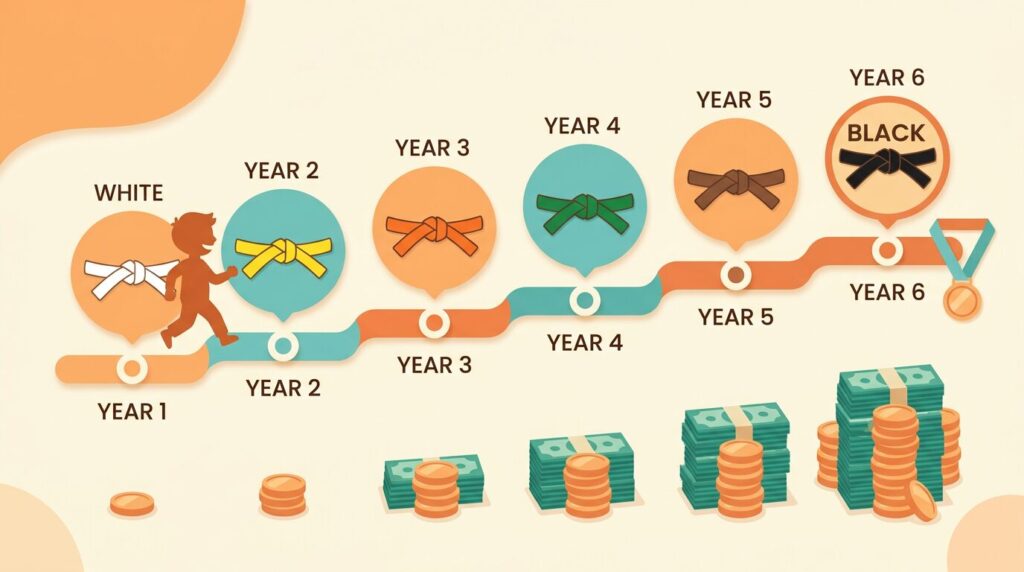
This story captures one face of North American karate well. What you get here is not necessarily “genuine karate technique” alone. Confidence, discipline, exercise habits, parent–child conversation, local community, a sense of accomplishment — those are the product value of a North American family martial-arts dojo.
5. Compared with Other Children’s and Adults’ Activities
North American karate schools are easier to understand when compared with other extracurriculars.
For children, common activities include soccer, baseball, basketball, gymnastics, dance, piano, swimming, scouting, theater, and art classes. A local recreation league may cost only a few hundred dollars a year, but once competitive club teams, travel teams, and private lessons are added, the bill can exceed several thousand dollars a year. In the United States, the rising cost of youth sports and lessons is discussed as a social problem. The Aspen Institute’s Project Play, for example, reported that in 2024 U.S. sports families spent an average of $1,016 on a child’s “primary” sport. A LendingTree survey put parents’ spending on children in extracurricular activities at an average of $731 per child per year. The figures shift depending on the survey and how “sport” or “extracurricular” is defined, but the shared concern is that income shapes access to opportunity.
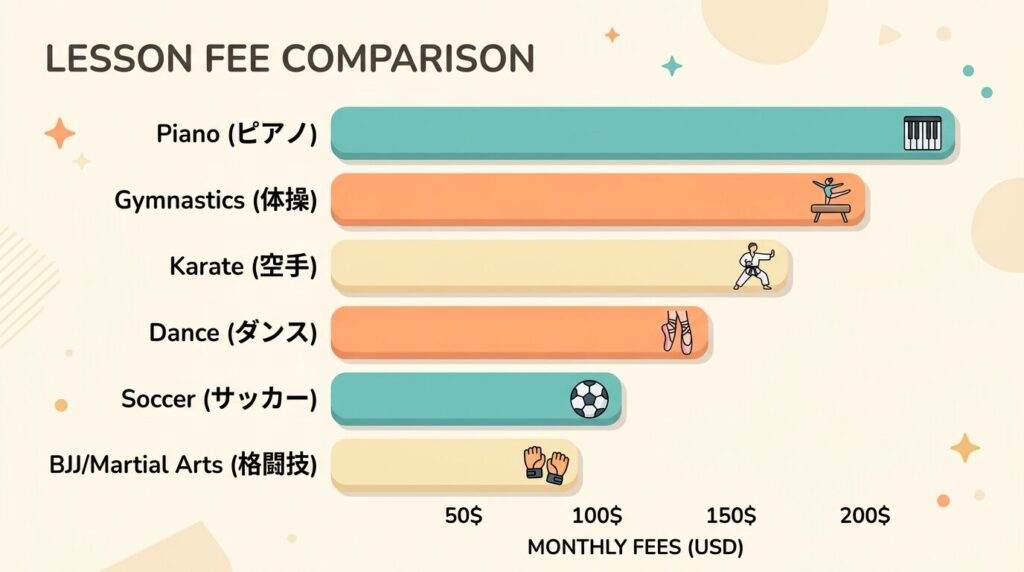
Within that landscape, karate and martial-arts schools occupy a middle position. A low-cost class using a community center, YMCA, or school facility may run only about $50–$100 a month. A commercial dojo with a dedicated studio, by contrast, ranges to roughly $120–$300 a month, and goes higher in cities and affluent areas. A school you can attend one to three times a week for about $100–$250 a month is not necessarily unusually expensive compared with private piano lessons, dance, gymnastics, or club sports. But once testing fees, gear, uniforms, camps, and long contracts are included, the total climbs substantially.
For adults, options include yoga, Pilates, CrossFit, the gym, running clubs, pottery, cooking classes, language and music, dance, BJJ (Brazilian Jiu-Jitsu), Muay Thai, and boxing. Adult martial-arts participants have different motives than children: they take up training for self-defense, health, weight loss, stress relief, competition, community, or as a fresh start in life. On cost, dedicated BJJ, Muay Thai, and kickboxing gyms often fall in the same roughly $100–$220-per-month range, and can run higher in cities. Yoga studios and CrossFit can carry comparable or higher monthly fees.
For adults, karate competes with BJJ and MMA (mixed martial arts). From the 1990s onward, those in North America seeking “real-world effectiveness” migrated to BJJ, Muay Thai, boxing, and MMA. As a result, karate dojos strengthened a “for kids,” “traditional culture,” “point-fighting,” and “family-oriented” image. At the same time, communities of adults who seriously study Shotokan, Kyokushin, and Okinawan karate still exist, and have if anything deepened into a small, dedicated culture.
6. Examples of Well-Known North American Karate Schools and Organizations
North American karate cannot be described as a monolith. Here are a few examples that differ in scale and character.
Shotokan Karate of America (SKA)
Shotokan Karate of America (SKA) is an important nonprofit-style organization that says it has taught traditional Shotokan karate in the United States since 1956. Developed around Tsutomu Ohshima, it is known less as a commercial franchise than as a body emphasizing traditional training. In any discussion of Shotokan karate in North America, it stands alongside the JKA and ISKF lineages as impossible to omit.
USA Karate
USA Karate (the USA National Karate-do Federation) is the central body for WKF-style competitive karate in the United States, positioned as the national governing body within the U.S. Olympic & Paralympic Committee system. If you are interested in WKF-rules kata and kumite, tournaments, the national team, or junior competition, this is the lineage of dojos and event information to check locally.
AAU Karate
The AAU (Amateur Athletic Union) is a large organization involved in U.S. amateur sport broadly, and it has a karate division. AAU Karate offers traditional-karate competition opportunities, a referee and coaching system, and events such as the Junior Olympics, for participants from children to adults. In the context of regional and junior competition, AAU Karate matters too. It is best understood not as the “head office of a style” that Japanese readers might imagine, but as a sports-event and membership platform.
NASKA
NASKA (the North American Sport Karate Association) symbolizes North American sport karate, especially open-tournament culture. “Sport karate” here is not necessarily the same as WKF-style controlled-contact karate. NASKA’s competition categories include traditional forms, creative forms, weapons, and point-sparring, and are bound up with a show-oriented competition culture that features musical performances and acrobatic routines.
Premier Martial Arts
Premier Martial Arts is a franchise-style martial-arts brand with many studios across the United States. Some public materials cite “200-plus” locations, and it offers children’s and adults’ programs blending Karate, Tae Kwon Do, Krav Maga, and kickboxing. Its website and franchise materials emphasize children’s confidence, discipline, leadership, self-defense, and fitness. More than a traditional-style karate dojo, it is a good example for understanding the North American family martial-arts industry.
Tiger Schulmann’s Martial Arts
Tiger Schulmann’s is a large martial-arts school centered on New York, New Jersey, Pennsylvania, and Connecticut, and in recent years with locations in Florida as well. Founder Daniel “Tiger” Schulmann has a Kyokushin karate background, but the school today operates as a comprehensive self-defense / fitness program that includes kickboxing, jiu-jitsu, and wrestling elements. It is also an example of how “karate” in North America becomes connected to MMA and fitness.
Regional Brands Such as Action Karate / National Karate
There are also family martial-arts schools, like Action Karate, that run many branches in specific regions such as Pennsylvania, New Jersey, and Florida. Others, like National Karate, operate across several states — Minnesota, Illinois, Wisconsin, Colorado, Florida — while holding strong name recognition region by region. In North America, local brands — “the dojo everyone in that city or state knows” — wield more power than nationwide fame.
Kyokushin, Shinkyokushin, Enshin, and Okinawan-Style Dojos
North America is also dotted with Kyokushin-lineage, Ashihara/Enshin-lineage, Okinawan Gōjū-ryū, Uechi-ryū, Shōrin-ryū, and Matsubayashi-ryū dojos. The Enshin Kaikan, for instance, is a notable North America–born example: a sabaki (evasive, angle-taking) style of full-contact karate founded by Jōkō Ninomiya, with its headquarters in Denver. They are not as numerous as the family-oriented commercial dojos, but they are an important home for dedicated practitioners. Those who want to study full-contact karate in particular, or who are interested in Okinawan kata, bunkai, and kobudō, will be searching for these smaller dojos.
7. If You Already Train in Karate and Want to Continue in North America
For someone who has practiced karate in Japan and then relocates, studies, or is posted to North America, there are several options for continuing.
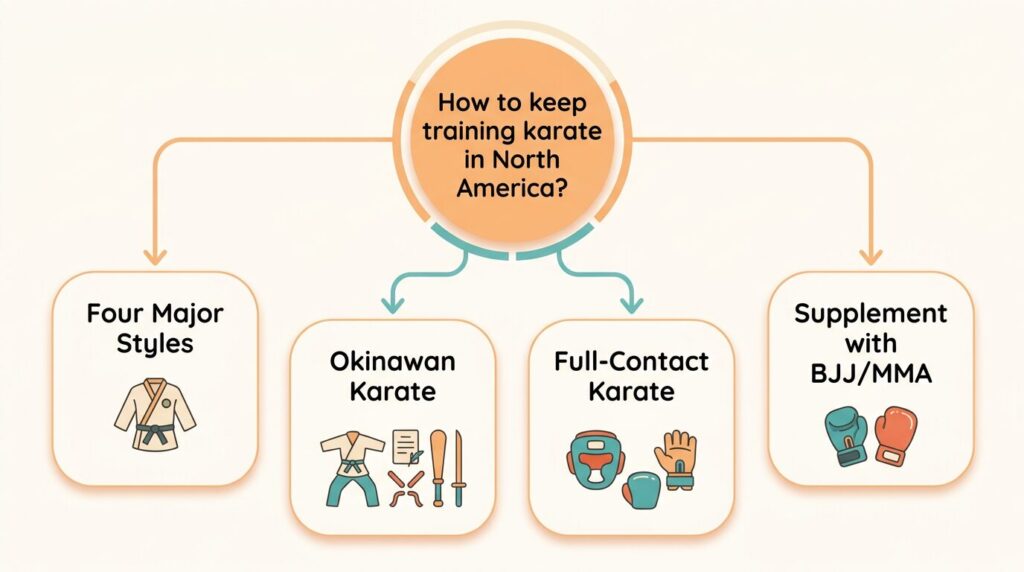
First, look for a dojo in one of the four major styles. For Shotokan, candidates include the JKA lineage, SKA, the ISKF lineage, university clubs, and local dojos. Gōjū-ryū, Shitō-ryū, and Wadō-ryū dojos also exist in cities. If you want to aim for WKF-style competition, look for a dojo connected to USA Karate or your state’s competition body.
To aim for WKF-style competition in Canada, use Karate Canada and the provincial/territorial competition bodies as your starting points. USA Karate in the United States and Karate Canada in Canada are the central gateways to each country’s competitive karate.
Second, look for Okinawan karate. Dojos calling themselves Okinawan Gōjū-ryū, Uechi-ryū, Shōrin-ryū, or Matsubayashi-ryū do exist in North America. Following the official dojo directories of bodies like the IOGKF, Uechi-ryū organizations, and Shōrin-ryū / Matsubayashi-ryū organizations makes it easier to find individual dojos. If you value kata, bunkai, training implements (hojo undō tools), kobudō, and small-group practice, this route may fit a Japanese practitioner’s sense of “karate as a martial art” better.
Third, full-contact karate. Searching for Kyokushin, Shinkyokushin, Enshin, Ashihara, or World Oyama may let you continue training close to a full-contact, direct-strike format. Seido is an important organization with a Kyokushin-lineage historical background, but its current training content and contact level vary by dojo, so it is better to confirm on a visit rather than lump it in as “full-contact karate.” Note, too, that the distribution of Kyokushin-lineage dojos varies greatly by region in North America. You are likely to find one in a big city, but options are limited in smaller towns.
Fourth, rather than insisting on karate, supplement it with BJJ, Muay Thai, boxing, or MMA. North America has highly developed BJJ and MMA infrastructure. Someone who trained in traditional karate in Japan can gain the grappling and groundwork understanding that karate lacked by studying BJJ locally. It is also realistic for a full-contact veteran to sharpen striking through Muay Thai or boxing.
When choosing a dojo, it helps to check the following:
- Is the instructor’s background specific?
- Are the explanations of affiliation, teacher, and rank internally consistent?
- Are adult practitioners sticking with it?
- Does the school honestly explain whether there is sparring and bunkai?
- Are fees, contract length, and testing fees clearly stated?
- Are children’s programs and adults’ training kept distinct?
- Are you spared excessive sales pressure during the visit or trial?
The most important thing for a Japanese karateka is not to search too hard for “the same thing as the dojo back home.” North American dojos exist within local housing, transport, school systems, family culture, and contract culture. You need to take the differences as a given and be clear about what, exactly, you want to keep doing.
8. If You Are a Japanese Karateka and Want to Open a Dojo in North America
So what should a Japanese karateka prepare to open a dojo in North America? There are shared challenges whether you set up a North American branch of your own style or go independent locally.
8-1 “Karate Skill” Alone Is Not Enough
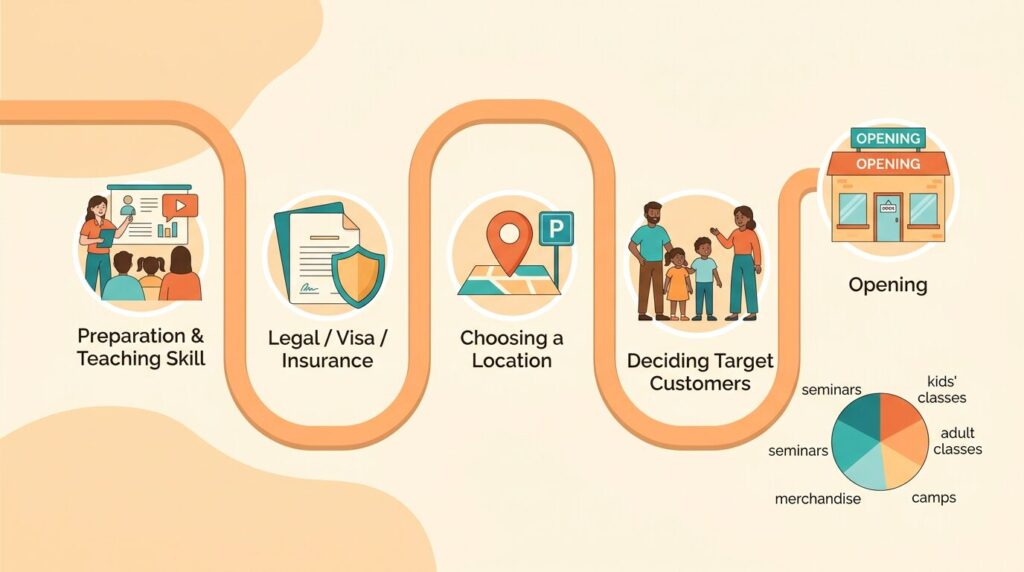
Opening a dojo in North America takes more than karate ability. You need skills as an educator, a business operator, a community builder, and a marketer.
The idea that “if a Japanese instructor teaches real karate, people will come” is dangerous. North American parents weigh how you treat children, convenience, safety, cost, reviews, scheduling, parking, cleanliness, and communication more than the orthodoxy of your style. Adult practitioners, too, want class times they can reach after work, a manageable injury risk, and instruction matched to their goals. You therefore need not only a technical system but the ability to design the funnel — from trial lesson to enrollment, retention, and pausing or canceling membership.
8-2 Legal Matters, Visas, Insurance, and Contracts
To open locally you must put in place a visa and work authorization, business incorporation, taxes, a lease, liability insurance, accident insurance, any required business licenses and zoning checks, child-protection rules, background checks, and waiver/consent forms. The United States has no single nationwide public license required to teach karate or martial arts; but as a business that rents a space, teaches minors, advertises, and collects tuition, you need the legal, tax, and insurance setup of any small business. If you become involved with a U.S. Olympic & Paralympic Committee–affiliated competition body such as USA Karate, you must also check SafeSport training, background screening, and the U.S. Center for SafeSport’s Minor Athlete Abuse Prevention Policies (MAAPP) — a policy requiring, among other things, that one-on-one contact between adult participants and minor athletes be “observable and interruptible.”
In Canada, too, not every private dojo nationwide is subject to the same procedures, but when teaching minors or vulnerable people, provincial, competition-body, or facility rules may require a Criminal Record Check or a Vulnerable Sector Check. Either way, the realistic approach is to prepare while consulting local lawyers, accountants, insurance agents, and member organizations.
Japanese-style “verbal promises” and “teacher–student bonds” alone will not work. You need written rules covering tuition, refunds, membership pauses, cancellation, injuries, photo usage, competition entry, testing fees, merchandise, personal data, and the drop-off and pickup of minors.
8-3 Location and Target Customers
Location is critically important. Many North American areas are car-dependent, so the availability of parking can make or break enrollment. Distance from schools, residential neighborhoods, shopping centers, fitness facilities, and community centers also matters. If you lease a dedicated storefront from the start, the upfront costs — rent, deposit, mats, interior build-out, signage, insurance, advertising, payment systems — are heavy. To limit risk, you can start by renting time at a community center, school, university club, or existing gym, and move to a dedicated dojo once membership becomes visible.
You must decide your target customer first:
- A children’s family dojo?
- An adult traditional-karate or Okinawan-karate dojo?
- A full-contact, combat-sport-oriented school?
- A school positioned as Japanese-culture education?
- Starting from a university club or community circle?
For children, you need an educational curriculum, parent communication, life-skills education, and event operations. For adults, technical depth, training safety, and the quality of the community matter. For full-contact, injury response, insurance, and sparring management are essential.
8-4 How to Use “Japaneseness”
When a Japanese karateka opens a dojo in North America, “being Japanese” can be a powerful brand. But over-mystifying it is risky.
What works is translating etiquette, terminology, the uniform, kata, history, and an understanding of Okinawan and Japanese culture into clear, accessible terms. What to avoid is the attitude of “I’m from the homeland, so obey without question.” North American students ask questions: Why do we bow? Why do we practice kata? Why are there belts? Why is contact restricted in kumite? You must be able to answer these in English.
8-5 Revenue Model
It is hard to make a living from a pure adult traditional-karate dojo alone. Realistically, you will combine revenue streams such as:
- Children’s classes
- Adults’ classes
- Parent–child classes
- Private lessons
- Belt-promotion tests
- Seminars
- Summer camps
- Guest instruction at schools and community events
- Online instructional material
- Sales of uniforms and protective gear
But rush monetization and you quickly become a target for McDojo criticism. Especially if testing fees, long contracts, special classes, camps, and merchandise become your main revenue, you must be able to explain how cost corresponds to technical and educational value. The key is to make the cost-to-value relationship clear. A dojo that transparently explains “what costs what” and “why that cost is necessary” tends to be trusted, even if it is commercial.
9. Extra Angles That Make North American Karate Interesting
Finally, here are a few angles that could make for engaging reading.
9-1 Is the “Black Belt” a Diploma or an Entrance?
In Japan, first dan is often understood as “finally, the entrance.” But at North American family dojos, the black belt is a long-term goal, and for a child it often carries a meaning closer to a diploma or proof of achievement. At the same time, not every dojo treats a child’s black belt as equivalent to an adult’s first dan. Some distinguish it as a Junior Black Belt and have the student re-take an adult grading once they reach a certain age. This difference in how rank is viewed mirrors a difference in how karate itself is understood.
9-2 The Boundary Between Karate and Taekwondo
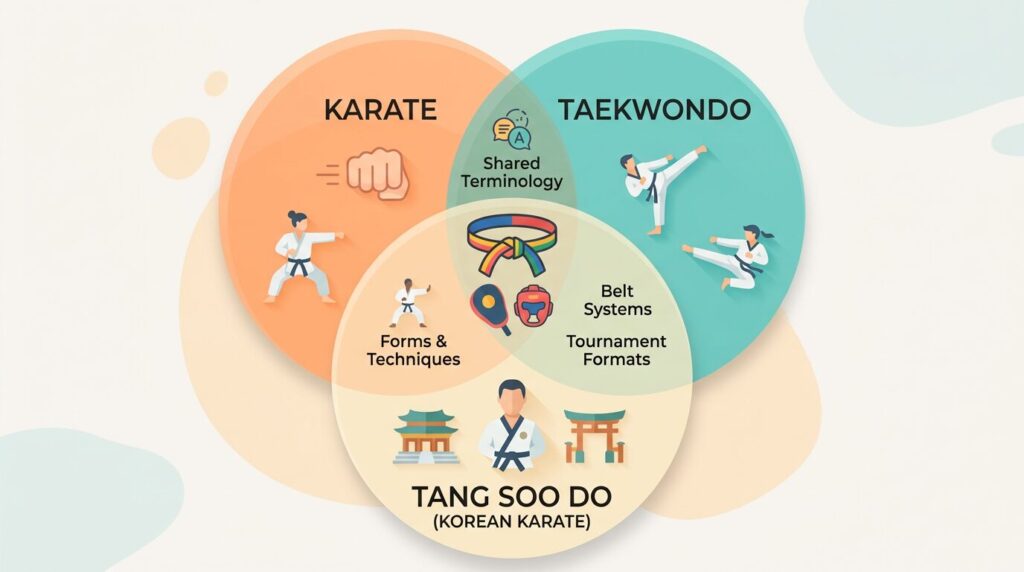
In North America, the boundary between karate, taekwondo, and even Tang Soo Do is blurrier than Japanese readers might imagine. Tang Soo Do is sometimes described in English as “Korean Karate,” and in postwar American martial-arts culture, Korean karate, American karate, taekwondo, and Kenpo have been used as near-interchangeable sign words. A sign may say “karate” while the kicks, the belt system, and the tournament format are closer to taekwondo. Conversely, a taekwondo dojo may incorporate karate-like elements as self-defense or martial arts. This is less a simple misuse than a historical hybridization that arose as East Asian martial arts were commercialized and localized in North America.
9-3 Advertising as “Self-Defense”
North American dojo advertising emphasizes self-defense and anti-bullying. But how far children’s point-sparring and pad work actually translate into real-world self-protection deserves careful thought. A conscientious dojo teaches self-defense as more than physical technique — including hazard avoidance, keeping distance, saying “no” clearly, raising your voice, escaping, and informing a trusted adult such as a parent, teacher, or the police. In other words, North American children’s self-defense advertising should be read not as combat technique alone, but as safety education, anti-bullying, and self-esteem training.
9-4 Karate and Immigrant Communities
The history of karate in North America is bound up with Japanese and Okinawan immigrants, U.S. military personnel, and Korean, Chinese, and Latin American communities. In Hawaii, karate arrived before the war through Okinawan immigrants; in Canada, the Japanese-Canadian community and postwar instructors took part in spreading it. On the U.S. mainland, several currents overlapped: military personnel who had experienced martial arts in Japan or Okinawa after the war, Japanese instructors who emigrated from the 1950s onward, and the spread of taekwondo and Tang Soo Do (often described as “Korean karate”) by Korean martial artists. The dojo was not merely a sports facility but a place where immigrant culture, military experience, and local business intersected and became localized.
9-5 The “Search for the Real Thing” After YouTube
Today’s North American practitioners compare dojo quality through YouTube, Reddit, and Instagram. English-language and international voices — Jesse Enkamp, Iain Abernethy, Karate Culture, Karate Dojo waKu — prompt local practitioners to ask themselves: “Is what I’m learning at my dojo really karate?” “How can the application of a kata actually be used?” “How do tradition and practicality connect?” The shift in the information environment sharpens McDojo criticism on the one hand, while also cultivating more discerning practitioners on the other. That said, while online information helps in choosing a dojo, there is also a danger of conclusively judging a style or instructor from a short video alone.
Conclusion — North American Karate Is Not a “Degraded Version,” but Karate That Survived in a Different Society
Looking at North American karate, Japanese karateka are often bewildered. Styles are vague, the children’s-business flavor is strong, black belts come early, technical systems are mixed, and the influence of entertainment runs deep. Some of these dojos are, indeed, low in quality. McDojo criticism has ample grounds.
Yet at the same time, North American karate is karate that changed in order to survive within North American society. A car culture, suburban life, dual-income households, a children’s-lessons industry, contract culture, the fitness market, the rise of BJJ and MMA, and the memory of movies and television — within these conditions, a large part of KARATE was reorganized as “family martial arts.” At the same time, Shotokan, Okinawan karate, Kyokushin-lineage schools, university clubs, and small dojos rooted in immigrant communities coexist alongside it, and North American karate cannot be explained by a single industry model.
There is much that Japanese people can learn from this. How do you explain karate? What do you offer children? How do you convey value to parents? How do you welcome adult beginners? How do you make costs transparent? How do you connect tradition to the needs of modern society while protecting it?
North American karate is not a mere degraded version of Japanese karate. It is one form of “KARATE” that, in a different society and answering different expectations, has at times been distorted and at times enriched, and continues to change today. The “martial arts” market described in statistics and industry reports includes not only karate but taekwondo, jiu-jitsu, judo, MMA, and kickboxing, so the numbers must be read with care. Even so, it is certain that karate in North America lives not only as a standalone martial art but as part of a broader martial-arts industry.
What Japanese karateka need is not a condescending attitude looking down from above, but a composed willingness to observe and to relativize their own view of karate. On the mats of North America, children call out “Yes, sir!” and repeat clumsy front kicks. In that scene, too, karate is unmistakably alive.
References and Sources
- Sports Destination Management, “After-School Programming Bringing In a New Generation of Karate Kids”
- Aspen Institute Project Play, “Project Play survey: Family spending on youth sports rises 46% over five years”
- LendingTree, “Parents Say Kids Are More Costly Than Expected”
- Statista, “Martial arts participation in the U.S.”
- IBISWorld, “Martial Arts Studios in the US”
- USA Karate official site
- U.S. Center for SafeSport, “Minor Athlete Abuse Prevention Policies (MAAPP)”
- AAU Karate official site
- NASKA official site
- Shotokan Karate of America official site
- Karate Canada official site; Karate BC NCCP / Instructor and Coach Requirements materials
- Premier Martial Arts official site and franchise materials
- Tiger Schulmann’s Martial Arts official site
- Action Karate official site
- Karate by Jesse, “93 Warning Signs Your Dojo is a McDojo”
- Reddit r/karate and r/martialarts, multiple threads on dojo costs, McDojos, and North American karate
- Previous article : Karate as the World Sees It — Decoding the Global Image of KARATE That Japan Rarely Notices