

About this reference
So Nei-chu (曺寧柱) — the Japanese reading of the name by which this figure is known in Western karate literature, and the form used as the primary name throughout this article; in Korean the same name reads Cho Yŏng-ju (조영주), with the variant Cho Nyŏng-ju (조녕주) also in circulation — appears again and again in Western histories of karate as the “other teacher” of Mas Oyama (Ōyama Masutatsu), the founder of Kyokushin karate — and yet almost nothing about the real man is known to English-language readers. He was, at the same time, a karateka, a Korean independence activist, an organizer of the wartime East Asia League movement, a confidant of the Japanese general Ishiwara Kanji, a devout Nichiren Buddhist, and a postwar leader of the Korean Residents Union in Japan (Mindan). This article is a biographical reference, written for karate historians and enthusiasts who cannot read Japanese, that traces the outline of So Nei-chu while carefully separating what can currently be confirmed as fact from what remains unverified legend.
0. On the Name and Its Spelling (please read this first)
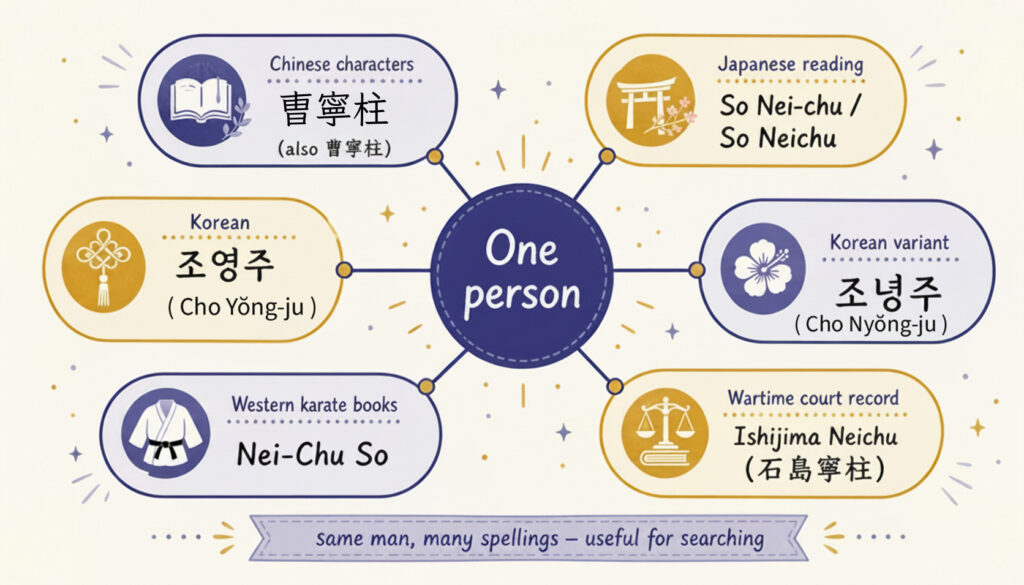
The first obstacle any non-Japanese researcher meets is that this man’s name is spelled differently in almost every source. Because this matters for searching and for matching one document against another, the variants are laid out here at the outset.
| Language / context | Principal spellings |
|---|---|
| Chinese characters (his legal/birth name) | 曺寧柱 (also written 曹寧柱; the erroneous forms 趙寧柱 and 曽寧柱 also circulate) |
| Japanese on’yomi reading (standard in karate circles) | Sō Neichū / So Nei-chu |
| Korean reading | 조영주 (Cho Yŏng-ju / Jo Yeong-ju). The Japanese Wikipedia gives 조녕주 (Cho Nyŏng-ju), but Korean reference works use 조영주 |
| Western karate literature | So Nei-chu / Nei-Chu So / So Neichu (word order and hyphenation vary) |
| Court records of the wartime forced-name-change era | Ishijima Neichū (石島寧柱), seen in records of his Peace Preservation Law case |
The names “So Nei-chu” and “Nei-Chu So” that appear so often in Western karate books and websites all refer to the same person described here. He is the figure who appears in biographies of Mas Oyama as the “other Gōjū-ryū teacher” or “Nei-Chu So.” This article adopts So Nei-chu as his primary name throughout.
A note on names and romanization. This article uses So Nei-chu — the Japanese reading by which he is known in Western karate literature — as his primary name; in Korean the name is Cho Yŏng-ju (조영주, the form preferred by Korean reference works), with Cho Nyŏng-ju (조녕주, used by the Japanese Wikipedia) also seen. For other names, well-known places and people are given in their conventional spellings (e.g., Busan, Gwangju, Yecheon; Choi Yeong-eui), which mostly follow Revised Romanization; otherwise, less familiar Korean names follow McCune–Reischauer, and Japanese names use modified Hepburn with macrons. Korean and Japanese personal names are written family-name-first.
1. Quick Reference (summary)
So Nei-chu (曺寧柱; Korean: Cho Yŏng-ju / Cho Nyŏng-ju)
- Year of birth: disputed — 1908, 1911 (per family register), or 1913. Korean reference works and Japanese historical scholarship most often give February 1913 (Yecheon County, North Gyeongsang Province, Korea); some karate sources give 1908.
- Year of death: either 1996 or 2001; this too is unsettled.
- Origin: Yecheon County, North Gyeongsang Province, Korea, into a wealthy landowning family.
- Education: secondary education in Keijō (today’s Seoul), then moved to Japan around 1931–32. According to the one scholarly study devoted to him (by the historian Matsuda Toshihiko), he entered the Faculty of Law and Economics (law department) at Ritsumeikan University in Kyoto soon after arriving. Other accounts have him passing through Naniwa Higher School in Osaka or Kyoto Imperial University, but Korean sources place Kyoto Imperial as a graduate school instead, and the details of his early education cannot be settled.
- Martial arts: Gōjū-ryū karate (under Yamaguchi Gōgen and Miyagi Chōjun) and Kōdōkan judo. He was at one point introduced as a hanshi, 9th dan.
- Standing in the karate world: one of the central figures of the prewar Ritsumeikan University karate club; after the war, vice-president / vice-chairman of the All-Japan Karate-dō Gōjū-kai. He is named as the first president of the Korea Karate Association, though its founding year (1950 vs. 1953) is disputed (see below).
- His other faces: Korean independence activist; organizer in the East Asia League movement; aide and bodyguard to General Ishiwara Kanji; lay believer of Nichiren Buddhism (Kokuchūkai); and twice chairman of the central headquarters of the Korean Residents Union in Japan (Mindan), 1960–61 and 1976–79.
- Relationship with Mas Oyama: the standard account says they met in 1939 in Busan, after which So housed the stowaway Oyama and taught him Gōjū-ryū (but contemporary records place the meeting in postwar Tokyo, so the time and place of their meeting are not settled). Oyama revered him as a lifelong “teacher,” yet in later years erased So’s name from his own life story.
- In popular culture: he is held to be the model for “Master Cho (Chō),” who teaches Oyama the “eighteen hands” in the manga Karate Baka Ichidai (“A Karate-Crazy Life”).
2. Origins and early life — the starting point of an independence activist
So Nei-chu was born into a wealthy landowning family in Yecheon County, North Gyeongsang Province, Korea. As a child he received a traditional seodang education (a Korean village school for classical Chinese learning) before entering a public ordinary school. By his own recollection, it was in this period that he first became emotionally aware of “the relationship between an overbearing Japan and an ill-treated Korea.”
The decisive event was the Great Kantō Earthquake of 1923. He himself said that learning of the massacre of Koreans in the chaos following that earthquake hardened his anti-colonial consciousness. After advancing to a higher common school in Keijō (Seoul) he was drawn to Marxism and came to envision Korean independence through a communist revolution. In 1929 he took part in the Gwangju Student Movement (the Gwangju Student Independence Movement), going from school to school within Keijō to incite a coordinated school strike; for this he is said to have been expelled.
He then moved to Japan around 1931–32. According to the research of Matsuda Toshihiko — one of the very few scholarly studies to treat him directly — he entered the Faculty of Law and Economics (law department) of Ritsumeikan University in Kyoto soon after arriving, encountered communist thought, and threw himself into spreading it. In Kyoto he joined the Japanese Red Aid Society, a front organization of the Japan Communist Party, and, drawing on a powerful physique built up through weightlifting and boxing, served as a front-line member in street activism. (A widely circulated alternative biography has him studying at Kyoto Imperial University by way of Naniwa Higher School in Osaka and leaving the university around the time of the 1933 Takigawa Incident — an academic-freedom purge — but these accounts rest partly on unverified hearsay, and Korean profiles place Kyoto Imperial as a graduate school. The details of his early education do not agree across sources and should be treated as unsettled.) When, around 1933, the mass ideological recantations of party leaders and the intensifying suppression of the left in Japan closed off the prospect of Korean independence through communism, he fell, in his own words, into an “ideological vacuum.” What filled that vacuum were the East Asia League movement, Nichiren Buddhist faith, and karate, all discussed below.
Glossary: the East Asia League movement (Tōa Renmei)
A political-ideological movement advocated by the army officer Ishiwara Kanji (1889–1949). Under the slogan of “harmony among the peoples of East Asia,” it called for realizing the equality and integration of Japanese and Koreans within a federated East Asian order led, for the time being, by the Japanese emperor. For some colonial-era Korean intellectuals it offered a channel — distinct from the independence movement — through which to seek better treatment for their people. The postwar mainstream (left wing) of the Korean movement in Japan regarded it as “pro-Japanese” collaboration, and it became one of the factors that split opinion about So Nei-chu.
3. So the martial artist — Ritsumeikan, Gōjū-ryū, and armored sparring
The core of So Nei-chu as a karateka lies in prewar Ritsumeikan University.
The Ritsumeikan University karate research society was founded in 1929 by Yamaguchi Gōgen (1909–1989) and, from 1931, was taught directly by visits from Miyagi Chōjun (1888–1953), the founder of Gōjū-ryū. It was thus a major center of Gōjū-ryū within the Japanese “home islands.” After re-enrolling at Ritsumeikan in 1934 (by way of the preparatory course), So joined this karate club, learned Gōjū-ryū from Yamaguchi Gōgen, and is thought to have received direct instruction from Miyagi Chōjun as well. In time he rose to serve as an assistant instructor.
Physically he was known for a toughness backed by his weightlifting and boxing experience from his Korean years; it is said that from the moment he joined he overwhelmed the other members in sparring. At the same time, testimony survives that he struggled against the low kicks to the legs of his senior, Okamura Mitsuyasu (later head of the Gōjū-ryū Kenshin-kan).
What deserves special attention is that this period at Ritsumeikan experimented with armored sparring (te-gumi). In a late-life interview So himself described the trial and error: it began with sparring using the chest protector of bayonet practice, the face mask of kendo, and boxing gloves; hockey shin guards were then introduced to spare the pain of bare-foot kicks against the armor; and finally forearm guards reaching to the elbow were added. Because the full set of armor required strength and stamina, only some members could take part — not the entire club. This is a suggestive piece of testimony for anyone considering the prehistory of Mas Oyama’s later “full-contact” (direct-strike) karate.
In 1939, when Yamaguchi Gōgen crossed over to Manchuria on Ishiwara Kanji’s orders, So took over leadership of the Ritsumeikan karate club. In parallel he served as a Gōjū-ryū instructor at the Gihō-kai, a martial-arts dōjō run by the judoka Fukushima Seizaburō. At the Gihō-kai the judoka Ushijima Tatsukuma taught judo, and So recalled being put through his paces by Ushijima. Also training there — combining judo with Gōjū-ryū — was the judoka Kimura Masahiko, later famed as “Kimura the Demon,” and So is said to have coached Kimura in makiwara striking practice.
Glossary: Gōjū-ryū
One of the major schools of Okinawan karate. Systematized by Miyagi Chōjun and shaped by southern Chinese boxing (such as White Crane), it takes the fusion of “hard” (gō) and “soft” (jū) as its guiding idea. Yamaguchi Gōgen led its spread on the Japanese mainland, forming “Japanese Gōjū-ryū.” It is characterized by forms (kata) such as Sanchin and Tenshō, by breathing methods (ibuki), and by close-range combat. Many elements of later Kyokushin karate’s body mechanics derive from Gōjū-ryū.
4. The East Asia League movement, Ishiwara Kanji, and imprisonment
From around 1938, So began frequenting Fukushima Seizaburō’s Gihō-kai and was appointed an instructor. Fukushima was an advocate of the East Asia League and a martial-arts adviser to Kenkoku University in Manchuria; when he set up the Kyōwa-juku (a student dormitory for the various peoples of East Asia) next to the Gihō-kai, So became its head.
In January 1939, through Fukushima’s introduction, So met Ishiwara Kanji. He was skeptical at first — reportedly the last Gihō-kai member to join the East Asia League movement — but came to be one of Ishiwara’s most ardent supporters, eventually becoming the only Korean to hold full participating membership within the movement. His conversion to Nichiren Buddhism, through prison and activism, also deepened the trust of the devoutly Nichiren Ishiwara.
In March 1942 So was arrested and imprisoned for violating the Peace Preservation Law, on the charge of “using the East Asia League movement to carry out a Korean independence movement.” This owed much to the suppression of the East Asia League movement itself by the Tokkō (special higher police) and the military police. At the end of 1943 he received a sentence of two years’ imprisonment, suspended for two years, and was released in early 1944. After his release he went to Tokyo and devoted himself to the East Asia League movement (including the Nichiren-doctrine “Seika-kai”), and during the war he also served as a supervisor of conscripted Korean laborers.
After the war, when Ishiwara Kanji died in 1949, So served as master of ceremonies at the funeral, and thereafter remained a central figure in the Ishiwara Kanji Peace Thought Study Group, working to spread Ishiwara’s ideas and train successors. In the 1988 controversy over relocating Ishiwara’s grave, he spent some five years building the gravesite and a memorial monument. This consistent devotion to Ishiwara became the single greatest reason he was criticized as “pro-Japanese” by the postwar left wing of the Korean community in Japan.
5. Relationship with Mas Oyama — the “other teacher”
The greatest reason Western karate historians take an interest in So Nei-chu is his teacher–student relationship with Mas Oyama (Ōyama Masutatsu; birth name Choi Yeong-eui, 1923–1994), the founder of Kyokushin karate.
There is a large discrepancy among the sources as to when and where the two met. According to The Authentic Biography of Mas Oyama (Ōyama Masutatsu Seiden) by Kojima Kazushi and Tsukamoto Yoshiko, the meeting took place in 1939 at a lecture for the East Asia League movement in Busan. The young Oyama — at the time the teenager Choi Yeong-eui, recently expelled from middle school — is said to have been captivated by So’s muscular frame and approached him first; So then demonstrated karate on the spot. “His punches were unlike a boxer’s, and his kicks reached higher than a man’s height,” Oyama recalled.
However, the record in the earliest karate trade press contradicts this. The inaugural issue of the monthly Gekkan Karate-dō (May 1956) — the first specialist karate magazine — places their meeting in postwar Tokyo, in the Ogikubo district, when Oyama was about 22 or 23 (roughly 1945–46). Most accounts handed down in the English-speaking world likewise hold that Oyama’s serious study of Gōjū-ryū under So took place in postwar Tokyo (1945–46); this most likely traces back to Oyama’s own statements in What Is Karate? (1958 edition). The text of What Is Karate? (1958) states that:
- Moved by watching karate practice by the students of a karate school, Oyama telephoned the Shōtōkan and enrolled.
- During the Second World War, through two years of severe training, he acquired the strength and technique to break more than ten roof tiles.
- He joined a political organization in Japan that promoted the ideal of Korean unification.
- There he met So Nei-chu, and on So’s advice he undertook a solitary mountain retreat on Mt. Kiyosumi in Chiba Prefecture.
This is also consistent with the fact that the “Eiwa Karate Research Institute” (discussed below) was located in postwar Tokyo. The 1939 Busan meeting therefore cannot be treated as established fact.
On the other hand, according to The Authentic Biography of Mas Oyama, at the end of that same year Oyama stowed away by ship from Busan to Shimonoseki and made his way to Kyoto, where So was; So lodged him in the Kyōwa-juku dormitory and taught him Gōjū-ryū, and the following year, when Oyama entered the Yamanashi Aviation Technical School, even stood as his guarantor. That said, an alternative account of Oyama’s move to Japan is also widely circulated — that he came earlier (around 1938) to enter an aviation cadet school — so his early movements in Japan are likewise unsettled. Whichever account one adopts, the basic characterization of So — as Oyama’s protector in the early days after his arrival in Japan, as his Gōjū-ryū teacher, and as a guide in matters of thought — is consistent in Oyama’s own testimony.
The relationship continued after the war. In September 1945 the two founded the “Eiwa Karate Research Institute” inside the youth training center of the Kenchō (the League of Young Koreans for the Promotion of National Founding). So is also recorded as serving as honorary master, and Oyama (then under the name Choi Maeng-ho) as instructor, at the “Hanmukwan,” a dōjō of Shuri-te lineage headed by the Korean-national karateka Yun Hui-byeong.
Most famous of all is the origin of the “mountain retreat,” the very core of the Mas Oyama legend. The story goes that, during the Kenchō training-center days, a kendo instructor, worried about Oyama’s conduct, warned So that “unless he disciplines his spirit, he will one day ruin himself” — and that this prompted So to urge Oyama into a solitary mountain retreat. It is also said to have been So who, while Oyama was secluded, wrote him a letter advising him in effect to “shave off one eyebrow” (so that he would not be tempted to abandon his training out of a wish to appear in public).
6. The postwar years — Mindan, the Korea Karate Association, and the Gōjū-kai
In the postwar period So Nei-chu left his deepest mark less as a karateka than as a political leader of the Korean community in Japan.
- The Korean Residents Union in Japan (Mindan): He did not join the communist-led League of Koreans in Japan (Chōren). Instead he joined the right-wing camp of his elder fellow provincial Pak Yŏl and others (the Alliance for the Construction of a New Korea) as a planning committee member, and after Mindan’s formation he held posts such as head of its planning office. He served twice as chairman of Mindan’s central headquarters: July 1960 – May 1961 and 1976–1979.
- The struggle against repatriation to North Korea: He opposed the program to repatriate Koreans in Japan to North Korea, and in the 1959 hunger strike against it he served as a representative.
- The unification movement: During his first term as chairman he set up a unification-issues study committee within Mindan and, through the newspaper Tōitsu Chōsen Shimbun (United Korea News), sought summit talks with Chongryon (the pro-North General Association of Korean Residents in Japan) — pursuing a unification movement of his own. His complexity lies in this attempt to bridge left and right while firmly maintaining his anti-communism.
- The Korea Karate Association: During the Korean War, karateka who had taken refuge in the temporary capital of Busan agreed to set up an association, and the Korea Karate Association was founded, with So named as its first president. The founding year, however, differs across sources. Karate-history blogs give 1950, the year the Korean War broke out, but a scholarly work on the history of taekwondo (a doctoral dissertation held in the Waseda University repository) holds that it was founded in May 1953 after consultation among Yun Hui-byeong, Yi Nam-seok, Yi Jong-u, Hyeon Jong-myeong, So Nei-chu, Kim In-hwa, and others. So’s own tenure is also unclear, and one account has Yi Jung-jae already serving as president in 1953. It is most prudent to present both the 1950 and 1953 founding dates and not to treat either as settled. In any case, the Mudukkwan and Chungdokwan withdrew early over dissatisfaction with the central-examiner qualifications, and unification was not achieved. This lineage forms one cross-section of the dawn of Korean karate and taekwondo, leading later to Hwang Kee’s Korea Tangsudo Association and then to Choi Hong-hi’s Korea Taekwondo Association (1959).
- The Gōjū-kai: In 1972, when the All-Japan Karate-dō Gōjū-kai was reorganized into the Gōjū-kai of the Japan Karate-dō Federation, he served as vice-chairman alongside Yogi Jitsuei, Uehara Yukinori, and others. When invited to a Korean martial-arts tournament in 1978 he was introduced as a hanshi, 9th dan.
At some point Mas Oyama erased So’s name from his own life story, and the two are said to have parted ways. As to why, the common explanation is that Oyama wished to hide his Korean origins; but some point out that this contradicts Oyama’s open avowal of his South Korean nationality in his later years, and instead see the cause in a clash of power-broker networks (So was tied, via Machii Hisayuki, to Kodama Yoshio, while Oyama was tied to Tanaka Kiyoharu). None of this is confirmed.
7. His own writings (primary sources)
The writings So Nei-chu left behind are not numerous, but they are important primary sources through which his thought can be traced directly.
- “My Motive for Conversion” (parts I & II), Ōdō Bunka (The Culture of the Kingly Way), vol. 10, nos. 2 & 4, 1949. — A self-account of his conversion to Nichiren Buddhism (Kokuchūkai). It can be read as a confession of thought linking the East Asia League movement to a religious turn.
- “Ishiwara Kanji: The Man and His Thought,” in The Road to Eternal Peace — Now, Why Ishiwara Kanji? (Ishiwara Kanji Centennial Committee, 1988). — A late-life essay giving his assessment of Ishiwara in his own words.
- “To the United Korea News,” Tōitsu Chōsen Shimbun, 25 January 1961, p. 1. — A contribution expressing his views on unification during his term as Mindan chairman.
Note that none of these concerns karate technique; all deal with thought, politics, and religion. To understand So Nei-chu only as a “karateka” is to miss the essence of the man.
8. Interviews with him (testimonial sources)
The single most important interview conveying So Nei-chu’s own voice appeared in the magazine Chūō Kōron.
- So Nei-chu & Nagasaka Satoru, “Koreans and Japanese — Listening to Mr. So Nei-chu,” Chūō Kōron, vol. 94, no. 8, 1979. — Here he frankly voices a view of history sharply at odds with the postwar left of the Korean community in Japan, including remarks that relatively credit Japanese colonial rule as having “aimed at assimilation.” It is a source that pinpoints the very fault line along which scholars divide for and against this man.
In late-life karate interviews, too, he spoke in his own words of the armored-sparring experiments at Ritsumeikan, of facing down dōjō challengers at the Gihō-kai, and of his ties to Oyama and to Kimura Masahiko — making these valuable testimony on the history of prewar Kansai karate.
9. References by Yamaguchi Gōgen and the Gōjū-ryū side
References from the Gōjū-ryū side are indispensable for situating So Nei-chu as a “karateka.”
- Accounts of Yamaguchi Gōgen’s career: Biographical profiles of Yamaguchi Gōgen in the All-Japan Karate-dō Gōjū-kai lineage (for example, his profile in the martial-arts magazine Hiden, and The Legend of the Creation of Karate-dō from Fukushōdō) state explicitly that when Yamaguchi went to Manchuria on Ishiwara Kanji’s orders in 1939, he entrusted leadership of the Ritsumeikan karate research society to “his friend So Nei-chu and others.” That Yamaguchi and So were colleagues and sworn friends is thus corroborated even from the Gōjū-ryū side’s own records.
- The official history of the Ritsumeikan University karate club: The club’s historical account lists, among its prewar members and instructors, “Yamaguchi Gōgen, So Nei-chu, Yogi Jitsuei, Ujita Shōzō, Kizaki Tomoharu, and Uchiage Kenzō.” This is confirmation from the organization itself that So was a core member at the birthplace of Japanese Gōjū-ryū.
- English-language Gōjū-ryū sources: So is also given an entry in English-language Gōjū-ryū reference works (for example, the Gōjū-Ryū Karate-Dō Desk Reference), so recognition of him is growing even within the English-speaking Gōjū-ryū community.
10. References by Mas Oyama
The records in which Mas Oyama himself spoke about So Nei-chu are the most valuable body of testimony for karate-history research.
- “What Is Karate?” (Nichibō Publishing, 1958): Oyama describes So as “a senior from his home region, a thinker and master of karate, a rare man full of individuality and confidence” (the corresponding English passage reads, “Mr. So, a thinker and master of karate, was a rare man of character and confidence”). He further writes that it was So who saved him when he was on the verge of self-destruction, and that So — a Nichiren believer — guided him by teaching that “martial arts and religion are inseparably united,” and that his mountain retreat too was undertaken on So’s advice. It should be noted that, although a maxim in the style of “temper the heated iron before it cools” is often quoted directly as So’s own words, the English text as far as can be confirmed reads, “As the proverb goes, ‘Temper the heated iron before it gets cold,’ so train yourself in self-discipline before you grow older if you wish to be a great man,” — i.e., So is quoting a proverb.
- The official biographies of the Kyokushinkaikan (successor organizations): After Mas Oyama’s death (1994) the Kyokushinkaikan split into several organizations, so there is no single “official Kyokushinkaikan.” That said, the Mas Oyama profile on the official “History of Kyokushin” page of the International Karate Organization (IKO) Kyokushinkaikan led by Matsui Shōkei (kyokushinkaikan.org) lists as his teachers “Funakoshi Gichin of the Shōtōkan, and Yamaguchi Gōgen and So Nei-chu of Gōjū-ryū.” In the official record of this successor organization, then, So is still positioned as one of Oyama’s teachers. The characterization of So as a “teacher” goes back to Oyama’s own writings while he was alive, the source being the aforementioned What Is Karate? (1958). That same What Is Karate? also contains a passage indicating that the Shōtōkan Oyama actually joined was led not by Funakoshi Gichin (1868–1957, the de facto founder of Shōtōkan) but by his third son, Funakoshi Gigō (1906–1945, who handled the hands-on technical instruction at the prewar Shōtōkan): “I wanted a good instructor and called at the Shoto-Kan (a Karate school) operated by Mr. Giko Funakoshi who was then considered the veteran master of Karate.”
What must be kept in mind, however, is that — as noted above — from a certain point onward Oyama deliberately removed So’s name from his own narratives and biography. The very coexistence of an “official record acknowledging him as a teacher” and an “erasure from his own autobiographical telling” is the crux of reading the Oyama–So relationship.
11. Other discourse about So Nei-chu
Beyond So himself, Oyama, and the Gōjū-ryū side, So has been discussed from many standpoints, and the assessments run to extremes of praise and blame.
- As the subject of tales of martial prowess: There are many anecdotes conveying the fearsomeness of his fighting — a bout against a dōjō challenger at the Gihō-kai (“with just a light touch the opponent fainted”), and the critic Inaba Shūzō’s recollection that “this fellow So was incredible. We got into a quarrel, and he tried to kill me with karate.”
- An inter-school bout with Kunii Zen’ya of Kashima Shinryū: A story is handed down that So lost when the formidable real-combat master Kunii Zen’ya met his flying kick with a shinai (bamboo sword). But because this contradicts So’s own statement that “kicks above the waist are useless in real combat,” the content of this bout is also open to doubt (see the source criticism below).
- Political assessment (from the left): The historian of Korean-Japanese society Min Jihun analyzes that, because So’s view of Japan was favorable, friction with the colonial-rule-rejecting Chōren was inevitable. Chŏng Ch’ŏl, in Mindan: Past and Present, harshly judges So as “bureaucratic and weak before power, a man of high ability who nonetheless left no real record of achievement as a Mindan activist.”
- Assessment from the Korean side: Korean reference works and commemorations stress his contributions to the struggle against North Korean repatriation and to the anti-communist, peaceful-unification movement, and record that in 1979 he received the Order of the Mugunghwa (first class) from the government of the Republic of Korea. The contrast between the Japanese (left) assessment and the Korean (conservative) assessment captures the boundary-crossing nature of this man.
- So in popular culture: He appears in the manga Karate Baka Ichidai (“A Karate-Crazy Life”), written by Kajiwara Ikki, and is held to be the model for “Master Cho (Chō),” who imparts to Oyama the “eighteen hands.” Through fiction, So’s name has reached Kyokushin fans around the world — in altered form.
12. The state of the sources and points of caution (sorting myth from fact)
Western researchers handling So Nei-chu should bear the following in mind.
- Basic facts are unsettled. Neither his year of birth (1908/1911/1913) nor his year of death (1996/2001) is fixed. The forced name change, his multiple fields of activity, and his mythologization have scattered and tangled the primary information. The dates in this article, too, should be treated as containing variants that differ by source.
- The verifiability of the tales of prowess. Anecdotes such as his having thrown Funakoshi Gigō (recorded in Harry Cook’s Shotokan Karate: A Precise History), the inter-school bout with Kunii Zen’ya, and the claim that “Miyagi Chōjun tried to name him his successor but was overruled because he was Korean,” should be handled as “anecdotes” with their source and teller made explicit; incorporating them into a chronicle as fact requires caution. Some have noted that the last “successor” claim carries a coloring of ethnic propaganda.
- The partisanship of assessments. Assessments of So are inseparably bound up with the left–right split within the Korean community in Japan, the gap in historical consciousness between Japan and Korea, and the organizational politics of Kyokushin. One must always be conscious of which camp a given source belongs to.
- Oyama’s “erasure.” The fact that Mas Oyama erased So from his own life story is a case in which the very gap in the record carries historical meaning.
13. Brief chronology
| Year | Event |
|---|---|
| 1908 / 1911 / 1913 | Born into a landowning family in Yecheon County, North Gyeongsang Province (year of birth disputed) |
| 1929 | Incites a coordinated school strike in response to the Gwangju Student Movement; expelled from a Keijō middle school |
| c. 1931 | Moves to Japan (c. 1931–32). Per Matsuda Toshihiko’s research, enters the Faculty of Law and Economics at Ritsumeikan University. An alternative account has him passing through Naniwa Higher School in Osaka. Kim Chŏng-myŏng (ed.), Korean Independence Movement, vol. 3, says he moved to Japan in 1932, passed through a Kyoto middle school, and graduated from Ritsumeikan University |
| 1933 | Active in the Japanese Red Aid Society. An alternative account has him studying at Kyoto Imperial University and leaving around the time of the Takigawa Incident (Korean sources call it “graduate school”) |
| 1934 | Re-enrolls at Ritsumeikan University; studies Gōjū-ryū in the karate club |
| 1938 | Frequents the Gihō-kai and becomes an instructor; becomes head of the Kyōwa-juku |
| 1939 | Meets Ishiwara Kanji. Said to meet Mas Oyama (Choi Yeong-eui) at a lecture in Busan (an alternative account places the meeting in postwar Tokyo). After Yamaguchi Gōgen leaves for Manchuria, takes over leadership of the Ritsumeikan karate club |
| 1942 | Arrested and imprisoned for violating the Peace Preservation Law |
| 1944 | Released; moves to Tokyo |
| 1945 | Japan’s defeat. Founds the “Eiwa Karate Research Institute” with Oyama |
| 1946 | Founds the Alliance for the Construction of a New Korea with Pak Yŏl |
| 1949 | Ishiwara Kanji dies; So serves as master of ceremonies at the funeral. Publishes “My Motive for Conversion” |
| 1951 | Forms the Kyōwa-kai with the former East Asia League executive Takeda Kunitarō |
| 1952 | Becomes a central organizer of the East Asia League Comrades’ Association |
| 1950 / 1953 | Named first president of the Korea Karate Association (founding year given as 1950 or May 1953). During the Korean War, involved in guiding Mindan volunteer soldiers |
| 1959 | Representative in the hunger strike against North Korean repatriation |
| 1960–61 | Chairman of Mindan central headquarters (first term) |
| 1972 | Vice-chairman of the Gōjū-kai of the Japan Karate-dō Federation |
| 1976–79 | Chairman of Mindan central headquarters (second term). Receives the Order of the Mugunghwa in 1979 |
| 1988 | Builds Ishiwara Kanji’s gravesite and memorial monument |
| 1996 / 2001 | Dies (year of death disputed). Joint funeral held at the Kokuchūkai in Edogawa Ward, Tokyo |
14. Bibliography
What follows is a guide to the literature for researching So Nei-chu. Works devoted to him alone are few; most material is scattered across biographies of Mas Oyama, histories of the Korean movement in Japan, studies of the East Asia League, and histories of Gōjū-ryū. (Japanese titles are given with an English gloss; original Japanese is retained so the items can be located in library catalogs.)
(1) Japanese-language sources
His own writings and interviews (primary sources)
- So Nei-chu, “A Memoir of the Japanese–Korean Harmony Movement in Kyoto” (京都に於ける内鮮協和運動の手記), Tōa Renmei 4(3), East Asia League Comrades’ Association, 1942. National Diet Library Digital Collection https://dl.ndl.go.jp/pid/1548266 (accessed 2026-06-28).
- So Nei-chu, “My Motive for Conversion” (parts I & II) (入信の動機), Ōdō Bunka, vol. 10, nos. 2 & 4, 1949.
- So Nei-chu, “Ishiwara Kanji: The Man and His Thought” (石原莞爾の人と思想), in The Road to Eternal Peace — Now, Why Ishiwara Kanji? (Ishiwara Kanji Centennial Committee, 1988).
- So Nei-chu, “Interview,” Gekkan Karate-dō: Legends of the Creation — Men Who Lived the Dawn, October 1998 supplement (月刊空手道 創世伝説), Fukushōdō, 1998.
- So Nei-chu & Nagasaka Satoru, “Koreans and Japanese — Listening to Mr. So Nei-chu” (韓国人と日本人), Chūō Kōron, vol. 94, no. 8, 1979.
History / history of the Korean movement in Japan
- Matsuda Toshihiko, “So Nei-chu and the East Asia League Movement in Kyoto — The East Asia League Movement and Korea/Koreans (2, concluded)” (曺寧柱と京都における東亜連盟運動), Research Bulletin of the Center for the Study of World Human Rights Problems, no. 3, 1998, pp. 31–64 (article page / PDF). — One of the very few scholarly articles to treat him directly; examines his origins and involvement in the East Asia League movement on the basis of primary sources. The single most important reference.
- Matsuda Toshihiko, “The National-Unification Movement of Koreans in Japan from the late 1950s to the 1960s — Centered on an Analysis of the United Korea News” (2016).
- Matsuda Toshihiko, The East Asia League Movement and Korea/Koreans — A Cross-Section of Colonial-Empire Japan during the Second Sino-Japanese War (東亜聯盟運動と朝鮮・朝鮮人), Yūshisha, 2015 (the monograph that treats his career and involvement in the East Asia League movement in the greatest detail).
- Min Jihun, “The Process of Change in Mindan’s Korea-Orientation Seen through Its Relationship with the Syngman Rhee Government,” Korea Studies, vol. 8, 2017, pp. 45–62 (Ritsumeikan University academic repository PDF). — Draws on the Chūō Kōron interview and Matsuda’s research to examine his education (Ritsumeikan Faculty of Law and Economics) and his view of Japan.
- Cho Ki-eun, “The Democratization Movement of Mindan-Affiliated Koreans in Japan” (2014).
- “A Historical Study of the Origin Problem of Taekwondo and the Formation Process of Competitive Sport” (doctoral dissertation, Waseda University, Waseda University academic repository PDF). — Dates the founding of the Korea Karate Association to May 1953; one basis for this article’s presentation of both founding-year accounts.
- Chŏng Ch’ŏl, Mindan: Past and Present — The Democratization Movement of Koreans in Japan (民団今昔) (1982).
- Pak Kyŏng-sik, A History of the Korean Movement in Japan — Before and After the 15 August Liberation (在日朝鮮人運動史), San’ichi Shobō, 1979.
- Chŏng Yŏng-hwan, The Narrow Road to Korean Independence — The Five-Year Liberation History of Koreans in Japan (朝鮮独立への隘路), Hosei University Press, 2013.
- The Memoirs of Kwon Il (権逸回顧録) (includes testimony on the evacuation and on East Asia League matters).
- A History of Asian Figures (アジア人物史), Shueisha, 2023 (includes an entry on So Nei-chu).
- Buraku Liberation Studies: Bulletin of the Buraku Liberation and Human Rights Research Institute (7), 1976. (Records that on 12 May 1940 the Kyoto Korean Students’ Association elected So Nei-chu chairman at an extraordinary general meeting; that on 18 March 1942 So and others were arrested, indicted on 9 November, and on 20 December “Ishijima Neichū” was sentenced to two years’ imprisonment; and that in January 1945 So and others formed the underground-factory-construction Isshin-kai.)
Karate history / biographies of Mas Oyama (including references to So)
- Ōyama Masutatsu (Mas Oyama), What Is Karate?, Nichibō Publishing, 1958 (includes the assessment of So and the account of the mountain retreat).
- Kojima Kazushi & Tsukamoto Yoshiko, The Authentic Biography of Mas Oyama (大山倍達正伝), Shinchōsha, 2006 (details the teacher–student relationship with So).
- Masuda Toshinari, Why Didn’t Kimura Masahiko Kill Rikidōzan? (木村政彦はなぜ力道山を殺さなかったのか), Shinchōsha, 2011 (the Gihō-kai, Kimura Masahiko, and his points of contact with So).
- Yamaguchi Gōgen, The Breath of Gōjū (剛柔の息吹) (1966; an expanded reprint exists).
- Fukushōdō, The Legend of the Creation of Karate-dō (空手道 創世伝説) (Yamaguchi Gōgen, Ritsumeikan, prewar Gōjū-ryū history).
- Ritsumeikan University Karate Club, official history (lists So Nei-chu as a prewar member and instructor).
(2) English- and other-language sources
- Harry Cook, Shotokan Karate: A Precise History (records the anecdote of the friendly bout between So and Funakoshi Gigō).
- Cameron Quinn, The Budo Karate of Mas Oyama, 1987 (refers to So Nei-chu as Oyama’s teacher).
- Gōjū-Ryū Karate-Dō Desk Reference (an English Gōjū-ryū reference work; includes an entry on So Nei-chu).
- “The Most Important Japanese Goju-ryu Master You’ve Never Heard Of” (an English biographical article on So Neichu; beisho.org).
- “Nei-Chu So” (a biographical entry at USAdojo.com; introduces So as a Nichiren believer and thinker).
- English Wikipedia, “Mas Oyama” (lists So Nei-chu as a Gōjū-ryū teacher, 1908–1996; en.wikipedia.org).
(3) Korean-language sources
- “Jo Yeong-ju (曺寧柱),” Encyclopedia of Korean Diaspora Culture (세계한민족문화대전), Academy of Korean Studies (okpedia.kr). — A representative Korean biographical-dictionary entry. Gives his birth as 1913 in Yecheon, North Gyeongsang Province, and centers on his Mindan, anti-communist, and peaceful-unification activities.
- Various Korean news reports and commemorative materials (on the Order of the Mugunghwa, the struggle against North Korean repatriation).
- (Adjacent material) Bang Hak-gi, Yain (The Wild Man) (야인); the film Fighter in the Wind (바람의 파이터); and other Korean popular-culture works depicting Mas Oyama, in which So may appear as a background figure.
(4) Websites and online materials consulted
The following are the main web sources consulted in writing and fact-checking this article. All are secondary, and when used as the basis for any assertion they should be checked against the scholarly articles and primary sources above. Note in particular that personal blogs and encyclopedia-type sites vary widely among authors (on dates of birth and death, the founding year of associations, and so on).
- “Cho Nyŏng-ju,” Japanese Wikipedia (ja.wikipedia.org). — Gives 1908–1996 and the reading 조녕주.
- Mr. whitebelt / Shobon-dō, “So Nei-chu — Wikipedia-style,” note, 2023 (note.com). — A detailed biography drawing on a wide range of materials; organizes the competing accounts of birth/death years and association founding year, but, as a personal work, requires cross-checking.
- “History of Kyokushin,” official site of the International Karate Organization (IKO) Kyokushinkaikan (Matsui Shōkei representative) (kyokushinkaikan.org). — One of the Kyokushin successor organizations after the 1994 split. Lists Funakoshi Gichin, Yamaguchi Gōgen, and So Nei-chu as Oyama’s teachers.
- “Chairman Jo Yeong-ju,” JoongAng Ilbo (joongang.co.kr). — Korean reporting at the time of his reappointment as Mindan chairman. Records him as a Ritsumeikan graduate, 4th dan in judo, 9th dan in karate.
- “Korean Independence Movement — The Quiet Patriot So Nei-chu” (personal blog; tajtokyo.blog98.fc2.com). — Quotes the text of the 1979 Chūō Kōron interview and records his death on 24 June 1996 at age 88 and the funeral.
- “The East Asia League Movement and So Nei-chu” (a book review on a personal blog; blog.livedoor.jp). — A summary of Matsuda Toshihiko’s The East Asia League Movement and Korea/Koreans.
(5) Addendum: National Diet Library Digital Collection
Results of a search for “曺寧柱 (So Nei-chu)” in the National Diet Library (NDL) Digital Collection — excerpts of works in which his name appears.
- Ministry of Health and Welfare (ed.), Report of the Meiji Shrine National Athletic Meet, 10th meet, 1940. NDL Digital Collection https://dl.ndl.go.jp/pid/1172875 (accessed 2026-06-28).
- Ishiwara Kanji, A Critique of Mein Kampf: The Early Movement of the National Socialist German Workers’ Party, East Asia League Comrades’ Association, 1945. NDL https://dl.ndl.go.jp/pid/1438933/1/11 (accessed 2026-06-28).
- Kim Tu-yong, A History of the Anti-Korean Ethnic Movement in Japan, Kyōdo Shobō, 1947. NDL https://dl.ndl.go.jp/pid/10263915 (accessed 2026-06-28).
- An Introduction to Nichiren Teaching, Seika-kai, 1950. NDL https://dl.ndl.go.jp/pid/12291522/1/78 (accessed 2026-06-28).
- Korea Research Institute [ed.], Korea Research (52), 1950-10. NDL https://dl.ndl.go.jp/pid/4427820 (accessed 2026-06-28).
- Maru 4(12), Ushio Shobō Kōjinsha, 1951-12. NDL https://dl.ndl.go.jp/pid/2807894 (accessed 2026-06-28).
- Yamaguchi Jūji, Ishiwara Kanji: The Tragic General, Sekai-sha, 1952. NDL https://dl.ndl.go.jp/pid/2973647 (accessed 2026-06-28).
- So Nei-chu, “Lieutenant General Ishiwara Kanji,” in Atō Shobō (ed.), The Last Days of Ten Generals, Atō Shobō, 1952. NDL https://dl.ndl.go.jp/pid/9542245/1/180 (accessed 2026-06-28).
- Keisatsu Jihō 7(7), Keisatsu Jihō-sha, 1952-07. NDL https://dl.ndl.go.jp/pid/2670678 (accessed 2026-06-28).
- So Nei-chu, “Memories of General Ishiwara, part 2,” Shin-Sekai 3(9)(5541), Shin-Sekai-sha, 1952-10. NDL https://dl.ndl.go.jp/pid/2221320 (accessed 2026-06-28).
- “So Nei-chu, Who Holds Sway over the Korean Youth,” in Han Ch’ŏl-yŏng et al., People Who Move Korea: First Selection, Fifty Figures, Gyerim Publishing, 1953. NDL https://dl.ndl.go.jp/pid/2973313/1/99 (accessed 2026-06-28).
- So Nei-chu, “Communism and Our Worldview” (referenced in Shinwa (2), Japan–Korea Amity Society, 1953-12. NDL https://dl.ndl.go.jp/pid/2252013/1/18; whether a book or an article is unclear).
- Nagamatsu Asazō, The Living Right Wing, Hitotsubashi Shoten, 1954. NDL https://dl.ndl.go.jp/pid/2991817/1/149 (accessed 2026-06-28).
- Watanabe Kango, A History of Japanese Social Movements, Tachibana Shobō, 1955. NDL https://dl.ndl.go.jp/pid/3024049/1/199 (accessed 2026-06-28) → on the formation of the Kyōwa-kai.
- Security Police Research Group (ed.), The Right-Wing Movement, Tachibana Shobō, 1955, 2nd ed. NDL https://dl.ndl.go.jp/pid/2982190/1/89 (accessed 2026-06-28).
- Tsubōe Senji (ed.), Ten Years of Liberation in South Korea: The Reality of the Syngman Rhee Dictatorship, Nikkan Rōdō Tsūshinsha, 1956. NDL https://dl.ndl.go.jp/pid/3006586/1/32 (accessed 2026-06-28) → “…So Nei-chu in the Japanese home islands, Kang Yŏng-sŏk in Korea, and Pak Sŏk-yun in Manchuria were called the three crows.”
- Karate Jihō-sha [ed.], Gekkan Karate-dō 1(1), Karate Jihō-sha, 1956-05. NDL https://dl.ndl.go.jp/pid/1823016 (accessed 2026-06-28) → here the meeting of Mas Oyama and So Nei-chu is placed in Ogikubo, Tokyo, when Oyama was about 22 or 23.
- Public Security Research Group (ed.), The Complete Book of the Right Wing, Kindai Keisatsu-sha, 1957. NDL https://dl.ndl.go.jp/pid/3032555/1/107 (accessed 2026-06-28).
- Tsubōe Senji, A Secret History of the Korean National Independence Movement, Nikkan Rōdō Tsūshinsha, 1959. NDL https://dl.ndl.go.jp/pid/3034748 (accessed 2026-06-28).
- A Survey of Korea: South, North, and the Korean Movement in Japan, Cabinet Secretariat Cabinet Research Office, 1960. NDL https://dl.ndl.go.jp/pid/2980572/1/101 (accessed 2026-06-28).
- So Nei-chu, “Speaking of the Reconstruction of the Korean Countryside,” Shinwa (81), Japan–Korea Amity Society, 1960-07. NDL https://dl.ndl.go.jp/pid/2251935/1/6 (accessed 2026-06-28) → includes a photograph of So Nei-chu.
- Chŏng Ch’ŏl, Mindan: The National Movement of Koreans in Japan, Yōyō-sha, 1967. NDL https://dl.ndl.go.jp/pid/2987961 (accessed 2026-06-28).
- Kim Chŏng-myŏng (ed.), The Korean Independence Movement, vol. 3 (Nationalist Movement), Hara Shobō, 1967. NDL https://dl.ndl.go.jp/pid/3000560/1/414 (accessed 2026-06-28) → records that he passed through a Keijō middle school and a Kyoto middle school and graduated from Ritsumeikan University.
- Korea Research (76), Japan Korea Research Institute, 1968-08. NDL https://dl.ndl.go.jp/pid/2262516 (accessed 2026-06-28).
- Ōyama Masutatsu (Mas Oyama), Karate for the Million (100万人の空手), Tōto Shobō, 1969. NDL https://dl.ndl.go.jp/pid/12142149 (accessed 2026-06-28).
- Tachihara Masaaki, Summer Light, Bungei Shunjū, 1970. NDL https://dl.ndl.go.jp/pid/12562272 (accessed 2026-06-28).