
Editorial note: This article is written for martial artists outside Japan, especially high-school graduates and young adults considering university-level study in Japan. It explains International Budo University (IBU) in Chiba Prefecture: its undergraduate faculty, graduate school, one-year Budo Specialization Program for international students, language requirements, karate environment, preparation for studying in Japan, access to the Katsuura campus, nearby accommodation, safety, and daily life. The information is based primarily on official and public sources available as of May 2026. Always check the official IBU website for the latest details: https://www.budo-u.ac.jp/
1. Introduction: Why International Budo University Matters
For karateka, judoka, kendoka, and other martial artists outside Japan, the idea of studying budo seriously at a Japanese university often appears at some point as a powerful possibility.
Japan has many universities with strong martial arts clubs and physical education programs. However, very few institutions place the word “budo” directly in the name of the university itself.
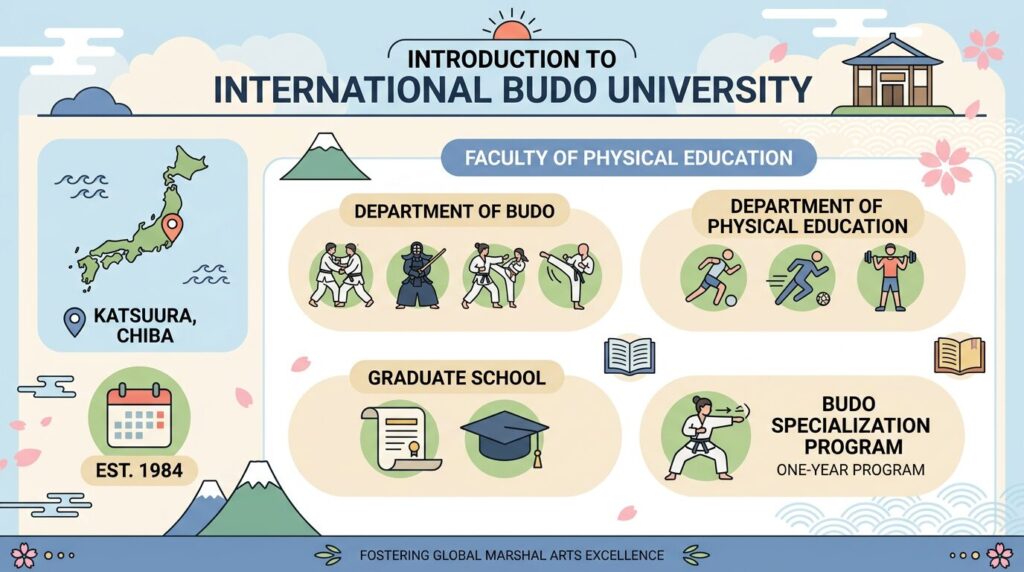
International Budo University — known in Japanese as Kokusai Budo Daigaku, and often abbreviated as IBU, Budai, or Kokubudai — is a private university founded in 1984 in Katsuura City, Chiba Prefecture. Its defining features are that it offers a Faculty of Physical Education where budo can be studied in a focused academic and practical environment, and that it operates a one-year Budo Specialization Program for international students.
According to IBU’s English-language information, the university’s total admission capacity is around 1,800 students. Students come from across Japan and from many countries overseas. Faculty members include former world champions, Olympians, national champions, professional trainers, coaches, doctors, and researchers. The university’s research and education cover a wide range of fields: budo culture, budo education, the internationalization of budo, budo and disability, budo history, sports science, sports management, coaching science, athletic training, exercise science, health science, sports education, and sports business.
At the same time, IBU is not an English-language international campus in Tokyo. It is a Japanese university located in Katsuura, a small coastal city in Chiba Prefecture. From Tokyo Station, the JR Wakashio limited express reaches Katsuura in roughly 90 minutes. Katsuura itself is a small city with a population of roughly 15,000.
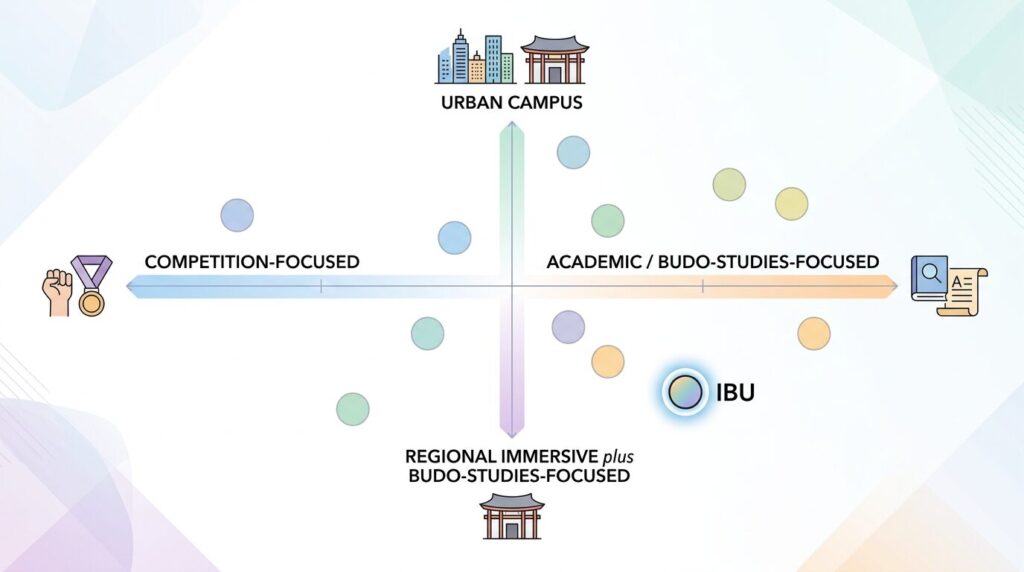
In other words, IBU is not the place to imagine a large, cosmopolitan, urban campus life. It is better understood as a university where students spend one, two, or four years in a quiet coastal town, surrounded by sea and mountains, focusing intensely on budo, physical education, and sport.
For overseas martial artists, that environment can be both a strength and a limitation. This guide explains both sides as clearly as possible.
2. Basic Profile of International Budo University
| Item | Details |
|---|---|
| Official name | International Budo University |
| Japanese name | 国際武道大学(Kokusai Budo Daigaku) |
| Common abbreviations | IBU, Budai, Kokubudai |
| Type | Private university operated by the school corporation International Budo University |
| Founded | 1984 |
| Location | 841 Shinkan, Katsuura City, Chiba Prefecture 299-5295, Japan |
| Undergraduate faculty | Faculty of Physical Education only |
| Undergraduate departments | Department of Budo; Department of Physical Education |
| Graduate school | Graduate School of Budo and Sport Studies, Master’s Program in Budo and Sport |
| Special program | Budo Specialization Program, a one-year program for international students, with an annual capacity of 20 students |
| Undergraduate intake | 400 students per year: 80 in Budo and 320 in Physical Education |
| Undergraduate capacity | 1,700 students as of the 2025 University Portrait data |
IBU’s founding philosophy is based on the vision of its founder, Shigeyoshi Matsumae. The university states that it seeks to respect the value of traditional budo culture, spread a vision of peace, deepen international friendship, and contribute to world peace. In contemporary terms, IBU describes its mission as enriching society through budo and sport.
The university’s founding precepts include the phrase:
“Young people, through budo, acquire an unshakable view of life.”
This phrase captures an important point. IBU is not only a sports university and not only a martial arts training hall. It presents budo as a way to connect physical discipline, education, international exchange, and character formation.
3. Undergraduate Study: Department of Budo and Department of Physical Education
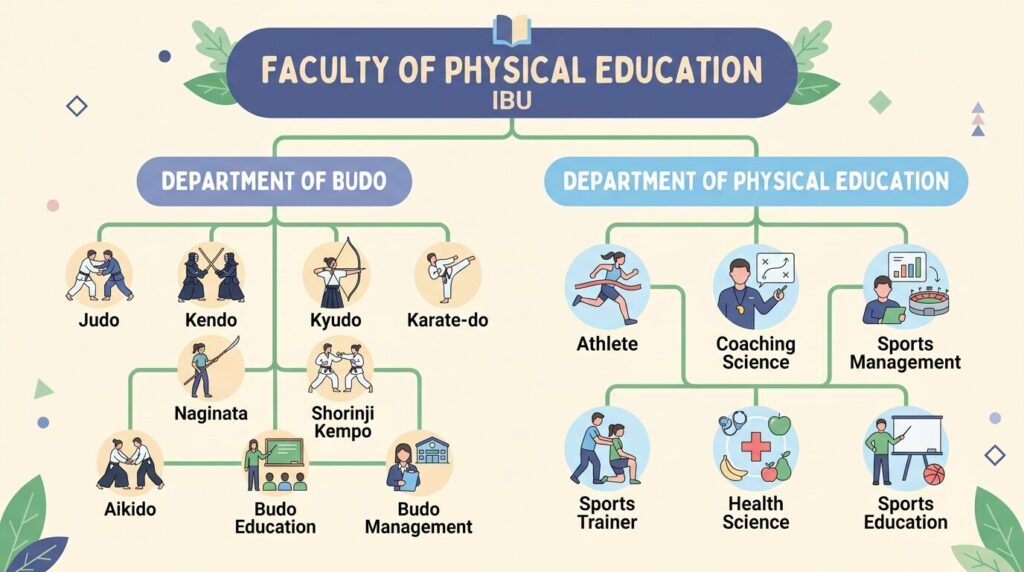
All undergraduate students at IBU belong to the Faculty of Physical Education. The faculty consists of two departments:
- Department of Budo — annual intake: 80 students
- Department of Physical Education — annual intake: 320 students
One important point for overseas readers is that students can continue to study and practice budo in either department. The Department of Budo is the more direct route for students who want to place martial arts at the center of their academic program. However, students in the Department of Physical Education can also participate in budo classes and clubs.
3.1 Department of Budo
The Department of Budo is designed for students who want to deepen both the practical and theoretical study of Japanese martial arts. According to the university, the department is organized into three broad areas and nine courses.
The main structure includes:
- Budo Specialization Courses
- Judo
- Kendo
- Kyudo
- Karate-do
- Naginata
- Shorinji Kempo
- Aikido
- Budo Education Course
- Budo Management Course
For overseas martial artists, the most important attraction is that students can study their main martial art not only as technique, but also through history, philosophy, pedagogy, internationalization, and management.
3.2 Department of Physical Education
The Department of Physical Education focuses on competitive sport, coaching, athletic training, health science, sports management, and physical education. Its courses include:
- Athlete Course
- Coaching Science Course
- Sports Management Course
- Sports Trainer Course
- Health Science Course
- Sports Education Course
Even students in Physical Education can continue serious martial arts practice through classes and university clubs. In practice, clubs such as karate, judo, and kendo include students from both departments.
3.3 Qualifications and Career Paths
Students in the Faculty of Physical Education may work toward qualifications such as junior-high and high-school health and physical education teaching licenses, health and fitness instructor credentials, athletic trainer qualifications, and various sports coaching credentials.
Typical career paths include:
- Budo instructor
- School teacher
- Police or Self-Defense Forces
- Fitness and training industry
- Public-sector employment
- Sports business
- Coaching and club management
- Graduate study in sport, education, or budo research
4. Graduate School: Budo and Sport Studies
IBU’s graduate school consists of the Graduate School of Budo and Sport Studies, offering a master’s program in Budo and Sport. The 2026 admissions information lists an intake of 10 students.
The curriculum is divided into common subjects, specialized subjects, seminar / practical-supervision subjects, research-foundation subjects, and research guidance. The specialized subjects are organized into three main areas:
- Budo and Sport Culture
- Budo history
- Budo thought
- Sociology of budo
- Cultural and anthropological approaches
- Health and Sport Science
- Exercise physiology
- Biomechanics
- Health science
- Psychology
- Budo and Sport Coaching
- Coaching science
- Technical analysis
- Instructional methods
- Education
For readers who are interested in a doctoral degree, it is important to note that IBU does not currently offer a doctoral program that can be completed entirely within the university. Students who wish to continue beyond the master’s level usually move on to doctoral programs at other universities, such as the University of Tsukuba, Nippon Sport Science University, the University of Tokyo, Kyoto University, or national universities with strong education and sport science programs.
For international applicants, the graduate school offers a foreign student admissions route. According to the official admissions policy, international applicants are assessed through a specialized-subject examination and an oral examination, with the university evaluating their basic academic ability, logical thinking, problem-solving ability, and research motivation. Applicants are typically required to submit a research plan, academic transcripts, and other documents requested in the latest application guidelines.
In Japanese graduate admissions, it is generally wise — and in some cases necessary — to consult the potential supervisor before applying. Applicants should discuss whether their research theme is appropriate and whether supervision may be possible. For international inquiries, IBU’s international affairs contact is the International Office.
5. Budo Specialization Program: A One-Year Route for International Martial Artists
One of IBU’s most distinctive features is the Budo Specialization Program, a one-year program designed for international students.
The program was established in 1994, roughly ten years after the university opened. The Matsumae Memorial International Exchange Hall, which functions as a dormitory and international exchange facility, was completed in the same period. The annual capacity of the program is limited to 20 students.
5.1 Overview
The purpose of the program is to contribute to the international spread of budo culture. Graduates are expected to become athletes, coaches, instructors, and cultural bridges in their home countries.
The program is generally designed for applicants who:
- Do not hold Japanese nationality
- Have completed 12 years of schooling, equivalent to graduation from high school
- Have a background in budo or martial arts
- Wish to study budo and Japanese culture intensively in Japan for one year
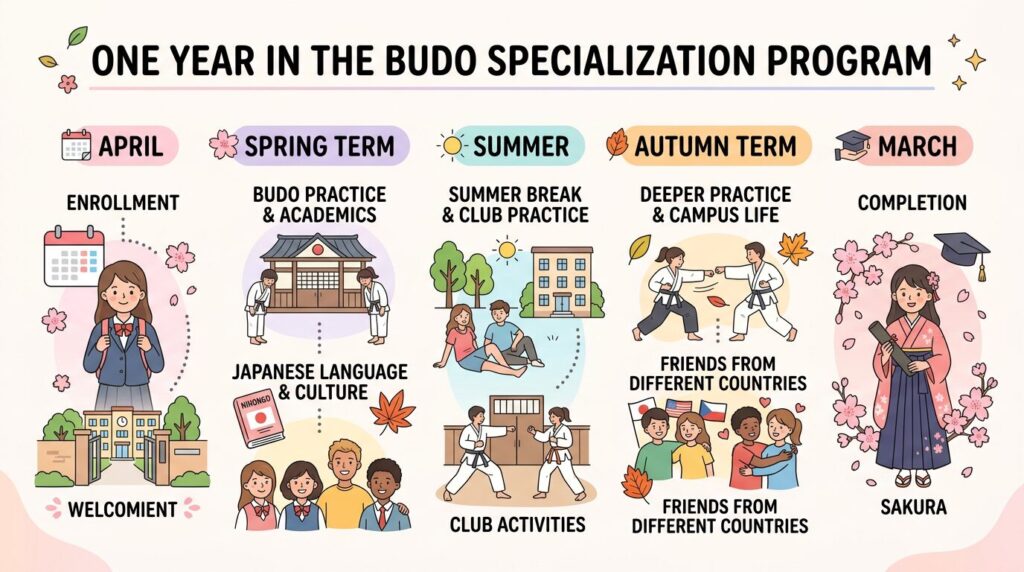
The program runs for one academic year, usually from April to the following March.
Students study:
- Practical budo
- Budo theory
- Japanese language
- Japanese culture
The practical budo classes include judo, kendo, kyudo, karate-do, naginata, Shorinji Kempo, and aikido. Most practical classes are taken together with Japanese undergraduate students, while Japanese-language and Japanese-culture classes are unique to the program.
The university explains that classes and club activities are conducted in Japanese. For that reason, Japanese ability around JLPT N4 level is desirable, although a JLPT certificate may not always be required.
5.2 Tuition and Fees
The following figures are approximate reference values based on published information for the 2026 academic year. They may change by year.
| Item | Amount |
|---|---|
| Application fee | 10,000 yen |
| Admission fee | 100,000 yen |
| Annual tuition | 500,000 yen |
| Health check and insurance | 10,990 yen |
Accommodation and food are not included in these amounts.
5.3 Dormitory: Matsumae Memorial International Exchange Hall
Many students in the Budo Specialization Program live in the Matsumae Memorial International Exchange Hall, located on or near the campus. The rent has commonly been around 30,000 yen per month.
For international students, the dormitory environment is important. It is not simply a place to sleep. It is also a place where martial artists from different countries live together, communicate daily, and learn from each other’s cultures.
Applicants should check the latest availability, rent, room type, and dormitory rules directly with IBU before applying.
5.4 What the Program Is — and What It Is Not
The Budo Specialization Program is sometimes misunderstood.
It is not a casual working-holiday-style martial arts stay. It is also not a degree program. Students who complete the program receive confirmation that they have completed the one-year course, but the program does not lead to a bachelor’s degree.
The program is best suited for people such as:
- Martial artists who already have a university degree or professional life in their home country and want one focused year of budo study in Japan
- Applicants who eventually want to enter IBU’s undergraduate or graduate school and need to improve Japanese ability and budo knowledge first
- National-team athletes, instructors, or coaches who want to experience a high-level Japanese university budo environment for one year
- Students who want a structured introduction to Japanese university budo before committing to a full four-year degree
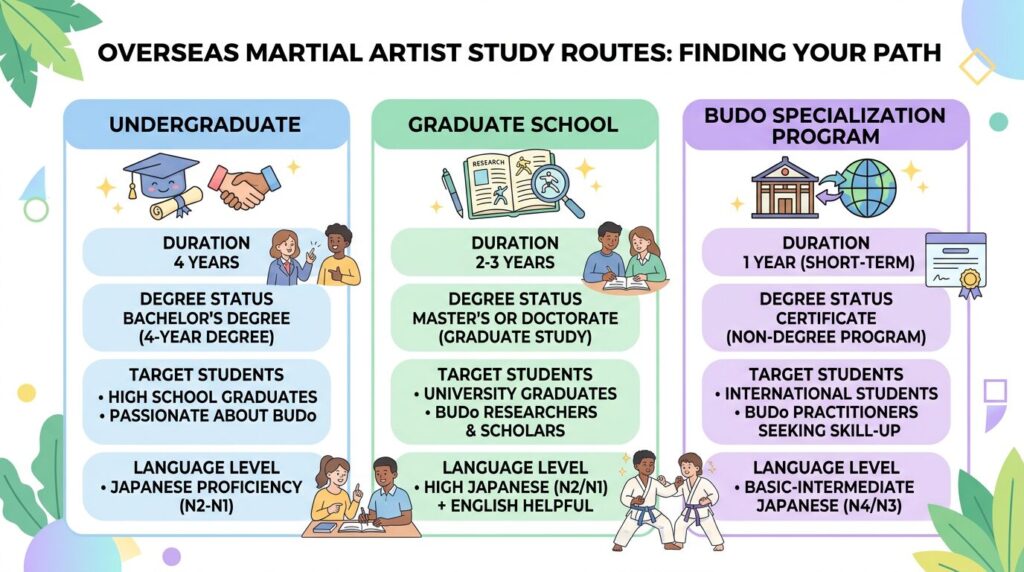
6. Admissions: Undergraduate, Graduate, and Special Program Routes
Admissions systems change by year, so applicants must always check the latest official application guidelines. The following is a general overview.
6.1 Undergraduate Admissions
IBU’s Faculty of Physical Education has several admissions routes, including:
- Comprehensive selection / AO-style admissions
- School recommendation admissions
- Designated-school recommendation admissions
- General entrance examination
- Common Test-based admissions
- Special selection routes
- Transfer admissions
For students graduating from high school outside Japan, the most realistic route is usually a special selection category for international students, when offered in the relevant year.
The exact name of the category, required documents, examination subjects, interview format, and Japanese-language requirements can change. Applicants should check the latest Faculty of Physical Education admissions page and application guidelines.
6.2 General Eligibility for International Undergraduate Applicants
Although details vary by year, overseas applicants to Japanese private universities usually need to satisfy conditions such as:
- Not holding Japanese nationality, or being treated as an international applicant under the relevant rules
- Completing 12 years of school education, or being expected to complete it before enrollment
- Being at least 18 years old at the time of enrollment
- Having sufficient Japanese-language ability for university-level classes
- Having the financial ability to support study and life in Japan
For regular undergraduate study, Japanese ability around JLPT N2 or higher is a realistic benchmark. Since classes, assignments, examinations, and club communication are generally in Japanese, students with only beginner-level Japanese will likely struggle in a regular degree program.
6.3 Undergraduate Tuition
The following is a rough guide based on published recent figures.
| Item | First-year amount |
|---|---|
| Admission fee | 120,000 yen |
| Tuition, spring term | 639,500 yen |
| Tuition, autumn term | 639,500 yen |
| Association and other fees | About 42,660 yen |
| Total first-year cost | About 1,441,660 yen |
This does not include accommodation, meals, equipment, travel, medical costs, or daily living expenses.
IBU publishes information on scholarships and tuition reductions, including some sport-related scholarships and other reduction systems. However, readers should not assume that a special scholarship for privately funded international students is automatically available. Always confirm the latest scholarship rules directly with the university.
6.4 Graduate Admissions
The graduate school has several admissions categories, including general admissions, working-adult admissions, and international student admissions.
For international applicants, the selection process may include:
- Specialized subject examination
- Oral examination
- Review of a research plan
- Review of academic transcripts and recommendation documents
- Confirmation of Japanese-language ability
Because graduate work requires close supervision, applicants should prepare a clear research plan in advance and consult the relevant faculty member before applying.
6.5 Applying to the Budo Specialization Program
Applications for the Budo Specialization Program usually open many months before April enrollment. For example, the application period for 2026 enrollment was announced as beginning around June 2025.
Required documents may include:
- Proof of high-school graduation or equivalent education
- Documents showing budo experience
- Dan or grade certificates, if available
- Recommendation letters from martial arts organizations or instructors
- Health certificate
- Photographs
- Proof of application-fee payment
- Passport copy
- Other documents requested by IBU
Some documents may need to be submitted in physical paper form. Applicants outside Japan should allow enough time for international mailing and document preparation.
7. Language: Are Classes Offered in English?
For overseas readers, this is one of the most important points.
In short: IBU’s regular undergraduate and graduate classes are generally conducted in Japanese. At present, IBU should not be understood as a university where students can complete a degree entirely in English.
7.1 Undergraduate and Graduate Language Environment
Although the university has “International” in its English name, it is not an English-medium global university in the way that some large Japanese universities operate English-degree programs.
In regular undergraduate and graduate study, the following are generally in Japanese:
- Lectures
- Seminars
- Budo practice explanations
- Club communication
- Reports
- Examinations
- Administrative notices
Therefore, students entering the undergraduate faculty or graduate school as regular degree students should aim for at least JLPT N2-level Japanese. In reality, for academic writing and seminar discussion, Japanese closer to N1 is often safer.
7.2 Support in the Budo Specialization Program
The Budo Specialization Program is more accessible to students whose Japanese is still developing. It is designed with international students in mind.
Students can expect:
- Japanese-language classes
- Japanese-culture classes
- Practical budo classes in which demonstrations and physical learning help compensate for limited language ability
- Opportunities to interact with Japanese students through practice and club life
However, this does not mean that Japanese is unnecessary. Budo training in Japan relies heavily on commands, etiquette, short instructions, and shared assumptions. Students who learn basic Japanese before arrival will adapt much more quickly.
A realistic minimum before arrival would include:
- Hiragana and katakana
- Basic greetings
- Numbers, dates, and time
- Basic classroom and dormitory vocabulary
- Core budo terms such as rei, kamae, tsuki, geri, uke, kata, kumite, keiko, dan, and kyu
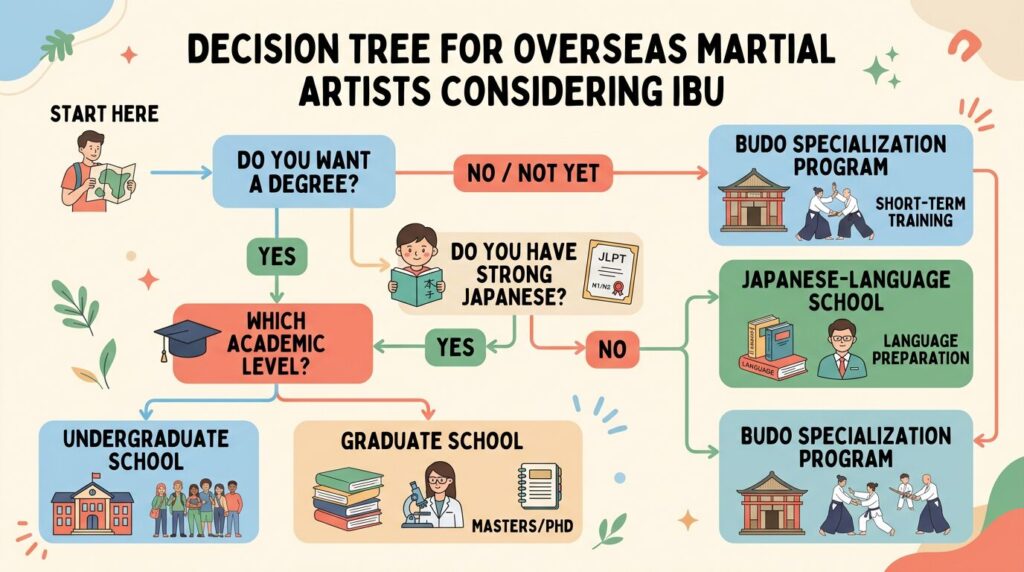
7.3 If You Want to Enter a Regular Degree Program
If your Japanese is not yet strong enough for undergraduate or graduate study, consider one of the following routes:
- Study at a Japanese-language school in Japan for one or two years, then apply after reaching JLPT N2 or higher
- Study Japanese in your home country before applying
- Enter the Budo Specialization Program first, then consider applying to the undergraduate faculty
- If your home university has an exchange agreement with IBU, explore short-term exchange options
The important point is to avoid underestimating language. Strong martial arts experience does not automatically solve the difficulty of reading university materials, writing reports, or passing examinations in Japanese.
8. What Can Karateka Learn at IBU?
This section focuses on karate, because many overseas readers will ask what kind of karate can actually be studied at IBU.
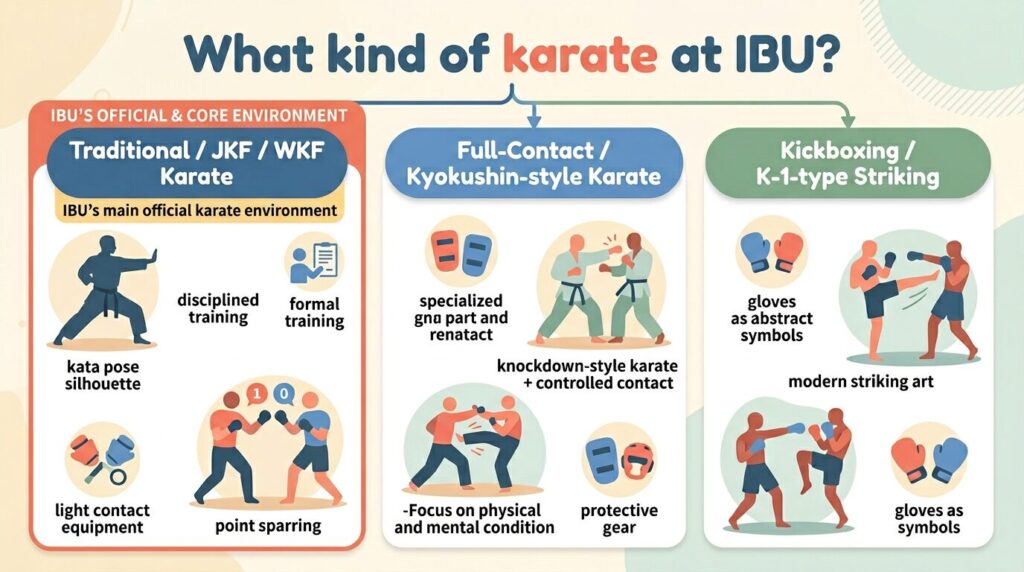
8.1 What Kind of Karate Is Practiced at IBU?
The word “karate” can mean different things depending on country, organization, and training background.
Broadly speaking, there are at least three major categories that overseas readers may be thinking of:
- Traditional / federation karate, connected to the Japan Karatedo Federation and World Karate Federation systems
- Full-contact karate, such as Kyokushin and related knockdown styles
- Kickboxing and K-1-type striking sports, which may include techniques influenced by karate but follow different rules and professional combat-sport structures
At IBU, “karate-do” should generally be understood as traditional karate in the JKF / WKF competitive system. This is the same broad family of karate that appeared in the Tokyo 2020 Olympic Games.
That means IBU’s karate environment is centered on:
- Kumite, a point-based sparring format that rewards controlled, effective techniques
- Kata, formal solo performance of prescribed sequences
- University competition under Japanese student karate structures
- Training influenced by multiple traditional styles, rather than by a single exclusive school
IBU’s karate club belongs to the Kanto Student Karatedo Federation. The university’s club information explains that students from various traditional karate styles gather there and that the club itself does not belong to one specific style.
This point matters. If you are looking for full-contact knockdown karate, Kyokushin-style fighting, kickboxing, or professional K-1-type training, IBU’s official karate environment is probably not the direct route you are imagining. It may still give you valuable physical education, coaching science, conditioning knowledge, and budo perspective. But the karate-do club and curriculum are not designed primarily as a full-contact fighting gym.
8.2 “Traditional Karate” Does Not Mean “No Contact”
Some readers outside Japan may hear the word sundome — often translated roughly as “stopping short” — and assume that traditional karate means techniques never touch the opponent.
That is too simple.
WKF-style kumite is not a knockdown system where the goal is to hit with maximum force and incapacitate the opponent. Excessive contact and techniques that cause injury can be penalized. However, controlled contact can occur, especially at senior levels. The key idea is not “no contact,” but controlled, rule-bound contact evaluated for timing, distance, form, and effectiveness.
For a student coming from full-contact karate, this can feel like a very different sporting logic. For a student coming from WKF or national federation karate, it will feel more familiar.
8.3 IBU Karate Club
IBU has an official karate-do club. According to university and club information, the club trains mainly on weekdays and Saturday mornings, with Sunday usually off. The training location is listed as the 7th Building kendo hall.
The club’s leadership and coaching structure has included:
- Club director: Toshiyasu Tada
- Head coach: Takanori Arakawa
- Assistant head coach: Masatoshi Arakawa
- Coach / special adviser: Emiri Iwamoto
- Adviser: Toshiki Fujimoto
Names and roles can change, so applicants should check the latest university club page and the karate club’s own website.
The club describes itself as a place where students from many traditional karate backgrounds gather. It emphasizes student initiative, flexible thinking, and the goal of contributing to society through karate-do. Activities also include teaching children in the community and participating in overseas exchange.
8.4 Karate as Academic Study
For overseas karateka, IBU’s greatest value may be the combination of practice and academic study.
At IBU, karate can be connected to:
- Budo history
- Budo thought
- Okinawan and mainland Japanese martial arts history
- Modernization and internationalization of karate
- Coaching science
- Sports biomechanics
- Exercise physiology
- Training science
- Sports sociology
- Budo education
- Community sport and youth instruction
This is difficult to reproduce in an ordinary dojo. A dojo can teach technique and culture deeply, but a university can also teach how to research, analyze, explain, and transmit karate as an educational and social practice.
8.5 Limits of IBU for Karate Specialists
IBU is a valuable environment, but it is not the only possible choice for karateka.
Students should understand several limitations.
First, IBU’s karate club is not always at the very top of Japanese university karate. Schools such as Teikyo University, Kyoto Sangyo University, Kindai University, Doshisha University, Komazawa University, Kokushikan University, and Taisho University are often prominent in national university karate competition.
Second, IBU’s official strength has historically been spread across multiple budo disciplines, including judo, kendo, kyudo, and others. Karate is one important part of a broader budo environment, not the only institutional focus.
Third, IBU is in Chiba, not Okinawa. If your primary goal is to study Okinawan karate at its source, you may want to consider universities or dojo networks in Okinawa, or to arrange training with specific Okinawan style headquarters.
In short, the best choice depends on your goal.
If you want the most competitive university karate team possible, compare several strong karate universities carefully.
If you want to study budo broadly, combine practice with academic learning, and experience a Japanese martial arts university environment, IBU is a distinctive option.
9. Other University Options for Karateka
The following universities are often discussed in relation to karate, budo, or sports science. This list is not a ranking, and it does not mean that students should choose these schools over IBU. It is simply useful context.
| University | Location | Why karateka may consider it |
|---|---|---|
| University of Tsukuba | Tsukuba, Ibaraki | A national university with strong physical education, coaching, and budo research, including doctoral-level options. |
| Nippon Sport Science University | Tokyo / Yokohama | One of Japan’s leading sport universities, with graduate programs and extensive coaching and sport science resources. |
| Teikyo University | Hachioji, Tokyo | A major powerhouse in university karate, often strong in national competition. |
| Kyoto Sangyo University | Kyoto | A strong western-Japan university karate program with a history of producing high-level athletes. |
| Kindai University | Higashiosaka, Osaka | A large comprehensive university and frequent contender in university karate. |
| Kokushikan University | Setagaya, Tokyo | A private university with a strong budo tradition across judo, karate, kendo, and other disciplines. |
| Taisho University | Toshima, Tokyo | Known in recent years for strong results in women’s kumite at the university level. |
| Takushoku University | Tokyo | Home to one of Japan’s historically important Shotokan-lineage university karate clubs, established in 1930. |
Compared with these universities, IBU’s unique strength is the combination of three things:
- A whole university built around budo and sport
- A multi-budo environment where students can encounter judo, kendo, kyudo, karate, naginata, Shorinji Kempo, aikido, and sport science in one place
- An official one-year program specifically designed for international budo students
10. Preparing Before Studying in Japan
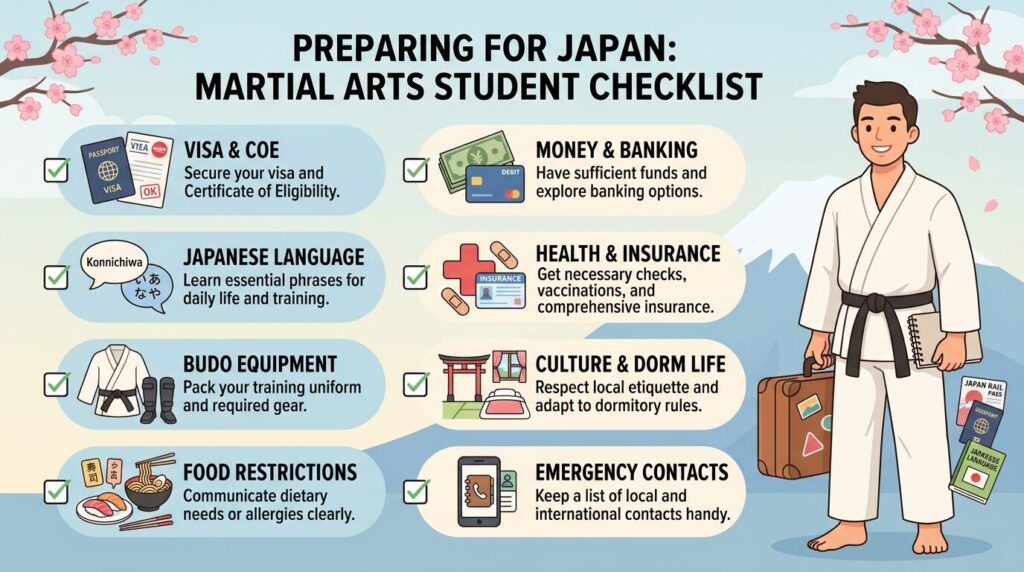
If you are seriously considering IBU, preparation should begin well before application.
10.1 Visa and Immigration Documents
Students who enroll in the Budo Specialization Program, undergraduate faculty, or graduate school will generally need a Japanese Student residence status.
In many cases, after admission, the receiving institution applies in Japan for a Certificate of Eligibility, often called a COE. After the COE is issued, the student applies for a visa at a Japanese embassy or consulate in their country or region.
The standard processing period for a COE can be one to three months, and it may take longer if documents are incomplete or additional materials are requested. Applicants should plan backward from the enrollment date and allow generous time.
Students should also check:
- Passport validity
- Embassy or consulate visa rules in their country
- Whether tuberculosis screening applies to their nationality or residence country
- Financial documents required for visa purposes
- Health and insurance documents required by the university
10.2 Financial Preparation
A rough annual cost estimate is as follows.
| Item | Budo Specialization Program | Undergraduate first year |
|---|---|---|
| Admission and application fees | About 110,000 yen | About 120,000 yen |
| Tuition | About 500,000 yen | About 1,279,000 yen |
| Fees and insurance | About 10,990 yen or more | About 42,660 yen |
| Dormitory / housing | About 360,000 yen per year if 30,000 yen per month | Similar or higher, depending on housing |
| Food and daily life | About 600,000 to 800,000 yen per year | Similar |
| Rough total | About 1.6 to 1.8 million yen | About 2.4 to 2.8 million yen |
These are only estimates. They do not include:
- Budo equipment
- Club fees
- Tournament or travel costs
- Medical costs
- Flights to and from Japan
- Personal expenses
- Emergency savings
Students with a Student residence status need permission before working part-time in Japan. This is called permission to engage in activity other than that permitted under the status of residence. Even with permission, work hours are limited, and students should not build a financial plan that depends on heavy part-time work. Budo training, university classes, language study, and health must come first.
10.3 Japanese-Language Preparation
Even students entering the Budo Specialization Program should study Japanese before arrival.
At minimum, learn:
- Hiragana and katakana
- Basic greetings
- How to introduce yourself
- Numbers, dates, and times
- How to ask for help
- Basic food, shopping, train, and hospital vocabulary
- Common budo terms
Regular undergraduate and graduate applicants should aim for JLPT N2 or higher before applying. Students aiming for research, report writing, and seminar discussion should ideally continue toward N1-level academic Japanese.
10.4 Health and Medical Preparation
International students staying in Japan with a residence card generally enroll in Japan’s National Health Insurance. With this insurance, the patient usually pays 30 percent of covered medical costs at the clinic or hospital.
However, not everything is covered. Dental orthodontics, some advanced treatments, sport braces, and certain private medical services may require large out-of-pocket payment.
Before departure, consider:
- Completing dental treatment
- Checking chronic medical conditions
- Preparing prescriptions and medical explanations in English or Japanese
- Getting an orthopedic check if you have old injuries
- Learning basic taping and injury-prevention methods
- Planning mental-health support and regular contact with family or friends
Martial arts training abroad can be physically and emotionally demanding. A quiet rural environment may be excellent for focus, but it can also feel isolating if students are unprepared.
10.5 Budo Equipment and Training Gear
Bring essential equipment that fits your body well, especially if it is difficult to replace.
Depending on your art, this may include:
- Karate gi, judo gi, kendo gear, kyudo equipment, or other specialized gear
- Belts
- Protective equipment
- Dan or kyu certificates
- Competition records
- Recommendation letters from instructors or federations
Karate gi, judo gi, and kendo gear can also be purchased in Japan, sometimes at high quality and reasonable prices. However, students who rely on specific equipment should not assume it will be immediately available in Katsuura.
10.6 Cultural Preparation
Japanese dojo and club culture can feel strict to students from overseas.
Important expectations include:
- Punctuality
- Bowing and etiquette
- Cleaning duties
- Respectful language
- Senior-junior relationships
- Group responsibility
- Careful attention to shared spaces and equipment
These customs are not merely decorative. In Japanese budo settings, they are often treated as part of training itself.
Students who prepare mentally for communal life will adapt more smoothly.
Food is another practical issue. Vegetarian, vegan, halal, kosher, and allergy-friendly options can be limited in small Japanese cities. Students with dietary needs should learn basic cooking, identify suitable ingredients, and prepare Japanese phrases to explain restrictions.
11. Access to the Katsuura Campus
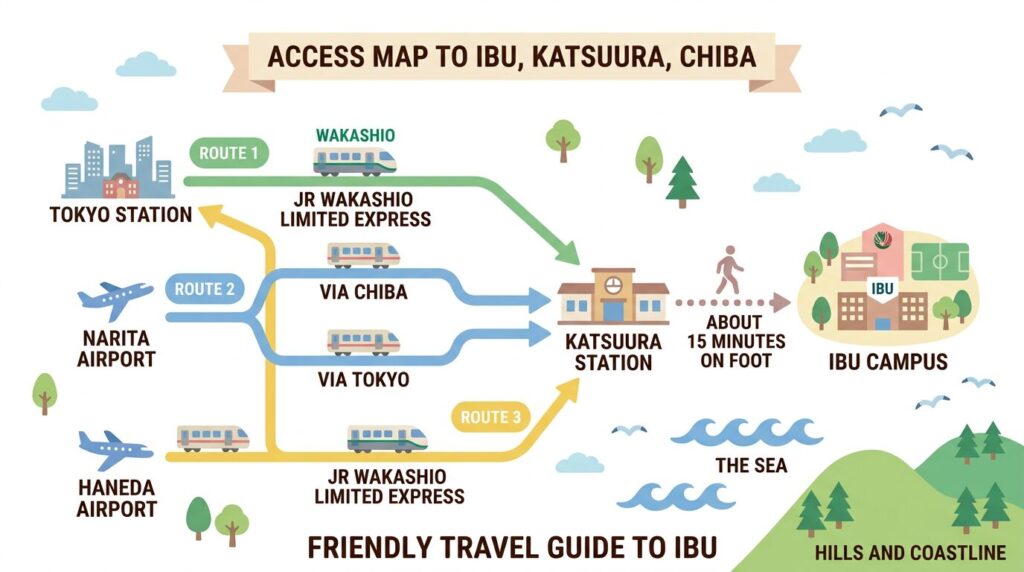
IBU is located at 841 Shinkan, Katsuura City, Chiba Prefecture. The nearest station is Katsuura Station on the JR Sotobo Line. The campus is about 15 minutes on foot from the station.
11.1 From Tokyo Station
The main train routes are:
- Tokyo Station → Soga Station → Katsuura Station by JR Keiyo and Sotobo lines
- About 2.5 hours by ordinary trains
- Tokyo Station → Katsuura Station by the JR Wakashio limited express
- About 90 minutes, depending on the train
- Katsuura Station → IBU
- About 15 minutes on foot
- About 5 minutes by taxi, depending on availability
There is also a highway bus route from the Tokyo Yaesu area toward Katsuura and nearby destinations. Some buses stop at or near a stop called Kosoku Budai Iriguchi, meaning “Highway Budo University Entrance.” The number of buses is limited, so students should check the latest timetable before relying on this route.
11.2 From Narita Airport
From Narita Airport, possible routes include:
- Train via Chiba or Tokyo, then JR Sotobo Line to Katsuura
- Train to Tokyo Station, then Wakashio limited express to Katsuura
- Bus routes with transfers, depending on the time of day
- Private transfer or taxi, which is convenient but expensive
Travel time is often around three to four hours by public transport, depending on connections. By car, it may be roughly 1.5 to 2 hours, but long-distance taxi fares can be very high.
For first-time arrivals, it is best to arrive during the daytime and reach Katsuura before dark if possible.
11.3 From Haneda Airport
From Haneda Airport, common routes include:
- Haneda Airport → Shinagawa, Hamamatsucho, or Tokyo area → JR limited express or ordinary trains to Katsuura
- Bus routes with transfers via the Tokyo Bay Aqua-Line area
A practical first-time route is:
- Haneda Airport to Tokyo Station
- Tokyo Station to Katsuura Station by Wakashio limited express
- Katsuura Station to IBU by taxi or on foot
This route is not always the cheapest, but it is relatively easy to understand for visitors unfamiliar with Japan.
11.4 Campus Facilities
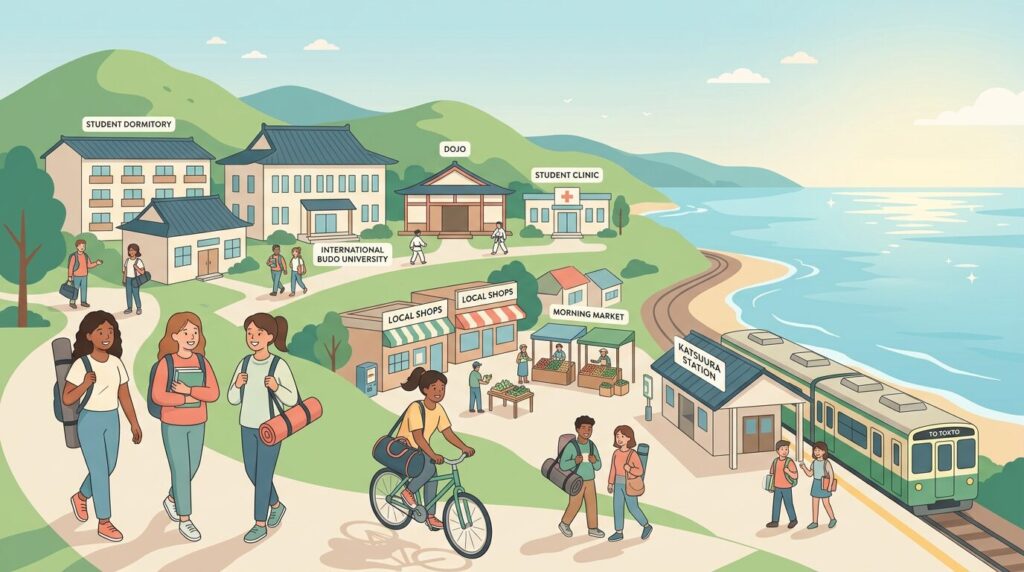
IBU’s campus includes lecture buildings, the library, dining facilities, dormitory-related facilities, research institutes, dojo, gymnasiums, athletic fields, tennis courts, and other sport facilities.
Major budo and sport facilities include:
- Judo halls
- Kendo halls
- Multipurpose dojo
- Training rooms
- Gymnasium
- Running course
- Heated 25-meter pool
- Wrestling hall
- Tatami training spaces
- Fitness and strength training facilities
- Athletic field
- Soccer and rugby fields
- Baseball field
The campus is compact enough that students can move between classes, practice, dormitory, and training facilities on foot. Outside campus, however, shopping, hospitals, and restaurants may require walking to Katsuura Station, cycling, or using local transport.
12. Hotels Near the University
For entrance examinations, interviews, campus visits, or parent and coach visits, accommodation in Katsuura is limited compared with Tokyo or Chiba City. It is best to book early.
The following are useful options to consider.
| Hotel or inn | Features | Approximate access |
|---|---|---|
| Family Lodge Hatagoya Chiba Katsuura | A simple roadside lodge with larger rooms, two queen-size beds in many rooms, free light breakfast, Wi-Fi, and parking. Convenient for families, teams, and visitors with a car. | About 0.8 to 1.0 km from IBU. |
| Mikazuki Inn | A simple inn located directly in front of JR Katsuura Station. Very easy for train users. | At Katsuura Station; walk or take a taxi to campus. |
| Umi no Yado Hinodeya | A small ryokan-style inn known for seafood and rooms with semi-open-air-style baths. | About 5 minutes on foot from Katsuura Station. |
| Tatsumi Ryokan | A traditional Japanese inn in the Sawakura area, known for seafood. Some information describes it as within walking distance of IBU. | Potentially walkable from campus; confirm pickup and access before booking. |
| Ryokan Matsunoya | A long-established traditional inn near the Katsuura morning market. Good for visitors who want a Japanese ryokan experience. | About 10 minutes on foot from Katsuura Station. |
| Kagaya Ryokan | A small inn in the Shinkan area. Check current operating status and booking conditions before relying on it. | Confirm access by taxi or on foot. |
| Katsuura Hilltop Hotel & Residence | A condominium-style hotel with kitchen facilities, suitable for families or longer stays. | About 20 minutes on foot or 5 minutes by taxi from Katsuura Station. |
| Hotel R9 The Yard Katsuura | A container-style roadside hotel opened in 2025 near Ubara Beach, with rooms equipped with microwave and refrigerator. | About 7 minutes by taxi from Katsuura Station; car or taxi recommended. |
| Mikazuki Sea-Park Hotel Katsuura | A large seaside resort hotel overlooking Katsuura Bay. | About 5 minutes on foot from Katsuura Station; roughly 1.5 km from IBU. |
For overseas visitors, the most practical choices are often:
- Family Lodge Hatagoya if traveling by car or with family
- Mikazuki Inn if arriving by train and prioritizing convenience
- Mikazuki Sea-Park Hotel Katsuura if looking for a larger resort hotel
- A traditional ryokan such as Matsunoya or Tatsumi Ryokan for a more Japanese-style stay
Some accommodations that appear in older travel discussions may no longer operate as inns. Always check the latest booking status before making plans.
13. Safety and Daily Life in Katsuura
13.1 Crime and Personal Safety
Katsuura is not a large entertainment district like central Tokyo or Osaka. The risks are generally different.
The area around IBU is quieter and more rural, but students should still follow basic safety habits:
- Lock dormitory or apartment doors
- Do not leave valuables in bicycles, cars, or visible places
- Avoid walking alone late at night in poorly lit areas
- Learn the route between station, campus, dormitory, and nearby shops
- Register emergency contacts
- Know how to reach the university office, police, ambulance, and local hospital
Japan is often described as safe, but “safe” does not mean “no risk.” Small cities can have burglary, theft, traffic accidents, and disaster risks.
13.2 Natural Disasters
Katsuura faces the Pacific Ocean. Students should prepare for:
- Earthquakes
- Tsunami warnings
- Typhoons
- Heavy rain
- Landslides
- Power outages
Katsuura City provides disaster information through local systems such as disaster radio, email, and apps. Students should learn the nearest evacuation sites after arrival.
Important questions to ask during orientation include:
- Where is the evacuation area for the dormitory?
- Where should students go during a tsunami warning?
- How does the university confirm student safety?
- Who should international students contact after hours?
- What supplies should be kept in the dormitory?
For students from countries with little earthquake experience, this preparation is essential.
13.3 What Kind of Town Is Katsuura?
Katsuura is a fishing town known for the Katsuura morning market, which is often described as one of Japan’s three great morning markets, together with Wajima in Ishikawa and Takayama in Gifu.
It is also known for beaches, surfing, seafood, and a relatively mild climate. The city has a small population, so daily life is quieter than in a major urban campus.
This is attractive for students who want to focus on training, study, nature, and a slower rhythm. It may feel limiting for students who want frequent concerts, nightlife, large international communities, or constant access to big-city events.
Tokyo is reachable, but it is not close enough for casual daily commuting. IBU students should think of Katsuura as their main living environment.
14. Other Practical Points for International Students
14.1 Climate
Katsuura is known in Japan for relatively cool summers. The city has long promoted the fact that it has not recorded a day above 35°C since modern observation records began there in 1906. Sea breezes, coastal conditions, surrounding forests, and limited urban heat-island effects all contribute to this reputation.
However, summers are still humid, and training in a gi or protective gear can be physically demanding. Students should still prepare for heat, sweat, hydration, and recovery.
Winters are not usually as severe as inland northern Japan, but coastal winds can feel cold. Students should bring:
- Waterproof jacket
- Windproof outer layer
- Warm training clothes
- Rain gear
- Shoes suitable for wet weather
The rainy season in June and typhoon season from late summer into autumn should also be taken seriously.
14.2 Medical Care
Katsuura has hospitals, clinics, and dental clinics, including Shioda Hospital. For everyday illness, minor injury, and regular consultation, local medical care is available.
However, for specialized tests, surgery, serious injury, or emergency care, students may be referred or transported to larger hospitals in nearby cities or farther away.
International students should:
- Enroll in required health insurance
- Learn basic Japanese medical phrases
- Keep emergency contacts written down
- Carry allergy and medication information
- Ask the university how to handle injuries during club activities
14.3 Money and Banking
Students should arrive with both cash and a card. Some places in rural Japan still prefer cash, and international cards may not work everywhere.
Opening a Japanese bank account usually requires:
- Residence card
- Registered address in Japan
- Student ID or enrollment documents
- Phone number
- Personal seal in some cases, depending on the bank
Some banks may restrict services for foreigners who have been in Japan for less than six months. Students who need to receive money from overseas or pay rent should ask the university which bank is most practical.
14.4 Phone and Internet
Short-term SIM cards and eSIMs can be purchased before arrival or at major airports. For longer stays, students can consider Japanese mobile services after they have residence documents and an address.
Dormitory or apartment internet conditions vary. Students who need stable video calls with family, online study, or cloud access may want a personal mobile data plan in addition to any dormitory Wi-Fi.
14.5 Official Contacts and Resources
Useful official resources include:
- International Budo University official website: https://www.budo-u.ac.jp/
- English website: https://www.budo-u.ac.jp/english/
- Budo Specialization Program: https://www.budo-u.ac.jp/english/e07_special/index.html
- IBU Europe Office: https://budo.college/
- International affairs inquiry: kokusai@budo-u.ac.jp
- Admissions inquiry: n-center@budo-u.ac.jp
Before applying, students should always confirm:
- Latest application period
- Required documents
- Tuition and fee amounts
- Dormitory availability
- Visa procedures
- Japanese-language requirements
- Scholarship possibilities
- Club participation conditions
15. Conclusion: Who Is IBU For?
International Budo University is best understood as a university for people who want to spend one, two, or four years in a Japanese regional city, focusing seriously on budo, sport, and physical education.
It is not the best fit for everyone.
It may not suit students who want:
- A degree entirely in English
- A large urban campus
- Frequent nightlife and big-city entertainment
- A university focused only on elite karate competition
- Full-contact karate or kickboxing as the main curriculum
- A doctoral program within the same institution
It may suit students who want:
- A Japanese university built around budo and sport
- A structured one-year budo program for international students
- A quiet environment for training and study
- Access to multiple Japanese martial arts
- Academic study of budo history, education, coaching, and sport science
- A route toward longer-term study in Japan
For karateka, the key is to understand the type of karate environment clearly. IBU’s karate is best understood as traditional, JKF/WKF-style karate-do within a broader budo university. It is not primarily a full-contact or professional striking-sport environment.
For martial artists in general, IBU’s value lies in the rare combination of dojo, classroom, dormitory, research, and international exchange. There are stronger individual clubs elsewhere, larger research universities elsewhere, and more urban student lives elsewhere. But there are few places where the entire university identity is built so directly around the idea of budo.
For the right student, Katsuura’s quietness is not a disadvantage. It is part of the training environment.
This article was prepared by the editorial team of mejiro.info in Tokyo as an English-language guide for readers outside Japan. It is based mainly on official and public information available as of May 2026. Before applying or making travel plans, always check the latest information directly with International Budo University and relevant Japanese authorities.