
Editorial note: This essay is a standalone review, written as a supplement (companion piece) to our guide “Essential Foreign-Language Books and Articles That Japanese Karate Researchers Should Read” (Japanese: Nihon no karate kenkyūsha ga yomu beki kaigai no jūyō shoseki・ronbun). It is an English translation of an article originally written in Japanese for readers in Japan and the wider Japanese-speaking world. Some expressions and references have been adapted, glossed, or supplemented for an international readership.
Lede
In 2018, Routledge published an English-language scholarly book titled The Historical Sociology of Japanese Martial Arts, written by the Spanish sociologist of sport Raúl Sánchez García. Routledge’s current catalogue lists the book at 252 pages with a copyright year of 2019, and a paperback edition followed in 2020. In 2020 the book won the Norbert Elias Book Prize, awarded by the Norbert Elias Foundation to an original, well-written work significantly inspired by Elias’s thought; for the 2020 cycle, nine titles published in 2018 and 2019 were in contention. By applying Norbert Elias’s theory of the “civilizing process” to the long-term history of Japanese martial arts, the book has come to be cited as a work that raised the theoretical bar for the study of Japanese martial arts in the West.
How should Japanese researchers of karate and the martial arts receive this book? To date there have been relatively few substantial reviews of it from within Japanese sociology or from within the field of martial-arts history. In this essay we first lay out the book’s structure and theoretical reach, and then discuss its strengths and its limitations, offering our own assessment along the way.[1]
The author and his vantage point
Raúl Sánchez García is a sociologist of sport who is also a long-time practitioner of several martial arts and combat sports — a “practitioner-scholar.” According to Routledge’s author biography, at the time of publication he was based in the School of Sports Science at the Universidad Europea de Madrid, and he holds a shodan (first-degree black belt) in Aikikai aikidō. He went on to teach at the Faculty of Physical Activity and Sport Sciences (INEF) of the Universidad Politécnica de Madrid and is now based at the Universidad Rey Juan Carlos (URJC) in Madrid; he earned his MA in the Sociology of Sport at the University of Leicester — long the home of the “figurational” (Eliasian) school of sport sociology. In the co-edited volume Fighting Scholars: Habitus and Ethnographies of Martial Arts and Combat Sports (Anthem Press, 2013), he played the role of bringing together combat-sport fieldworkers from around the world.[2]
What matters here is that the author is not someone who sits in judgment over Japanese martial arts “from above” using Anglo-American theory. He is, rather, a person who carries both the European sociological tradition and his own embodied experience on the training mat. Like many Japanese researchers, he takes the sense of friction felt in the training hall as his scholarly starting point. The book is written out of the productive tension between theory constructed off the mat and bodily experience accumulated on it — or so it seems to us.
The book’s structure and theoretical background
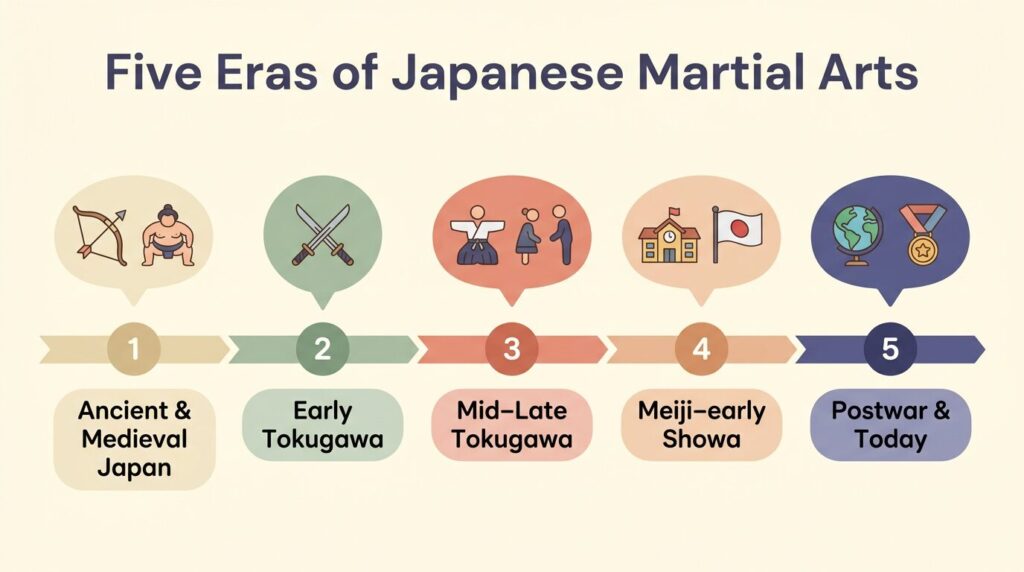
The book is organized into twelve chapters, including an introduction and an epilogue. Its scope runs from the earliest traces of archery (kyūjutsu) and sumō, through the formation of martial “schools” (ryū), the stabilization and transformation of these schools during the Tokugawa period (1603–1868), the nationalization and militarization of the martial arts across the Meiji, Taishō, and early Shōwa eras, and finally the postwar reorganization and internationalization of budō. In broad strokes, the narrative turns on the following five periods:
- Ancient and medieval Japan: the earliest traces of archery and sumō, and the emergence of composite martial ryū during the period of the Northern and Southern Courts and the Warring States era.
- Early Tokugawa: the stabilization of the martial ryū and their institutionalization, as they moved away from actual combat.
- Mid- and late Tokugawa: the transformation and diffusion of martial practice, with growing emphasis on standardized forms (kata), etiquette, and spirituality.
- Meiji, Taishō, and early Shōwa: the binding of the martial arts to Japanese identity, and their reorganization within school education, state institutions, and militarization.
- Postwar and contemporary period: reorganization after the Allied occupation, internationalization, and the advance of “sportization” and hybridization.
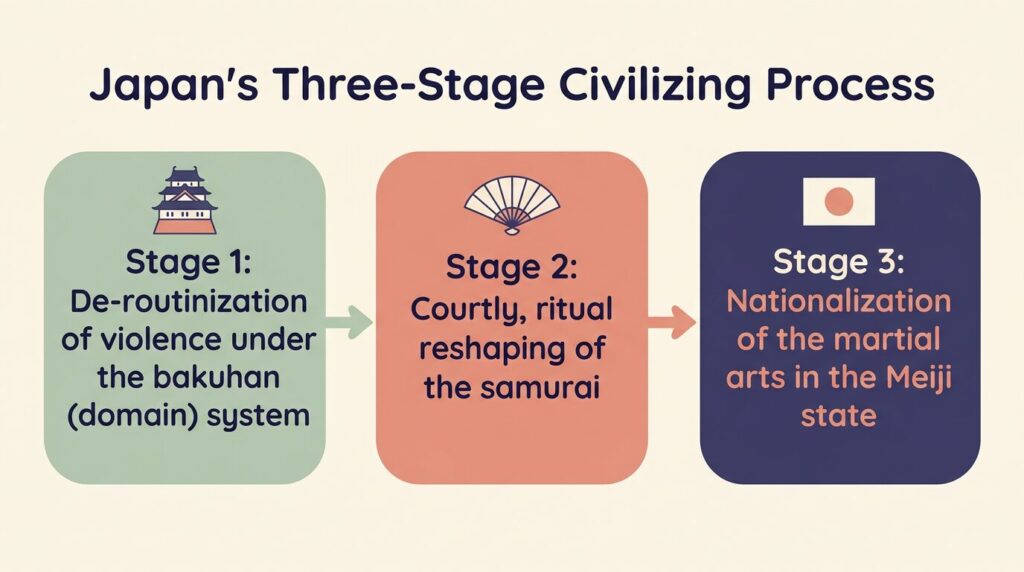
The theoretical backbone running through this long-term history is Norbert Elias’s concepts of the “civilizing process” and “figuration.” In The Civilizing Process (originally published in German in 1939), Elias described the advance of the monopolization of violence (state formation) and the control of emotions (courtly culture and manners) in Western Europe from the medieval to the modern era as a long-term social process. Sánchez García searches for an analogous process within Japanese society, and rereads the history of budō as a three-stage “Japanese civilizing process”: (1) the de-routinization of violence under the bakuhan (shogunate-and-domain) system; (2) the courtly, ritualized reshaping of the samurai; and (3) the nationalization of martiality during the period of Meiji state formation.[3]
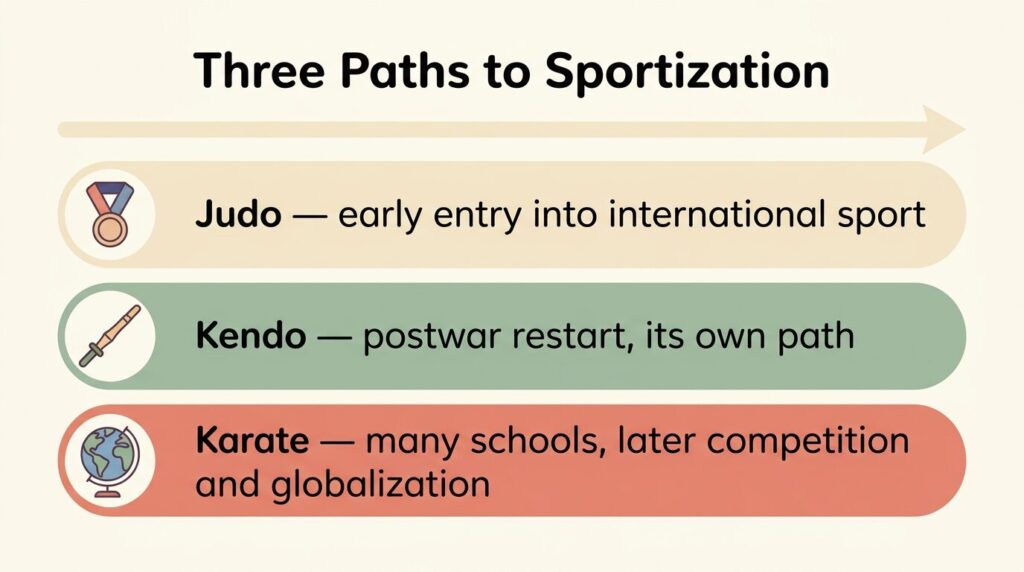
The book also applies the concept of “sportization” — developed in the sport sociology of Eric Dunning and others to describe the process by which playful violence is reorganized into modern sport governed by rules, records, and fairness — to Japanese martial arts. It compares the different ways in which judo, kendo, karate, and others connected with sporting forms. Judo was incorporated relatively early into the institutions of international sport; kendo, after a postwar restart, followed its own path; and karate advanced toward competition and internationalization while carrying the plurality of its many schools. Reading these differences in connection with Japan’s long-term processes of state formation, bodily discipline, and emotional control is the book’s central payoff.
Strengths (our assessment)
First, the book is groundbreaking in bringing “sociological theory as long-term history” to the study of Japanese martial arts. Japanese research on the history of budō has an excellent accumulation of work in the history of individual schools, biographies, and institutions; but long-term historical narratives that genuinely import the theoretical frameworks of Western sociology are not so common. Shun Inoue’s Budō no tanjō (“The Birth of Budō,” Yoshikawa Kōbunkan, 2004) vividly described the “invention of budō” from the Meiji period onward, and his English essay “The Invention of the Martial Arts: Kano Jigoro and Kodokan Judo” (in Stephen Vlastos, ed., Mirror of Modernity, University of California Press, 1998) is widely read — yet a sociological survey covering everything from the Warring States period to the present in a single volume remains rare even in Japanese-language scholarship. Sánchez García cut into that gap with the sharp instrument of Eliasian theory.[4]
Second, the book gently but decisively dismantles, from the side of sociology, the nationalistic claim that “Japanese martial arts can only be understood by Japanese people.” Seen from an Eliasian vantage point, Japanese budō is by no means a unique phenomenon. It is one regional variation of a process — the modern formation of the state and the reorganization of violence — that has been observed universally across human societies. This relativization does not deny the distinctiveness of budō. On the contrary, it holds that a comparative framework is precisely what one needs in order to speak of distinctiveness at all. This can be a healthy stimulus for Japan’s own self-understanding. It is worth adding that the book is not only a study of the history of Japanese budō: it is also an exercise in comparative-historical sociology, comparing the development of combat practices in Japan, England, France, and Germany in order to illuminate the socio-cultural dynamics of state formation.
Third, the handling of sources and prior scholarship is solid. In addition to the work on martial-arts history available in English (the writings of Alexander Bennett, Karl Friday, G. Cameron Hurst, and others), the book carefully gathers up the English-language articles and books of Japanese researchers such as Shun Inoue, Atsushi Yabune, Yoshiaki Tōdō, and Naoki Murata. From its notes and bibliography, one could almost reconstruct a map of the major English-readable literature on Japanese martial arts. This is also a fact that drives home, once again, the importance of Japan-based scholars publishing in English.
Fourth, by winning the Norbert Elias Book Prize, the book secured a place at the intersection of Elias studies and East Asian studies. The prize is awarded to original works strongly inspired by Elias’s work, and the 2020 award to this book may be called a symbolic moment in which the Eliasian school took up the case of Japanese martial-arts history in earnest. To read this book is also to glimpse where Anglophone sociology currently stands.[5]
Fifth, the author’s experience as a coach and instructor breathes life into the abstract theory throughout. Points such as the tension between kata (prearranged forms) and randori (free sparring), the way competition rules rewrite bodily techniques, and the staging and consumption of “Japaneseness” in overseas dojos carry a tactile quality that cannot be derived from texts alone. Although it is a work of sociology, it also rewards practitioners.
Reservations (our assessment)
With the book’s importance in mind, several reservations should also be stated plainly.
First, internal criticism of Eliasian theory itself is by no means minor within recent sociology and history. There is a long-running debate — including among insiders such as John Pratt and Stephen Mennell — over the unidirectional view of progress implied by the word “civilization,” the tendency to take Europe as an implicit standard, and the inclination to reduce qualitative changes in violence to quantitative decline. Because the book adopts a stance of applying Eliasian theory affirmatively, these internal controversies are largely treated as settled premises, which can make the theory’s reach and limits hard to see for newcomers. Japanese readers would do well to read Mennell’s introduction (Norbert Elias: An Introduction) alongside Elias’s own principal works before turning to this book.
Second, the treatment of karate is relatively thin compared with judo and kendo. Judged by the allocation of pages across the book, the most space goes to judo (Kanō Jigorō and the Kōdōkan), followed by kendo (the Dai Nippon Butokukai and the All Japan Kendo Federation). Karate is discussed especially in the context of the postwar proliferation of schools and internationalization, and the move toward competition in the run-up to its adoption at the Tokyo 2020 Olympics; but the book’s engagement with the history of Okinawan karate itself is limited. This is defensible given the book’s stated scope (the historical sociology of Japanese budō), but it leaves something to be desired for researchers focused on karate history. For the Okinawan side of that history, after reading this book one needs to move on to the work of scholars such as Andreas Quast, Patrick McCarthy, and Tōru Kadekaru.
Third, because the book relies heavily on sources and secondary literature circulating in English, there are passages where, in the fine grain of source interpretation, a different reading would be possible if one took into account the nuances of the original Japanese and the accumulated scholarship in Japanese. For instance, in passages dealing with Kanō Jigorō’s statements or with prewar debates inside the Butokukai, the translation of terms and the framing of context can tip the interpretation one way or another. This is less a problem of the author as an individual than a structural constraint shared by Anglophone research on Japanese martial arts as a whole.
Fourth, the problematic of gender is an important theme that the book explicitly addresses, even as it leaves room for further expansion as an independent subject. Routledge’s catalogue description itself notes that the book sheds light on a “gender blind spot,” taking into account the neglected role of women in martial arts. It would therefore be inaccurate to say that the book “does not address it at all.” Still, the work of fully connecting the gendered structures of budō — in its conceptions of the body, its organizational culture, and its competitive institutions — to research on the history of women in budō and on the history of women’s self-defense movements remains a task for the future.
Fifth, because the book was published in 2018, developments from the 2020s onward (budō under the COVID-19 pandemic, the karate competition at Tokyo 2020, and the further globalization of MMA and grappling) fall outside its scope. A revised edition or a sequel would be welcome.
Implications for karate studies in Japan
Even so, there is much to be gained when Japanese karate researchers read this book. Let us organize our own view.
First, the book offers a perspective that relativizes karate history as a part of “the history of Japanese budō.” There is a long-standing tension between the position that treats Okinawan karate history as an independent, distinct history and the position that treats it as a tributary of mainland budō history. Sánchez García discusses karate’s trajectory after its transmission to the mainland (university karate clubs, affiliation with the Butokukai, the postwar splintering into schools, and the turn toward competition) within the same “sportization of budō” frame that he applies to judo and kendo. Not a few researchers on the Okinawan karate side will feel discomfort at this treatment. But that very discomfort is important. Putting that discomfort into words can become an occasion for sharpening the theoretical edge of Okinawan karate-history research.
Second, the book demonstrates a method for treating concepts such as “the spirit of budō,” rei (etiquette/courtesy), and zanshin (sustained awareness after a technique) — concepts that all too easily drift toward essentialism — as products of social processes. This is not a matter of devaluing them, but of historicizing their value. A value that has been historicized does not become fragile; if anything, it becomes stronger, as something that can be chosen again and again. The book gives those who speak of budō’s spirituality a vocabulary with a longer reach.
Third, the book is also practical as a theoretical foothold for discussing karate abroad. In seminars on the sociology of sport in physical-education graduate programs in the English-speaking world, this book is almost always cited when Japanese budō comes up. When Japan-based scholars publish their own research in English, explicitly positioning this book as a critical reference point is a shortcut to placing the discussion on an international footing.
How to read it, and a recommended route
To get the most out of this book, we would suggest the following reading order:
- Read the introduction to grasp the author’s framing of the problem and an overview of Eliasian theory.
- Read the chapters dealing with the Warring States and Edo periods to understand the theoretical grasp of the process by which martial arts were turned into kata and infused with spirituality.
- Read the chapters on the Meiji and Taishō periods alongside Shun Inoue’s Budō no tanjō and Shoji Yamada’s Zen to iu na no Nihon-maru (English translation: Shots in the Dark). Note that the three works treat roughly the same period yet place the emphasis of their conclusions differently.[6]
- Connect the chapters on the postwar and contemporary period with recent research on the internationalization of judo and on the Tokyo 2020 Games.
- After reading the final chapter, move on to the co-edited volume Fighting Scholars and set the book against fieldwork from around the world.
Readers who feel unsure about Eliasian theory itself will find the book’s argument coming into three-dimensional view if they keep Mennell’s introduction, or a Japanese translation of Elias’s own The Civilizing Process (vols. I and II; Japanese edition from Hosei University Press), close at hand.[7]
Conclusion
Sánchez García’s book is an earnest attempt to bring an outside theoretical perspective to bear on a long tradition that has spoken of Japanese budō “from the inside.” The application of Eliasian theory is not always successful, and the treatment of karate is not free of dissatisfaction. Even so, to read this book, to criticize it, and to respond to it is a sure step toward pushing the study of Japanese budō open — from an “in-house inheritance” toward “a discipline open to the world.”
It would be a shame for Japanese martial-arts researchers to ignore a book that has earned the imprimatur of European sociology in the form of the Norbert Elias Book Prize. Whether one agrees or objects, the place to begin is a close reading. In the basic discipline of scholarship — answering theory with theory and sources with sources — this book is a thoroughly worthwhile opponent.
References
- Raúl Sánchez García, The Historical Sociology of Japanese Martial Arts, Routledge, 2018 (Norbert Elias Book Prize 2020): https://www.taylorfrancis.com/books/mono/10.4324/9780203702574/historical-sociology-japanese-martial-arts-raul-sanchez-garcia
- Routledge catalogue (paperback edition): https://www.routledge.com/The-Historical-Sociology-of-Japanese-Martial-Arts/SanchezGarcia/p/book/9780367499266
- Raúl Sánchez García & Dale C. Spencer (eds.), Fighting Scholars: Habitus and Ethnographies of Martial Arts and Combat Sports, Anthem Press, 2013: https://anthempress.com/fighting-scholars-pb
- Norbert Elias Foundation (Book Prize): https://norbert-elias.com/norbert-elias-foundation/prize/
- Norbert Elias Book Prize 2020 announcement: https://norbert-elias.com/the-norbert-elias-book-prize-2020-3/
- Stephen Vlastos (ed.), Mirror of Modernity: Invented Traditions of Modern Japan, University of California Press, 1998: https://www.ucpress.edu/book/9780520206373/mirror-of-modernity
- Shoji Yamada, Shots in the Dark: Japan, Zen, and the West, University of Chicago Press, 2009: https://press.uchicago.edu/ucp/books/book/chicago/S/bo6512379.html
- Norbert Elias, The Civilizing Process (Japanese edition, vols. I & II), Hosei University Press: https://www.h-up.com/book/9784588007392.html
- Martial Arts Studies (Cardiff University Press, related journal): https://mas.cardiffuniversitypress.org/
Last updated: 25 June 2026 / Edited by the mejiro.info editorial team