

🌐About this English edition
This article is an English translation of a piece originally written in Japanese, for a Japanese readership — chiefly karate practitioners, instructors, and research-minded readers in Japan. The original assumes a degree of familiarity with Japanese and Okinawan history and with Japanese martial-arts vocabulary, and it argues throughout from the vantage point of what the Japanese karate world stands to gain by reading scholarship produced overseas. In this English edition, brief explanatory notes and supplements have been added wherever a phrase or reference might be unclear to readers outside the Japanese-speaking world, and romanized Japanese terms are glossed on first use. The standpoint and the conclusions of the original have been preserved.
Lead
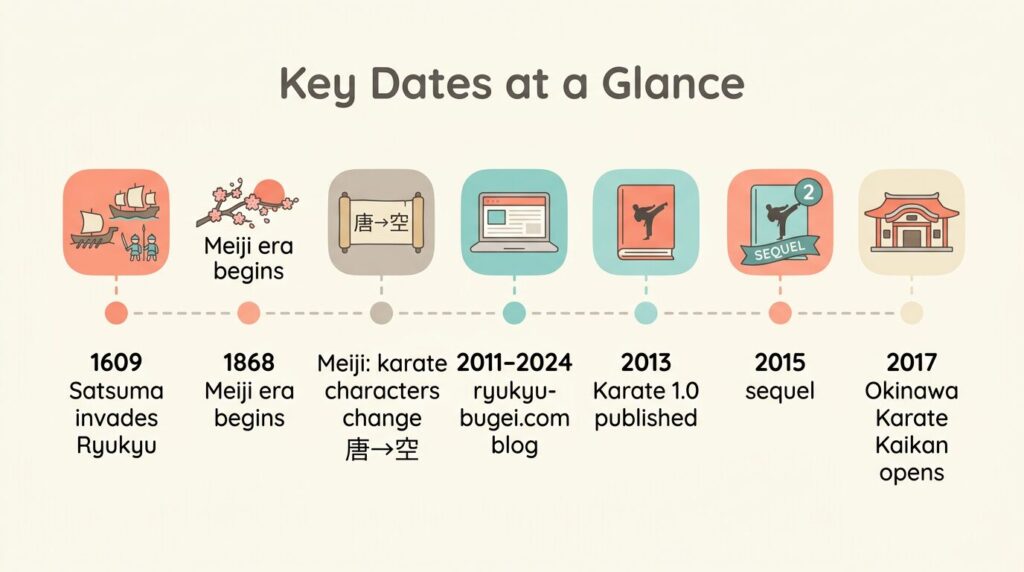
Anyone who begins to follow the history of karate in earnest will, sooner or later, collide with the name of the German researcher Andreas Quast. His Karate 1.0: Parameter of an Ancient Martial Art, self-published in 2013, is among the most ambitious source-driven works on karate history ever written in English — 27 pages of front matter and 502 pages of main text, some 529 pages in all. The book did not issue from an academic publisher, nor has it been peer-reviewed. And yet it has become one of the de facto reference points cited by researchers and enthusiasts in Europe and the Americas whenever karate history is discussed. How did that come about? And now, when excellent karate-history scholarship written in Japanese (the work of Kadekaru Tōru, Takamiyagi Shigeru, Nakamoto Masahiro, Hokama Tetsuhiro, and others) has steadily accumulated, what is the value of a Japanese researcher deliberately reading Quast? This article sets out — with my own assessments interwoven — the achievements and the limits of the book, and considers how it ought to be positioned within Japanese karate studies.[1]
The Author and Where He Stands
Andreas Quast is an independent, non-academic researcher based in Germany who has long studied and disseminated the martial arts of the Ryūkyū Islands. The bibliographic information at the time of the 2013 printing gives Düsseldorf as the place of publication. His principal profession lies in technical translation and technical writing; he does not hold a university post. A practitioner of karate and kobudō (kobudō = the older Okinawan weapons arts, such as those of the bō staff and sai truncheon) himself, from 2011 to 2024 he ran the English-language blog ryukyu-bugei.com. By his own 2025 reckoning, over those thirteen-odd years he accumulated more than 900 translations of primary sources and essays. The book appeared at roughly the midpoint of that activity.[2]
The first thing to grasp is that Quast confronts karate history as “a third party who is neither Japanese, nor Okinawan, nor Chinese.” Karate discourse since the Meiji era (the period beginning in 1868, when Japan embarked on rapid modernization as a nation-state) has been inseparably entangled with several competing narratives — Okinawan regional identity, the “nationalization” of the martial arts on the Japanese mainland, and the postwar identity-politics of the individual karate styles. Being an insider eases access to the sources, but it also lends a particular slant to interpretation. Quast stands outside all of this and approaches Ryūkyū and karate with the methods of Asian and Oriental studies as developed in the German-speaking academic world. This sense of distance, in my view, produces both the strengths and the weaknesses of the book.
The Structure and Method of the Book
With its 27 pages of front matter and 502 pages of text, Karate 1.0 is a massive volume. True to its subtitle, Parameter of an Ancient Martial Art, it dissects the elements that make up karate and Ryukyuan martial arts one by one, treating each as a “parameter” and laying out the relevant sources for it — an essentially encyclopedic, catalogue-like structure. The first half organizes the environment surrounding Ryūkyū (geography, history, religion, social structure); the middle traces the history of contact with Chinese martial arts, the place of the martial under Satsuma rule (Satsuma being the powerful southern-Kyūshū domain that brought Ryūkyū under its control after its 1609 invasion), and the process by which karate was carried to the Japanese mainland from the Meiji era onward; the latter half moves into specific topics such as kata (the set forms of movement), implements, bodily technique, and lines of transmission.[3]
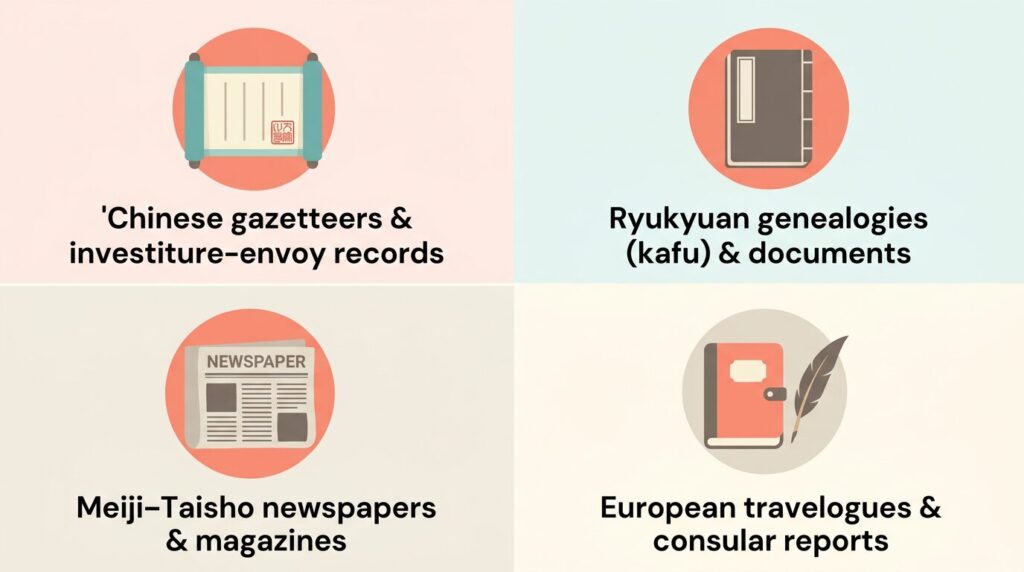
What is methodologically striking is its cross-cutting use of four kinds of sources of differing character: (1) Chinese local gazetteers and the records of the Chinese investiture envoys (sappōshi — the embassies China sent to formally invest the Ryukyuan king); (2) the household genealogies (kafu — the official genealogical registers kept by Ryukyuan samurai families) and public documents of the Ryūkyū side; (3) newspapers and magazines from the Japanese mainland and from Okinawa in the Meiji and Taishō periods (the Taishō era running 1912–1926); and (4) European-language travelogues and consular reports. Quotations are given close to their original languages (classical Chinese, Old Ryukyuan, modern Japanese, English, German, French), and the notes are comparatively careful. Though it has not been peer-reviewed, its handling of sources approaches the manner of an academic monograph.
Another feature of the book is the rhythm of its frequently inserted long quotations and the plain commentary that frames them. The posture of letting the sources speak for themselves is maintained throughout, rather than any flourish of readable prose. This is the polar opposite of the essayistic, popular karate-history books of the English-speaking world (such as the essay-style writing of Michael Clarke).
Points of Merit
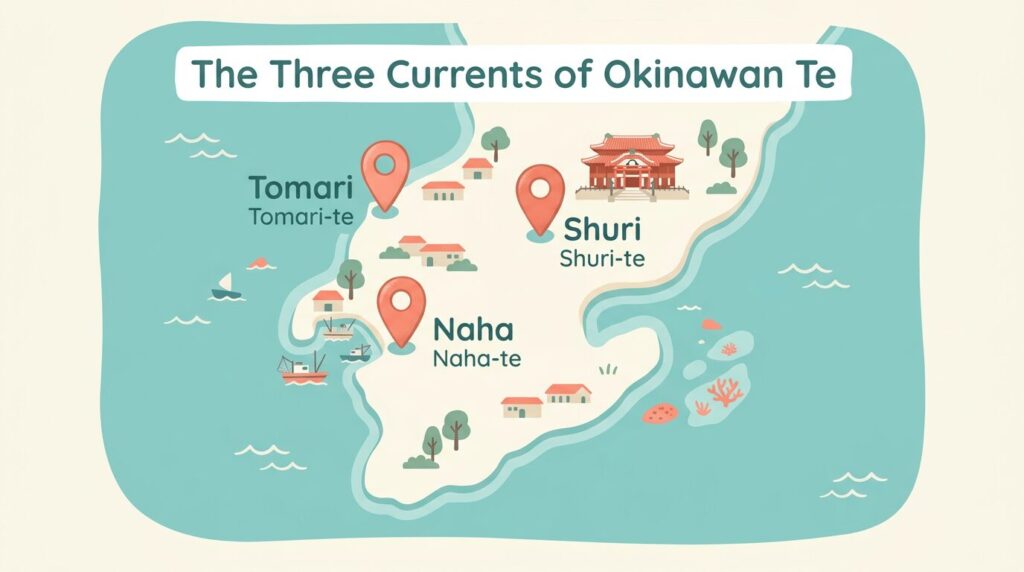
First, the book’s attempt to dismantle the “mythologized” accounts of karate history at the level of the sources is significant. The story tying the origins of Okinawan karate directly to the Shaolin Temple in China; the narrative that deifies a particular individual as “the creator of a kata”; the “three-lineage” discourse of Shuri-te, Naha-te, and Tomari-te (the three regional currents of Okinawan te — the indigenous fighting art that became karate — named after the towns of Shuri, Naha, and Tomari) as organized in the modern period — Quast tests each carefully against individual sources. He swings to neither extreme of denial nor affirmation, accumulating instead restrained conclusions of the form “from this source, we can say only this much.” This methodological asceticism is a virtue that tends to be lost in popular Japanese-language books.[4]
Second, there is the achievement of systematically re-cataloguing the body of karate- and Ryūkyū-related literature written in European languages. The book’s bibliography functions, in itself, as a stand-alone research guide. As a first map for the Japanese researcher reaching toward secondary literature in German, French, or Spanish, there is at present almost nothing to rival it — or so it seems to me.
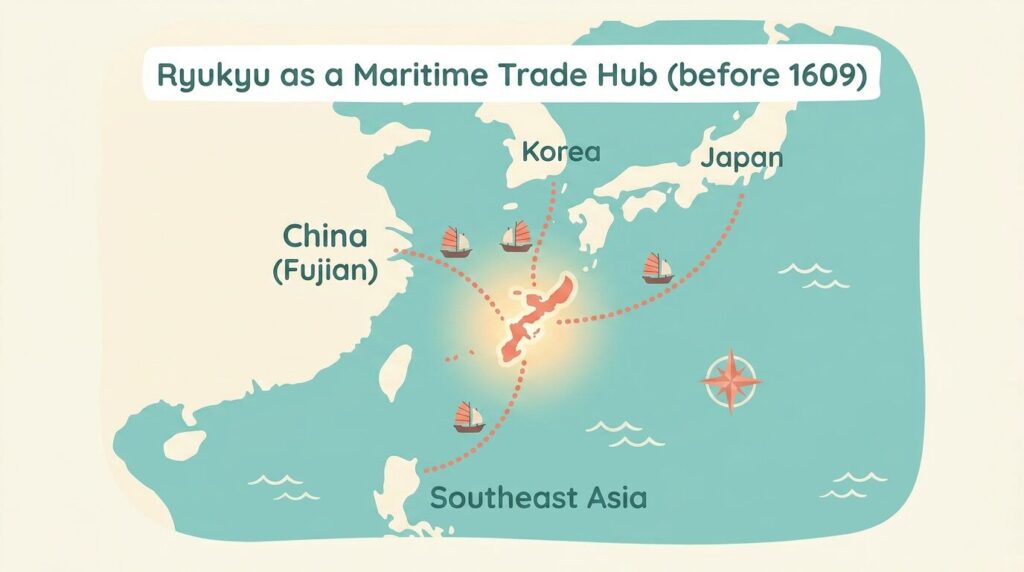
Third, the book consistently maintains the perspective of re-situating Ryūkyū within the maritime world of East Asia, rather than as a periphery of Japanese history. Pre-1609 Ryūkyū was an entrepôt trading state linked with China, Korea, and Southeast Asia. The angle of vision that treats te, the matrix of karate, as a composite bodily technique formed within this maritime network resonates with Gregory Smits’s Maritime Ryukyu (University of Hawai‘i Press; hardback 2018, paperback 2020), and offers an alternative to mainland-centered narratives of martial-arts history.[5]
Fourth, the book strongly impresses on the reader the distinction between tradition (transmitted lore) and source. Consider traditions such as “Matsumura Sōkon learned Jigen-ryū swordsmanship in Satsuma” or “Higaonna Kanryō studied under Ryū Ryū Ko in Fuzhou.” (Matsumura Sōkon was a legendary nineteenth-century Okinawan martial artist; Jigen-ryū, a school of swordsmanship of the Satsuma domain; Higaonna Kanryō, a foundational figure of Naha-te; Fuzhou, a port city in Fujian, China; Ryū Ryū Ko, the semi-legendary Chinese master said to have taught him.) Without rejecting such traditions outright, Quast checks, one by one, whether contemporaneous sources support them. As a result, the reader is forced to reconsider just how much of the karate history they had believed rests on “facts backed by contemporaneous sources” and how much depends on “the recollections of later disciples” or “postwar compilations.” This is hardly a comfortable experience for the reader, but as a starting point for research it is the right kind of discomfort.
Points of Reservation
On the other hand, the book has weaknesses that cannot be overlooked.
The first stems from its mode of publication. Karate 1.0 was issued not by an academic publisher but by the author himself. With no peer review and only limited editorial restructuring, the chapter organization is not always logically optimized, and the same point is sometimes repeated in several places. The index, too, is incomplete. The reader must be prepared to build an index of their own as they go.
Second, there is the matter of the English prose. The author is not a native speaker of English, and German-inflected syntax and over-literal phrasing remain here and there. Difficult passages can often be supplemented by turning to the short translations and commentaries accumulated on ryukyu-bugei.com. I would recommend consulting the individual blog posts as appropriate while reading the book.
Third, some of the source interpretation contains inferences pushed a step too far. In the discussion of the origins of certain kata names, or of the martial education of the Ryukyuan gentry class, there are places where — even with hedges such as “it is suggested” or “it is thought” — the underlying sources are thin. The reader must constantly keep in mind, as they read, “on what source does this statement rest?” Ironically, this is the very attitude the author himself demands of others.
Fourth, the book has not adequately incorporated the karate scholarship of Okinawa and the mainland from the twenty-first century onward — in particular the empirical research and source-organization that have advanced in Japanese (Kadekaru Tōru’s doctoral dissertation; the exhibitions, video records, and outreach programs that have progressed since the opening of the Okinawa Karate Kaikan, the prefectural Karate Hall that opened in Okinawa in 2017). Given the year of publication (2013), this is partly unavoidable, but anyone reading the book today must read it in tandem with the latest Japanese-language research. The sequel, A Stroll Along Ryukyu Martial Arts History (2015), is, by the author’s own account, closer to a condensed version of Karate 1.0 than to a substantially revised edition.[6]
Fifth, the book’s reach is heavily weighted toward “history” and “documents,” and its analysis of bodily technique itself is surprisingly thin. Topics of keen interest to practitioners — kata bunkai (the analysis and combative application of the movements contained in a kata), footwork, the mechanics of striking — are scarcely treated. This is less a defect than a question of the division of labor; it must be supplemented by a different body of literature (such as the sports-science research discussed below).
What the Book Means for Karate Research in Japan
With all this in mind, let me set out what it means for a Japanese karate researcher to pick up this book.
To begin with, merely learning how closely a serious foreign researcher has engaged the primary sources of Okinawa and Japan will reliably broaden one’s horizons. In the Japanese-speaking world there is a stubborn preconception that “a karate history written by a foreigner must be superficial.” In fact Quast works his way into the Naha City History, the Okinawa Prefectural History, the Ryukyuan household genealogies, and the Meiji-era Okinawan press. To dismiss the book unread is one thing; to criticize it after reading is quite another, and the quality of the resulting argument differs entirely.
Next, the book makes visible, from an external vantage point, the tension between the discourse of “Japanese budō” and that of “Okinawan karate.” On the process by which karate, written with the character for “Tang/China” (kara 唐, i.e. “Chinese hand”), was rewritten as karate with the character for “empty” (kara 空, i.e. “empty hand”) within the current of the mainland’s nationalization of the martial arts, Quast — not being a party to it — often writes more coolly than Japanese researchers, and is the more suggestive for it. Read alongside mainland budō-history scholarship (Inoue Shun, Alexander Bennett, Yamada Shōji, and others), it brings into three-dimensional relief the reorganization of “the martial” from the Meiji era onward.
Furthermore, the book’s value as a bibliography is exceptionally high. Following the leads of its notes and reference list to the work of Wojciech Cynarski (Poland), Raúl Sánchez García (Spain), and Bowman & Judkins (Britain and the United States), the terrain of the new academic field known as Martial Arts Studies comes into view. In this sense the book functions as a “gateway” to the overseas academic world of martial-arts studies.[7]
And as a practical matter, there is the advantage of acquiring a “common reference point” for discussing karate history in English. One becomes able to frame an argument for foreign readers and students of the form, “Quast states this, but corrected against the Japanese-side primary sources it can be adjusted thus.” For anyone who would speak about karate internationally, this is no small weapon.
Highlights and a Suggested Reading Route
Reading the book through is no easy task. As the present writer, I would propose the following order of approach.
- First, read the introductory chapter and the chapters dealing with methodology, to grasp the author’s guiding questions and his view of the sources.
- Then read selectively in the chapters corresponding to the themes that most interest you (Ryūkyū–China relations, Satsuma rule, the process of transmission to the mainland, and so on).
- Write out the list of cited sources for the relevant chapter, and, as far as possible, go back to the Japanese-language originals (the Ryukyuan household genealogies, the Okinawa Prefectural History, relevant municipal histories) to check them for yourself.
- Read the related posts on ryukyu-bugei.com to confirm the points on which Quast himself has revised or supplemented his account since the book’s publication.
- Use the sequel, A Stroll Along Ryukyu Martial Arts History, to re-grasp the whole picture as a connected narrative summary, with the footnotes and inferences pared away.
Followed in this order, you can preserve the pleasure of touching the sources themselves before the difficulty of the English overwhelms you. Rather than aiming to read the whole book, the right approach is to treat it as “an encyclopedia to keep permanently at the side of your own research.”
In Closing
Karate 1.0 is not a perfect book. Even so, the reason it continues to occupy an important place in karate-history research is that its author, an independent scholar, has practiced over many years the basic discipline of research: “present the source, make your inference explicit, and leave it open to others’ verification.”
Japanese karate research is unrivaled by Europe or the Americas in the whereabouts and the sheer volume of its sources. And yet, without critical reading from an external vantage point, it cannot escape the danger of resting easy within its own in-group narratives. The very act of reading Quast’s work critically should raise the quality of Japanese-side research.
To cast the book aside as “a foreigner’s superficial overview,” or conversely to enshrine it uncritically as “the definitive work,” both miss its true contribution. Calm, critical reading is itself the greatest respect one can pay to the author, Andreas Quast.
Reference URLs
- Andreas Quast, Karate 1.0: Parameter of an Ancient Martial Art (Düsseldorf, 2013): https://ryukyu-bugei.com/?p=1413
- Andreas Quast, A Stroll Along Ryukyu Martial Arts History (CreateSpace Independent Publishing Platform, 2015): https://ryukyu-bugei.com/?p=4332
- ryukyu-bugei.com (the author’s blog): https://ryukyu-bugei.com/
- Andreas Quast, “Ryukyu Bugei’s Impact Statement” (July 16, 2025): https://ryukyu-bugei.com/?p=11842
- Gregory Smits, Maritime Ryukyu, 1050–1650, University of Hawai‘i Press, hardback 2018 / paperback 2020: https://uhpress.hawaii.edu/title/maritime-ryukyu-1050-1650/
- Martial Arts Studies (Cardiff University Press): https://mas.cardiffuniversitypress.org/
Last updated: June 16, 2026 / Edited by the mejiro.info editorial desk