
🌐About this English edition
This article is an English translation of a piece originally written in Japanese for a Japanese readership — chiefly karate practitioners, instructors, and research-minded readers in Japan. The original assumes a degree of familiarity with Japanese and Okinawan history and with Japanese martial-arts vocabulary. In this English edition, brief explanatory notes and supplements have been added wherever a phrase or reference might be unclear to readers outside the Japanese-speaking world, and romanized Japanese terms are glossed on first use. The vantage point throughout remains that of the original: it asks what the Japanese karate world stands to gain by reading scholarship produced overseas.
Introduction — Why Turn to Foreign-Language Karate and Budō Literature Now?
There is no shortage of Japanese-language writing on the history and philosophy of karate. The autobiographies, technical manuals, and memoirs left by the “founding fathers of modern karate” — Funakoshi Gichin, Mabuni Kenwa, Ōtsuka Hironori, Higaonna Kanryō, and Miyagi Chōjun — together with the commentaries written by their students and grand-students, have unquestionably formed the bedrock of karate scholarship in Japan. (These figures are associated with the founding or shaping of major styles such as Shōtōkan, Shitō-ryū, Wadō-ryū, and Gōjū-ryū.)
And yet Japanese karate research still carries certain distinctive blind spots. First, much of the writing narrates the internal transmission history of each style in the in-group’s own idiom, without fully connecting to the methods of academic history, sociology, or sports science developed outside that world. Second, how foreign scholars have portrayed the “world history” of karate — a movement that spread from Okinawa to mainland Japan and then across the globe — rarely reaches Japanese-language readers. Third, the recent international current of scholarship that relativizes modern budō (Japanese martial ways) as a whole as an “invented tradition” has not yet been fully digested within Japan.
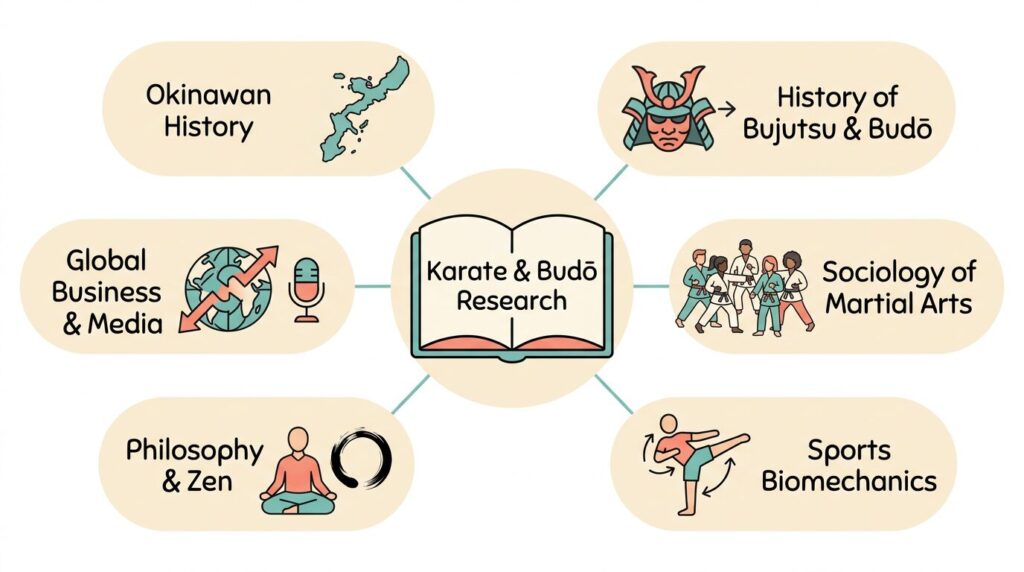
Taking these circumstances as its starting point, this article introduces — as comprehensively as space allows — the foreign-language books and academic papers that Japanese karate researchers, enthusiasts, and instructors would do well to pick up. It looks beyond works that treat karate directly, casting a wide net over the surrounding fields: Okinawan history, the history of bujutsu (martial techniques) and budō, the sociology of martial arts, sports biomechanics, critiques of “Eastern philosophy,” and studies of the image of the samurai. Because it ranges across genres, each individual comment here is no more than an entry point. I hope it will be read as a “map” — something to send you back to the primary sources so you can verify them with your own hands.
⚠️Notes and caveats
- For bibliographic details (title, author, publisher, year), I have given priority to the official information provided by each book’s publisher or the relevant university press.
- Where a Japanese translation of a work exists, I have noted it wherever possible. However, the availability of a translation reflects the situation at the time of writing; newer editions or translations by other publishers may have appeared since.
- Because the assessment of foreign scholarship is continually being updated within the field, the introductions here are no more than “a provisional map as of 2026.” There is no intention to claim that “what is written here is the truth.”
- For works I could not consult directly and had to rely on at second hand, I have either said so explicitly or refrained from introducing them.
- All URLs and references are gathered at the end of the article.
Chapter 1. The Landscape of Martial Arts Research Abroad — The New Field of “Martial Arts Studies”
Research that treats karate, jūdō, kendō, and aikidō together as a single, cross-cutting object of study had already been accumulating before the 2010s, within individual society journals, study groups, and regional networks. What was lacking, however, was a clear hub to bind them together internationally and across disciplines. That situation changed dramatically in the 2010s.
Paul Bowman of Cardiff University, together with Benjamin N. Judkins — a scholar who earned his doctorate in political science at Columbia University — founded the peer-reviewed academic journal Martial Arts Studies in 2015. Published by Cardiff University Press, it is an online, open-access journal that now follows a “Diamond Open Access” policy, charging neither readers nor authors. It publishes work on martial arts and combat sports regardless of discipline — sociology, history, media studies, philosophy, sports science, anthropology — and in 2025 it marked its tenth anniversary. It is fair to say that it has established itself as the “hub” of martial arts research in the English-speaking world.
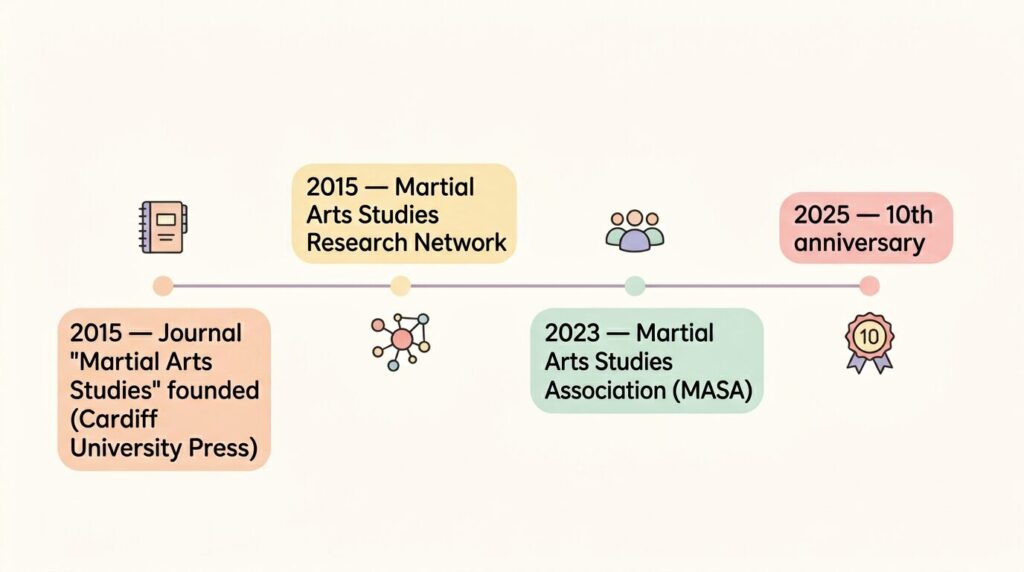
In parallel, the Martial Arts Studies Research Network has also been active since 2015, continually hosting international conferences and research events. In 2023 the Martial Arts Studies Association (MASA) was formally launched, institutionalizing this work by taking over the network’s activities. Papers dealing with Japanese budō appear here too: for example, Yasuhiro Sakaue’s “The Historical Creation of Kendo’s Self-Image from 1895 to 1942: A Critical Analysis of an Invented Tradition” (2018) is an important study that analyzes modern kendo’s self-image through the lens of “invented tradition.”
Knowing that this field exists carries two practical benefits.
- You can read peer-reviewed papers close to your own research theme, free of charge.
- If you write a paper yourself, the journal becomes a realistic venue for submission. For Japanese budō researchers, it is one of the most open windows onto the international stage.
I recommend starting at the official site (mas.cardiffuniversitypress.org) and browsing the latest and back issues. Pick a single paper you want to read, follow its reference list, and the terrain of overseas martial arts research will gradually come into view.
Chapter 2. Essential Works Dealing Directly with Karate and Okinawa
This chapter takes up foreign-language works whose principal subject is karate itself, from introductory books to heavyweight historical studies.
2-1. Patrick McCarthy, Bubishi: The Classic Manual of Combat
- Bibliographic information: Patrick McCarthy (trans. and annotated), Bubishi: The Classic Manual of Combat, Tuttle Publishing; first edition 1995, expanded new edition 2016.
- About the author: Patrick McCarthy (b. 1954) is a Canadian-born karate researcher resident in Australia. As director of the International Ryukyu Karate Research Society (IRKRS), he has long pursued comparative research on prewar Okinawan and Chinese martial arts. He is said to have spent more than a decade traveling to Okinawa and Fujian to write this book, gathering documents and conducting interviews.
- Overview: The Bubishi is an old manuscript reportedly called the “bible of karate” by Miyagi Chōjun, founder of Gōjū-ryū. (Note for non-Japanese readers: this karate Bubishi is a distinct text from the famous Ming-dynasty Chinese military encyclopedia written with the same characters; it is a hand-copied compendium transmitted privately among masters.) It records the techniques, vital points, herbal remedies, and strategy of southern Chinese boxing, and was handed down as a secret text by the masters of pre-modern Okinawan te (the indigenous fighting art that became karate). McCarthy collated several manuscript lineages and added an English translation, annotations, and historical commentary, ranging across the textual genealogy of the manuscripts, analysis of the techniques in the illustrations, and a medical-history reading of the herbal and vital-point sections.
- Why it matters for Japanese researchers: The Bubishi itself has been set into print in Japan in the versions associated with Funakoshi Gichin and Mabuni Kenwa, but few works rival McCarthy’s in sorting out the differences among manuscripts and explaining the text to English readers while connecting it to Chinese martial-arts history. It is valuable both as a comparative reference when handling the Bubishi in Japan and as a model for the translator’s task of “how to narrate, in English, the crossing point of Okinawan te and southern Chinese boxing.”
- A note of caution: Some passages on the transmission route of the original manuscripts include conjecture, so they should not be cited as settled fact.
2-2. Andreas Quast, Karate 1.0: Parameter of an Ancient Martial Art
- Bibliographic information: Andreas Quast, Karate 1.0: Parameter of an Ancient Martial Art, 2013, published by Andreas Quast (self-published / independent distribution). Related works include A Stroll Along Ryukyu Martial Arts History (2015) and titles on Okinawan kobudō (old weapons arts).
- About the author: Andreas Quast is a German-born independent researcher. In 1999 he made a research-and-training trip to Japan and Okinawa, and has since pursued historical research alongside his practice of Okinawan karate and kobudō. For many years he has published his findings on the website Ryukyu-bugei.com.
- Overview: Karate 1.0 is a massive work of over 500 pages that reconstructs the prehistory of karate while taking in the social structure of the Ryūkyū Kingdom, its samurai (shizoku) class system, its diplomatic history with China and with the Satsuma domain, its tribute system, the martial education of the gentry, and the geographic and social contexts of Shuri, Naha, and Tomari. As the author’s work is sometimes described as “encyclopedic,” the writing is thoroughly source- and evidence-driven.
- Why it matters for Japanese researchers: Much of the karate history circulating in Japan tilts toward genealogies of modern styles. This book instead verifies, one by one, the social, institutional, and geographic conditions under which Okinawan te could come into being, squarely confronting the question of “when, where, by people of what status, and for what purpose martial arts could be maintained.” It is regrettable that no Japanese edition has appeared, but even readers uneasy with English can find footholds into the primary sources simply by working through the chapter structure and notes.
- A note of caution: Some dismiss the book on the grounds that it is self-published and that the author does not belong to institutional academia. Yet judging by the breadth and precision of the primary sources cited, it deserves to be counted among the essential works of karate history.
2-3. Mark Bishop, Okinawan Karate: Teachers, Styles, and Secret Techniques
- Bibliographic information: Mark Bishop, Okinawan Karate: Teachers, Styles, and Secret Techniques; first edition A&C Black, 1989; new edition Tuttle Publishing, 1999.
- About the author: Mark Bishop is an English karateka who lived in Okinawa for an extended period from the 1970s. He studied directly under elders and masters of various Okinawan schools and placed the resulting interview records at the heart of the book.
- Overview: Centered on interviews with the practitioners themselves, the book sets out the lineages and training content of Okinawa’s principal schools — Gōjū-ryū, Uechi-ryū, Matsubayashi-ryū, Shōrin-ryū, Motobu Udundī, Okinawa Kenpō, and others. Its documentary value lies in preserving the living voices of masters who were already elderly at the time of writing, and in recording the human relationships of the prewar Okinawan karate world from an insider’s vantage point.
- Why it matters for Japanese researchers: This is less an academic monograph than something close to an “oral history.” That is precisely why it has primary-source value when reconstructing the social history of modern Okinawan karate. The fact that the testimony of masters who have since passed away survives in English is suggestive even for readers who work only in Japanese. When citing it, one should remain conscious of Bishop’s standpoint as interviewer and the biases of memory.
2-4. Michael Rosenbaum, Kata and the Transmission of Knowledge in Traditional Martial Arts
- Bibliographic information: Michael Rosenbaum, Kata and the Transmission of Knowledge: In Traditional Martial Arts, YMAA Publication Center, 2004. The same author also wrote Okinawa’s Complete Karate System: Isshin Ryu (2001).
- About the author: Michael Rosenbaum is an American karate practitioner and author. YMAA’s author information introduces him as a third-degree black belt (3rd dan) in Isshin-ryū who has trained in that style for many years. He has published essays that reconsider kata (set forms) as a vehicle of oral culture and bodily technique.
- Overview: The book positions kata as “a folk-dance-like medium of oral knowledge” and asks what was lost in the process of adapting it to modern education. The historical discussion is somewhat introductory, but it offers even beginners an accessible way into the idea that “the body is a device for carrying memory.”
- Significance: It is useful as an entry point for beginning a methodological discussion of kata practice. In Japan, kata tends to be reduced to “an object of demonstration” or “an object of grading”; this is an easy read for relativizing that assumption.
2-5. Other Foreign-Language Books on Karate
Beyond the above, quality work by independent researchers continues to grow — for example, Christopher M. Clarke’s Okinawan Karate: A History of Styles and Masters (CreateSpace Independent Publishing Platform, two volumes, 2012; Vol. 1: Shuri-te and Shorin-ryu, Vol. 2: Fujian Antecedents, Naha-te, Goju-ryu, and Other Styles), and the Okinawan karate-history research of Charles C. Goodin. The Hawaii Karate Museum founded by Goodin, and its collection, are a precious body of material for thinking about the transmission of Okinawan karate by way of prewar immigrants to Hawai‘i.
Chapter 3. Classic Studies in the History of Bujutsu and Budō
From here we turn to foreign classics that, while not treating karate directly, are unavoidable for understanding the historical formation of “bujutsu” and “budō.” In karate-history research, whether or not you hold a map of modern Japanese martial culture as a whole makes an enormous difference to the reach of your argument.
3-1. Donn F. Draeger, the Martial Arts Trilogy
- Bibliographic information: Donn F. Draeger, Classical Bujutsu, Classical Budo, and Modern Bujutsu & Budo, Weatherhill, 1973–1974. All three volumes were published as part of The Martial Arts and Ways of Japan series.
- About the author: Donn F. Draeger (1922–1982) was a former U.S. Marine who lived for many years in postwar Japan and trained in jūdō, kendō, iaidō, and classical jūjutsu. He is known for his major contribution to the development of “hoplology” (the comparative anthropology of weapons and combative behavior).
- Overview: The trilogy surveys Japan’s martial arts by sorting them into three stages: the older combative arts (classical bujutsu), their development as a “way” (classical budō), and modernized martial arts and ways (modern bujutsu & budō).
- Significance and limits: This is the work that announced the beginning of martial arts studies in the English-speaking world, and later researchers invariably take it as a point of departure. By present-day scholarly standards, however, its weak source criticism and its tendency to over-essentialize a “Japanese spirituality” have been criticized (see the arguments of Bowman and Sixt Wetzler, discussed later). For karate history too, it retains citation value, but when used as a source it should be read alongside more recent critical scholarship.
3-2. G. Cameron Hurst III, Armed Martial Arts of Japan: Swordsmanship and Archery
- Bibliographic information: G. Cameron Hurst III, Armed Martial Arts of Japan: Swordsmanship and Archery, Yale University Press, 1998 (paperback 2005).
- About the author: G. Cameron Hurst III (c. 1941–2016) was a historian specializing in Japanese and Korean history who taught at the University of Pennsylvania and elsewhere. He was known for studies of late-Heian political history, including Insei: Abdicated Sovereigns in the Politics of Late Heian Japan.
- Overview: Using swordsmanship and archery as its material, the book traces how battlefield techniques came to be organized into “schools” (ryūha), systematized as early-modern martial arts, and transformed into modern sports. Its scope runs from the early-modern debates surrounding the Yagyū family, to the institutionalization of kyūdō and kendō in the Meiji era, to postwar internationalization.
- Significance: As one of the very few martial-arts histories written as orthodox academic scholarship in the field of Japanese medieval history, it is regarded as a monumental work in which a mainstream Japanese-history specialist took up the martial arts. Karate is not treated directly, but the larger map it offers — that in Japan, “the martial” has been reinvented again and again — serves as a coordinate axis for thinking about karate history.
3-3. Karl F. Friday, Legacies of the Sword, Hired Swords, and Others
- Bibliographic information: Karl F. Friday with Seki Humitake, Legacies of the Sword: The Kashima-Shinryū and Samurai Martial Culture, University of Hawai‘i Press, 1997. Also Karl F. Friday, Hired Swords: The Rise of Private Warrior Power in Early Japan, Stanford University Press, 1992.
- About the author: Karl F. Friday is a historian specializing in medieval Japan and the history of the warrior class, who has taught at the University of Georgia and at Saitama University. His collaborative research with the master Seki Humitake is a rare endeavor that combines participant observation with documentary history.
- Overview: Legacies of the Sword takes the Kashima-Shinryū — a living classical school — as its field, analyzing from both documentary sources and training experience how the school was historically formed and how it functioned as a system of physical, spiritual, and moral education. Hired Swords is an orthodox study of medieval Japanese history dealing with the rise of private military power in the late Heian period.
- Significance: Friday fundamentally re-examines, on the basis of sources, the popular Japanese understanding of budō — asking, for instance, “Did warriors really use the sword as their primary weapon?” and “Where did the spirituality of budō come from?” For karate researchers too, this is suggestive when comparing the theme of “bodily techniques and thought transmitted through forms.” Several Japanese-language interviews with him are also available, making him an author who is easy to approach even for those uneasy with English.
Chapter 4. The “Invention” of Budō and Its Critical Study
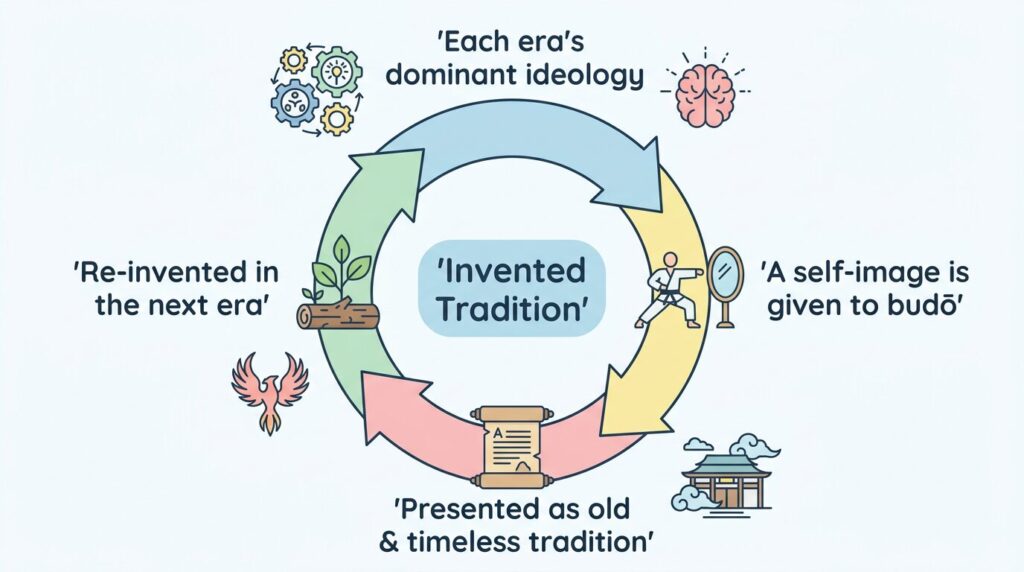
One of the most important turns in the study of modern Japanese budō has been a body of work applying the “invention of tradition” thesis of Eric Hobsbawm and others to the martial arts.
4-1. Inoue Shun’s “The Invention of the Martial Arts” and Its International Reach
Inoue Shun’s Budō no tanjō (“The Birth of Budō,” Yoshikawa Kōbunkan, 2004) is a work aimed at a Japanese readership, but preceding it, his English-language article “The Invention of the Martial Arts: Kano Jigoro and Kodokan Judo” was included in Mirror of Modernity: Invented Traditions of Modern Japan, edited by Stephen Vlastos (University of California Press, 1998). Through this, Inoue’s argument became an important reference point in English-language sociology and sports history. (Note: the Japanese book’s title uses the word “birth,” while the English essay uses the word “invention”; the two are closely related but distinct pieces of writing.)
Inoue’s claim, in a sentence, is that “budō” such as jūdō, kendō, and karate is a modern national body-culture “invented” in parallel with the formation of the nation-state from the Meiji era onward, with Kanō Jigorō’s Kōdōkan jūdō as the model case. (Kanō Jigorō was the founder of jūdō; the Kōdōkan is the institution he established.) For Japanese karate researchers, the significance of this argument is that it lends sociological vocabulary and an international context to the hypothesis that “karate, too, brought from Okinawa to the mainland, imitated the modernization model of Kōdōkan jūdō and was reorganized within the framework of school education and imperial body-culture.”
4-2. Alexander Bennett, Kendo: Culture of the Sword
- Bibliographic information: Alexander C. Bennett, Kendo: Culture of the Sword, University of California Press, 2015. As author and translator he has also produced Hagakure: The Secret Wisdom of the Samurai (2014), Bushido and the Art of Living (2017), Bushido Explained (2019), and many more.
- About the author: Alexander C. Bennett is a New Zealand–born professor at Kansai University and a kendō kyōshi 7th dan. He earned a doctorate at Kyoto University and later a second doctorate at the University of Canterbury. After posts at Teikyo University and elsewhere, he teaches Japanese history and culture at Kansai University; he is a specialist in the history of Japanese budō and Bushidō studies and one of the most widely read historians of kendō in the English-speaking world.
- Overview: The book traces kendō as a continuous history, from the various sword schools of the Muromachi period, through early-modern dōjō swordsmanship, the Butokukai of the late Edo and Meiji periods, the imperial-nation kendō of the wartime era, postwar sportization, and present-day globalization. Its central theme is the repeated cycle of “invented tradition,” examining how the dominant ideology of each age gave kendō a self-image — and stripped one away.
- Significance: For students of karate history, this is one of the best introductory books for grasping firsthand “the international context in which Japanese budō is read and interpreted.” Although kendō and karate followed different paths, they share the influence of institutionalization by bodies such as the Dai Nippon Butoku Kai (the state-affiliated organization that, from 1895, standardized and promoted Japanese martial arts). The book explains that institutional background carefully for English readers, and it serves as a guiding line for understanding Japanese-language research on the Butokukai.
4-3. Yamada Shōji, Shots in the Dark: Japan, Zen, and the West
- Bibliographic information: Shōji Yamada, trans. Earl Hartman, Shots in the Dark: Japan, Zen, and the West, University of Chicago Press, 2009. It develops, for an English-speaking audience, research connected to Yamada’s Japanese essay “The Myth of Zen in the Art of Archery” (1999) and his book Zen to iu na no Nihon-maru (Kōbundō, 2005).
- About the author: Yamada Shōji is a professor at the International Research Center for Japanese Studies (Nichibunken). He is a researcher who works across the history of Japanese thought, copyright theory, and the intellectual history of budō.
- Overview: The book dismantles, through two case studies, the formation of the postwar Western image of “Zen as the essence of Japanese culture.” The first case is Eugen Herrigel’s Zen in the Art of Archery (German edition 1948; English translation 1953). The second is the rock garden of Ryōan-ji. From witness testimony and documents, Yamada demonstrates a wide gulf between the reality of Herrigel’s study of archery under Awa Kenzō and the episodes Herrigel later recounted in his book.
- Significance: Zen in the Art of Archery has long been cited within Japan as “a fine example of the overseas transmission of the spiritual theory of budō.” Yamada’s research shows that the story of “the inseparability of Zen and archery” was itself strongly reconstructed for the postwar West, and is bound up in complex ways with Herrigel’s own past as a member of the Nazi party. For karate researchers, the book offers material for soberly re-examining how much the very discourses of “Zen,” “Bushidō,” and “the Japanese spirit” — to which karate is so often linked — may be after-the-fact constructions.
Chapter 5. The Sociology of Martial Arts and Studies of Globalization
Karate today is less “a Japanese thing” than a global movement-culture practiced the world over. To grasp that reality, the language of sociology is indispensable.
5-1. Raúl Sánchez García, The Historical Sociology of Japanese Martial Arts
- Bibliographic information: Raúl Sánchez García, The Historical Sociology of Japanese Martial Arts, Routledge, 2019. Winner of the 2020 Norbert Elias Book Prize.
- About the author: Raúl Sánchez García is a Spanish sport sociologist. At the time of publication he is listed as a lecturer in the sociology of sport at the Universidad Europea de Madrid, and he is known for applying Norbert Elias’s theory of the civilizing process to martial arts and combat sports.
- Overview: Taking Elias’s concept of the “civilizing process” as its guiding thread, the book analyzes the development of Japanese martial arts over the long run, from the Warring States period to the present, through the lenses of “the control of violence,” “habit formation (habitus),” and “the sportization of bodily technique.” It treats kendō, jūdō, karate, aikidō, sumō, and even mixed martial arts (MMA).
- Significance: Japanese budō history often closes in on the genealogical narrative of one’s own style, but this book is an ambitious attempt to run external sociological concepts through martial arts as a whole. It provides a framework for re-reading the sportization and internationalization of karate as a “civilizing process.” As the Norbert Elias Book Prize attests, it is also highly regarded within European sociology.
5-2. Raúl Sánchez García & Dale C. Spencer (eds.), Fighting Scholars: Habitus and Ethnographies of Martial Arts and Combat Sports
- Bibliographic information: Raúl Sánchez García and Dale C. Spencer (eds.), Fighting Scholars: Habitus and Ethnographies of Martial Arts and Combat Sports, Anthem Press, 2013.
- Overview: Introducing Pierre Bourdieu’s concept of “habitus,” this is an anthology of “carnal ethnography” in which anthropologists and sociologists themselves enter the field as practitioners. It covers Wing Chun, taijiquan, Brazilian jiu-jitsu, capoeira, kalaripayattu, taekwondo, kyūdō, and more. It directly inherits the lineage of Loïc Wacquant’s celebrated boxing ethnography Body & Soul: Notebooks of an Apprentice Boxer (Oxford University Press, 2004).
- Significance: In a single volume you can learn what it means to treat karate as an object of the “sociology of the body,” and the methodological models for doing so. For Japanese karate researchers, it is one of the most practical guides for bridging “training on the floor” and “academic description.”
5-3. Wojciech J. Cynarski and the “Humanistic Theory of Martial Arts”
- Representative works: Wojciech J. Cynarski, Martial Arts & Combat Sports: Towards the General Theory of Fighting Arts (2019), among many others. His papers appear in the Polish Journal of Sport and Tourism, Archives of Budo, and Ido Movement for Culture: Journal of Martial Arts Anthropology, among others.
- About the author: Wojciech J. Cynarski is a researcher at the University of Rzeszów in Poland. He advocates his own theoretical frameworks — the “Humanistic Theory of Martial Arts (HTMA)” and the “Anthropology of Martial Arts (AMA)” — and serves on the editorial boards of several international journals.
- Overview: Using philosophical and anthropological concepts, he attempts to answer questions such as what divides martial arts from combat sports, and how the warrior differs from the athlete.
- Significance: From a Japanese researcher’s standpoint, some of the conceptual scheme may seem rough, but it is unavoidable for understanding the theoretical current of martial arts research in Central and Eastern Europe. For Japanese readers, it offers a route to connect with karate researchers in Poland, the Czech Republic, Hungary, and elsewhere.
5-4. Paul Bowman / Benjamin N. Judkins and “Martial Arts Studies”
- Representative works: Paul Bowman, Martial Arts Studies: Disrupting Disciplinary Boundaries, Rowman & Littlefield International, 2015. Paul Bowman (ed.), The Martial Arts Studies Reader, Rowman & Littlefield International, 2018. Also Benjamin N. Judkins and Jon Nielson, The Creation of Wing Chun: A Social History of the Southern Chinese Martial Arts, SUNY Press, 2015.
- Overview: Bowman discusses martial arts across disciplines from a background in media and cultural studies; Judkins does so from a background in political economy and Chinese martial-arts history. The former works from views such as “martial arts evolve together with media images” and “after Bruce Lee, the martial arts and film can no longer be separated”; the latter focuses on the socio-economic history of southern Chinese martial arts.
- Significance: Karate too, from the 1980s onward, can hardly be discussed apart from The Karate Kid, K-1, and the media strategy of Kyokushin karate. As an entry point to the theory of media representation in the martial arts, Bowman’s edited volumes are ideal.
5-5. Other Works in Sociology and the Sociology of Sport
- Loïc Wacquant, Body & Soul: Notebooks of an Apprentice Boxer (Oxford University Press, 2004). An ethnography of boxing, but a benchmark work that Sánchez García and others cite repeatedly.
- Alex Channon and Christopher R. Matthews (eds.), Global Perspectives on Women in Combat Sports: Women Warriors around the World (Palgrave Macmillan, 2015). A representative essay collection on women and combat sports; a comparative reference for thinking about the history of women in karate.
Chapter 6. Martial Arts Research from Anthropology and the Study of the Body
6-1. John J. Donohue, Warrior Dreams: The Martial Arts and the American Imagination
- Bibliographic information: John J. Donohue, Warrior Dreams: The Martial Arts and the American Imagination, Praeger / Bergin & Garvey, 1994. The same author has also written The Forge of the Spirit: Structure, Motion, and Meaning in the Japanese Martial Tradition (Garland Publishing, 1991) and Herding the Ox: The Martial Arts as Moral Metaphor (Turtle Press, 1998).
- About the author: John J. Donohue (b. 1956) is an American author and martial-arts practitioner trained in anthropology, introduced as a karate black-belt holder.
- Overview: Reading anthropologically, the book asks how the martial arts have been received in American society and what “myths” they have generated. It is an essay in which the themes of post–Cold War America — a longing for “Eastern spirituality” and the reconstruction of masculinity — intersect.
- Significance: It remains an effective introductory book for understanding the social and psychological background to the explosive spread of karate and jūjutsu in the United States.
6-2. Michael Maliszewski, Spiritual Dimensions of the Martial Arts
- Bibliographic information: Michael Maliszewski, Spiritual Dimensions of the Martial Arts, Charles E. Tuttle, 1996 (first edition).
- Overview: A survey of the meditative and religious elements in martial arts around the world. According to the publisher’s information, it treats the spiritual beliefs and practices in the martial arts and combat sports of India, China, Korea, Japan, Indonesia, the Philippines, Thailand, Brazil, and the United States.
- Significance: It serves as a foundational resource for re-situating the discourse of “spirituality” surrounding karate within a global comparison. Because it was published in 1996, it is best read alongside the latest research in the sociology of religion and the study of body culture.
Chapter 7. Philosophy and Thought — The Myths Surrounding Zen and the Martial Arts
7-1. Eugen Herrigel, Zen in the Art of Archery
- Bibliographic information: Eugen Herrigel, Zen in der Kunst des Bogenschießens, Curt Weller, 1948. English translation, Zen in the Art of Archery, Pantheon Books, 1953 (trans. R. F. C. Hull, with an introduction by D. T. Suzuki). Japanese translation Yumi to Zen (Fukumura Shuppan and others).
- Overview: A short book in which the German philosopher Herrigel reconstructed, for the postwar German and Western world, his experience of studying archery under Awa Kenzō from 1924 to 1929 while lecturing on philosophy at Tōhoku Imperial University (today Tōhoku University). It spread the model of “Zen as the spirit of the artistic ways (geidō)” around the world.
- Significance: It is unavoidable for considering the overseas reception of the postwar discourse equating “Japanese budō = Zen = spirituality.” It has long been read within Japan too, and cited as a stock phrase when discussing the spiritual theory of budō. As Yamada Shōji’s Shots in the Dark (Chapter 4) showed, however, Herrigel’s account contains embellishment and must be evaluated together with his ties to the Nazi party and affiliated organizations. When citing this book as a “source,” I strongly recommend always discussing it alongside Yamada’s critique.
7-2. D. T. Suzuki, Zen and Japanese Culture
- Bibliographic information: Daisetz T. Suzuki, Zen and Japanese Culture, Bollingen Series / Pantheon Books, 1959 (the current edition is from Princeton University Press). Its prototype is Zen Buddhism and Its Influence on Japanese Culture (Eastern Buddhist Society, 1938).
- Overview: Written in English by Suzuki Daisetsu, this is the book that fixed the postwar Western image of “Zen and Japanese culture.” It discusses the unity of sword and Zen (ken-Zen ichinyo), tea and Zen, haiku and Zen, and more.
- Significance: Although it does not treat karate directly, it became one of the important starting points for considering the overseas reception of the spiritual theory of budō. It should be read with critical scrutiny. Read in the context of the “critique of Zen modernization” by Robert H. Sharf and others (along with Bernard Faure), it yields a thicker understanding.
7-3. Other Philosophical Studies
- Trevor Leggett, Zen and the Ways (Routledge & Kegan Paul, 1978). A work on the relationship between Zen and the “ways,” by an English author, translator, and judoka who long led the BBC’s Japanese-language service and was awarded 6th dan in Kōdōkan jūdō.
- Thomas P. Kasulis, Zen Action / Zen Person (University Press of Hawaii, 1981). A classic by Kasulis, a scholar of Japanese religious thought and comparative philosophy. Direct references to the martial arts are few, but it remains influential to this day for thinking about the understanding of action, body, and personhood in Zen.
Chapter 8. Sports Science and Biomechanics Research
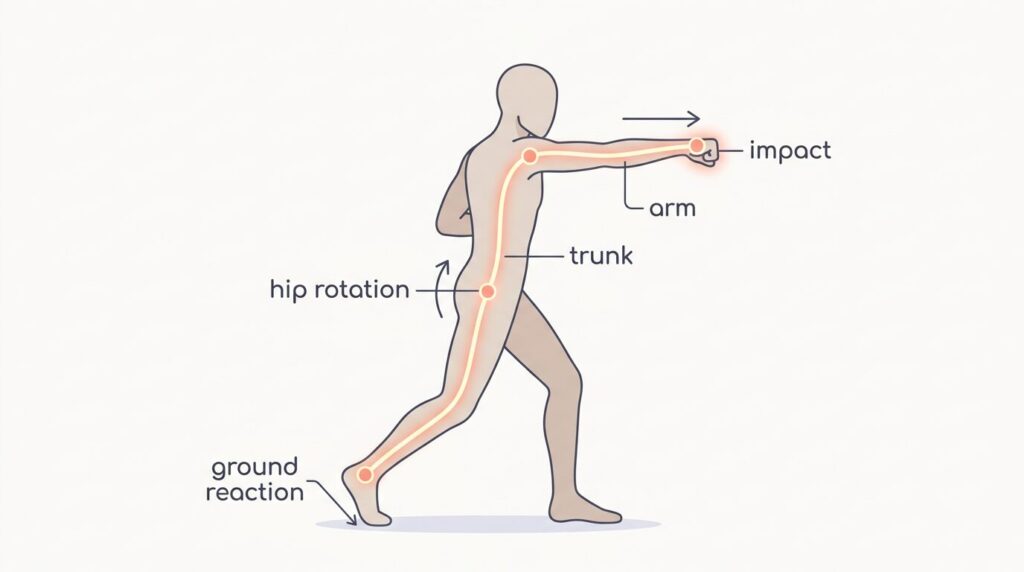
For those who research technique rather than concentrating on karate history or philosophy, the sports-science papers accumulating rapidly in recent years are also indispensable. They are not yet well introduced within Japan, but in the world of English-language papers, biomechanical research on karate striking, kicking, and kumite (sparring) tactics has come to form a genre of its own.
8-1. Gavagan & Sayers (2017), a Comparative Study of the Roundhouse Kick
- Paper information: Colin J. Gavagan and Mark G. L. Sayers, “A biomechanical analysis of the roundhouse kicking technique of expert practitioners: A comparison between the martial arts disciplines of Muay Thai, Karate, and Taekwondo.” PLOS ONE 12(8): e0182645, 2017. University of the Sunshine Coast (Australia).
- Overview: The study compares the kinematic and kinetic parameters of the roundhouse kick performed by experts in Muay Thai, karate, and taekwondo. It shows quantitatively that, while the three kicks share a basic common movement pattern, characteristic differences by discipline and style appear in pelvic axial rotation, hip abduction and flexion, knee extension, and weight transfer.
- Significance: It lets us discuss “what differs even in the same kick” with numbers rather than impressions. It is one of the most readily cited benchmark papers when transmitting karate technique internationally.
8-2. VencesBrito et al., Kinematic Studies of the Straight Punch
- Example paper: A. M. VencesBrito et al., “Kinematic and electromyographic analyses of a karate punch.” Journal of Electromyography and Kinesiology 21(6): 1023–1029, 2011. This paper takes the choku-zuki (straight punch) as its subject. A related study is M. Rinaldi et al., “Biomechanical characterization of the Junzuki karate punch: indexes of performance,” European Journal of Sport Science 18(6): 796–805, 2018 (PubMed PMID: 29609507), which analyzes the jun-zuki (lunge punch).
- Overview: Combining surface electromyography with kinematic measurement, these studies quantify the differences between expert and non-expert punches, as well as the force, joint angles, and muscle activity characteristic of specific punching techniques. The coordination of the lower-limb muscle groups, trunk rotation, and changes in elbow-joint angle are among the objects of analysis.
- Significance: They offer a foothold for translating the experiential expressions spoken on the training floor — “put your hips into it,” “strike from the hara (the lower abdomen / center)” — into the language of biomechanics. They are especially recommended for instructors who want to build coaching feedback on a scientific footing.
8-3. Other Studies in Sports and Health Science
- Luca Molinaro et al., “Assessing the Effects of Kata and Kumite Techniques on Physical Performance in Elite Karatekas.” Sensors 20(11): 3186, 2020. Treats differences in physical performance and stability between kata competitors and kumite competitors.
- Gérome C. Gauchard et al., “Postural control in high-level kata and kumite karatekas.” Movement & Sport Sciences – Science & Motricité 100(2): 21–26, 2018. A comparison of postural-control ability between high-level kata and kumite competitors.
- Henrik Sørensen et al., “Dynamics of the martial arts high front kick.” Journal of Sports Sciences 14(6): 483–495, 1996. The subjects are skilled taekwondo practitioners performing the high front kick; this is not karate itself, but it has reference value as a biomechanical study of a high-speed kicking motion that chains from proximal to distal segments.
All of these papers can be accessed relatively easily through PubMed, PLOS, ResearchGate, and the like. Reading them against Japanese sports-science journals (such as Tairyoku Kagaku and Budō-gaku Kenkyū) is also a way to learn the conventions of research method.
Chapter 9. Japanese and Okinawan History Seen from Abroad (Classics for Background Understanding)
To discuss the history of karate, one wants to have a grasp of both Okinawan and Japanese history — and, if possible, “from the outside.” Here are a few standard works written by foreign historians.
9-1. George H. Kerr, Okinawa: The History of an Island People
- Bibliographic information: George H. Kerr, Okinawa: The History of an Island People, Charles E. Tuttle, 1958 (Tuttle Publishing edition, 2000). The 2000 edition adds an introduction and supplementary material by Mitsugu Sakihara. Japanese translation Ryūkyū no rekishi (trans. Yamaguchi Eitetsu and others, Bensei Shuppan).
- About the author: George H. Kerr (1911–1992) was an East Asia specialist who had served in the U.S. State Department. He is also known as the author of the Taiwan history Formosa Betrayed.
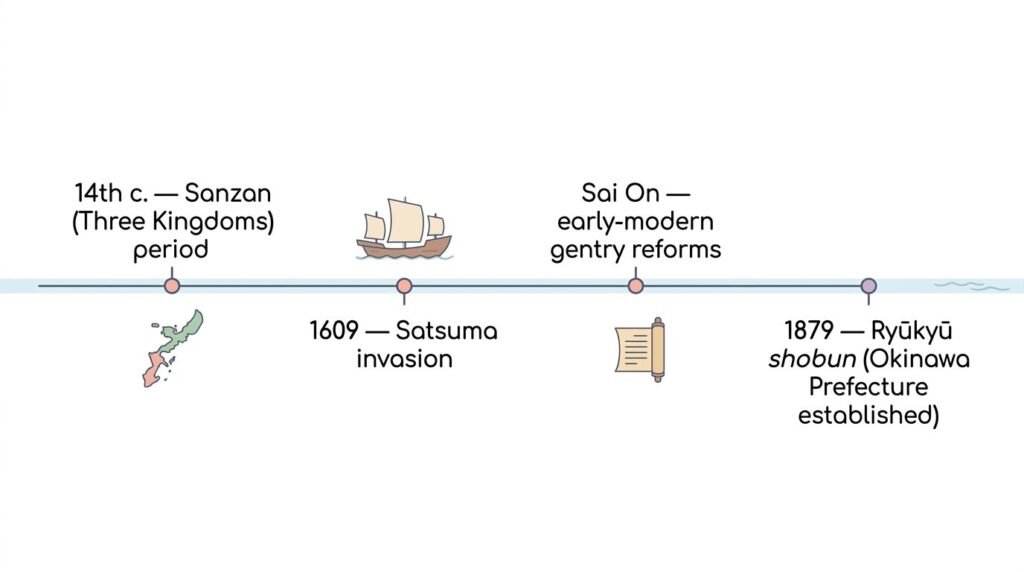
- Overview: A general history of Ryūkyū/Okinawa from the 14th-century Three Kingdoms (Sanzan) period to the postwar U.S. occupation. It is among the earliest general histories of Okinawa written in a Western language, and was long used as a standard reference.
- Significance: There is great value in grasping the social structure of the Ryūkyū Kingdom — the prehistory of karate — through a standard English-language work. The book’s assessments have been considerably updated since the 1970s by the newer Ryūkyū scholarship of Smits and others, but its value as an introduction has not faded.
9-2. Gregory Smits, Visions of Ryukyu and Maritime Ryukyu
- Bibliographic information: Gregory Smits, Visions of Ryukyu: Identity and Ideology in Early-Modern Thought and Politics, University of Hawai‘i Press, 1999. Maritime Ryukyu, 1050–1650, University of Hawai‘i Press, 2019.
- About the author: Gregory Smits is a professor of history and Asian studies at Pennsylvania State University. He specializes in Ryūkyū history and the maritime history of East Asia, and in recent years has focused on the history of the Ryūkyū Islands from the 10th to the 17th centuries.
- Overview: Visions of Ryukyu reads the thought and political practice of Ryukyuan gentry intellectuals such as Sai On, centering on the period from the 1609 Satsuma invasion to the 1879 abolition of the kingdom (the Ryūkyū shobun, when Japan annexed the kingdom and established Okinawa Prefecture). Maritime Ryukyu is an ambitious general history that re-situates Ryūkyū not as an appendage of China or Japan, but as one node of the maritime world of East Asia.
- Significance: The argument that short-circuits the prehistory of karate into the Satsuma invasion and a “ban on weapons” is, by now, scholarly hard to support. Smits’s picture of Ryūkyū history updates a foundational premise for karate-history research.
9-3. Eiko Ikegami, The Taming of the Samurai
- Bibliographic information: Eiko Ikegami, The Taming of the Samurai: Honorific Individualism and the Making of Modern Japan, Harvard University Press, 1995. Winner of the American Sociological Association’s Best Book Award on Asia.
- About the author: Eiko Ikegami is a sociologist and historian at The New School for Social Research, known as the Walter A. Eberstadt Professor. She is a historical sociologist working in the tradition of Norbert Elias and Max Weber.
- Overview: Built around the concept of “honorific individualism,” the book depicts the formation and transformation of the samurai ethos from the Warring States period through the late Edo and Meiji eras. It presents a sweeping historical picture of how the competition over a warrior’s “name” connected with the early-modern bureaucratic order and led all the way to the modern Japanese conception of the individual.
- Significance: Karate-history research often sets “Bushidō” and “the Japanese spirit” in the background, but it is worth confirming, in the language of cutting-edge historical sociology, what the “samurai” actually were as a social formation. In that sense the book belongs to the basic literacy of the karate-history researcher.
9-4. Other Reference Works on Japanese History Seen from Abroad
- Andrew Gordon, A Modern History of Japan (Oxford University Press, 4th ed., 2019). A standard textbook of modern Japanese history.
- Marius B. Jansen, The Making of Modern Japan (Harvard University Press, 2000). A classic on the history of nation-building in the Meiji era.
- Mark Ravina, To Stand with the Nations of the World: Japan’s Meiji Restoration in World History (Oxford University Press, 2017). Re-situates the Meiji Restoration in the context of world history.
Chapter 10. Research on Business and Global Expansion
Karate is at once a traditional culture and a vast global market. The Kyokushin Kaikan, the JKA, the WKF, various tournament promotions, budō tourism, and the protective-gear and karate-gi industries — academic analysis of these is still scarce, but it is gradually accumulating.
- The various papers in Ido Movement for Culture: Journal of Martial Arts Anthropology on the globalization, touristification, and body culture of the martial arts. The journal is peer-reviewed and open-access, covering martial arts, combat sports, and cultural tourism. Wojciech J. Cynarski is known as its editor-in-chief.
- Andreas Niehaus and Max Seinsch (eds.), Olympic Japan: Ideals and Realities of (Inter)Nationalism (Ergon Verlag, 2007). An essay collection on Japan’s reception of the Olympics and nationalism; not a book that discusses the karate business directly, but useful background for considering the adoption of karate at the 2020 Tokyo Olympics as “the international transmission of Japanese culture.”
- Eduardo González de la Fuente, “Recentering the Cartographies of Karate: Martial Arts Tourism in Okinawa.” Ido Movement for Culture: Journal of Martial Arts Anthropology 21(3): 51–66, 2021. Analyzes the institutionalization of karate tourism by the Japanese government and Okinawa Prefecture from the 2010s onward, linking regional development, tourism policy, and the mobility of karate practitioners worldwide.
- Eduardo González de la Fuente, “In which Ways is Karate(dō) Japanese? A Consideration on Cultural Images of Bushidō and Nihonjinron in the Postwar Globalization of Martial Arts.” Journal of Inter-Regional Studies: Regional and Global Perspectives 4: 15–30, 2021. Treats how the “Japaneseness” and “Okinawanness” of karate are reconstructed amid postwar globalization, the image of Bushidō, media representation, and national identity. (Nihonjinron refers to the genre of discourse about Japanese uniqueness.)
- Noah C. G. Johnson, “Striking Distance: Karate as Global Assemblage and Transnational Cultural Practice.” PhD dissertation, University of Iowa, 2022. Taking in the United States, Okinawa, Japan, Australia, and elsewhere, it analyzes karate as a transnational cultural practice in which people, practices, institutions, and images move.
As for the karate business, there is as yet no standard book that surveys the whole picture in a single volume. Research that cuts across dōjō management, the licensing structures of international organizations, tournament promotion, the protective-gear and karate-gi industries, and Okinawan karate tourism is especially lacking. There is ample room for Japanese researchers to write the papers that would fill this gap.
Chapter 11. How to Access These Works — Where to Begin
11-1. Routes to Obtain Them
- Academic papers: Martial Arts Studies is fully open-access, and anyone can download the PDFs for free. The same is true of biomechanics papers in PLOS ONE and the like.
- Books: Publications from university presses (Yale, Harvard, Hawai‘i, Chicago, California, and so on) can be read via each university’s e-book platform, or at the National Diet Library and major university libraries.
- Using libraries in Japan: By combining the National Diet Library Digital Collections, CiNii Books, the OPACs of various university libraries, and ILL (interlibrary loan), you can reach many of the works introduced here.
- Personal purchase: For many titles, obtaining an English paperback or Kindle edition is the practical option.
11-2. A Suggested Reading Order (Tentative)
- First, general histories — George Kerr → Gregory Smits → G. Cameron Hurst III, to grasp the framework of Okinawan history and the history of Japanese martial arts.
- Next, the karate specialist books — Mark Bishop → Patrick McCarthy → Andreas Quast.
- Then critical perspectives — Inoue Shun’s English-language “The Invention of the Martial Arts” → Alexander Bennett, Kendo → Yamada Shōji, Shots in the Dark.
- A sociological update — Raúl Sánchez García, The Historical Sociology of Japanese Martial Arts → Sánchez García & Spencer (eds.), Fighting Scholars.
- Finally, read selectively according to your own area of interest (media theory / sports science / philosophy / business) — Bowman, Cynarski, Donohue, Gavagan, VencesBrito, and others.
11-3. A Word of Caution
Approaching foreign literature as an “answer key” against which to check Japanese research is an attitude best avoided. Foreign researchers, too, carry their own cultural and institutional biases. The healthy way to use these works is to treat the differences — “seen from outside, it looks like this”; “here, a different question is being posed” — as material for re-sharpening our own problem-settings.
Conclusion — Reading Foreign Scholarship Means Renewing Karate Research in Japan
Karate research in Japan has been supported by three pillars: technique, history, and thought. Onto that foundation, new guiding lines are now being drawn one after another from abroad — “institutions,” “gender,” “the body,” “the global economy,” “media representation,” “biomechanics.” The books and papers introduced here are something like gifts arriving from across the sea, sent to help us draw those lines.
Of course, this article is not a perfect bibliography. There must be many important works omitted, and biases in assessment as well. Additions, corrections, and rebuttals from readers are welcome. To better understand karate as a movement-culture — formed within the history of Okinawa and its modern global expansion, and still living and practiced around the world today — we, too, must be read and re-read without cease.
As noted at the outset, this article is no more than a map. Once you have finished reading the map, I hope you will, by all means, take the primary sources into your own hands.
Sources and Reference URLs
Below are the main official information sources for the books, papers, and journals mentioned in this article, listed in order of appearance in the text.
- Martial Arts Studies (journal, Cardiff University Press): mas.cardiffuniversitypress.org
- Martial Arts Studies 10th-anniversary article (Cardiff University): cardiff.ac.uk
- Martial Arts Studies Association (successor to the Research Network): martialartsstudies.org
- Yasuhiro Sakaue, “The Historical Creation of Kendo’s Self-Image from 1895 to 1942” (Martial Arts Studies): mas.cardiffuniversitypress.org
- Paul Bowman profile (Cardiff University): profiles.cardiff.ac.uk
- Andreas Quast, Karate 1.0 review (Ikigai Way): ikigaiway.com
- Andreas Quast author page (Ryukyu Bugei): ryukyu-bugei.com
- Patrick McCarthy, Bubishi: The Classic Manual of Combat (Tuttle): tuttlepublishing.com
- Patrick McCarthy / IRKRS author information: koryu-uchinadi.com
- Mark Bishop, Okinawan Karate (Internet Archive): archive.org
- Michael Rosenbaum author information (YMAA): ymaa.com
- Michael Rosenbaum, Kata and the Transmission of Knowledge (YMAA): ymaa.com
- Christopher M. Clarke, Okinawan Karate: A History of Styles and Masters (Google Books): books.google.com
- Hawaii Karate Museum materials (Charles C. Goodin): budojapan.com
- G. Cameron Hurst III, Armed Martial Arts of Japan (Yale University Press): yalebooks.yale.edu
- Karl F. Friday and Seki Humitake, Legacies of the Sword (University of Hawai‘i Press): uhpress.hawaii.edu
- Donn F. Draeger trilogy, bibliographic information (BUDO JAPAN): budojapan.com
- G. Cameron Hurst III biography (University of Pennsylvania Almanac): almanac.upenn.edu
- G. Cameron Hurst III biography and bibliography (FPRI): fpri.org
- Karl F. Friday, Hired Swords (Stanford University Press): sup.org
- Alexander C. Bennett, Kendo: Culture of the Sword (University of California Press / JSTOR): jstor.org
- Shoji Yamada, Shots in the Dark (University of Chicago Press): press.uchicago.edu
- Inoue Shun, “The Invention of the Martial Arts: Kanō Jigorō and Kōdōkan Jūdō,” in Mirror of Modernity (UC Press, 1998): degruyterbrill.com
- Inoue Shun, Budō no tanjō, bibliographic information (University of Iowa Library): search.lib.uiowa.edu
- Alexander C. Bennett biography (Kansai University): kugakujo.kansai-u.ac.jp
- Alexander C. Bennett biography and major works (Penn Forum on Japan): web.sas.upenn.edu
- Shoji Yamada biography (University of Chicago Press): press.uchicago.edu
- Yamada Shōji, “The Myth of Zen in the Art of Archery” (CiNii Research): cir.nii.ac.jp
- Raúl Sánchez García, The Historical Sociology of Japanese Martial Arts (Routledge): routledge.com
- Norbert Elias Book Prize 2020: norbert-elias.com
- Raúl Sánchez García & Dale C. Spencer (eds.), Fighting Scholars (JSTOR): jstor.org
- Raúl Sánchez García & Dale C. Spencer (eds.), Fighting Scholars (Anthem Press): anthempress.com
- Wojciech J. Cynarski publications (ResearchGate): researchgate.net
- Paul Bowman, Martial Arts Studies: Disrupting Disciplinary Boundaries (Bloomsbury / Rowman & Littlefield): bloomsbury.com
- Paul Bowman (ed.), The Martial Arts Studies Reader (Bloomsbury / Rowman & Littlefield): bloomsbury.com
- Benjamin N. Judkins and Jon Nielson, The Creation of Wing Chun (SUNY Press): sunypress.edu
- Loïc Wacquant, Body & Soul (Oxford University Press): global.oup.com
- Alex Channon & Christopher R. Matthews (eds.), Global Perspectives on Women in Combat Sports (Springer / Palgrave Macmillan): link.springer.com
- John J. Donohue, Warrior Dreams, bibliographic information (University of Iowa Library): search.lib.uiowa.edu
- John J. Donohue works and biography (Encyclopedia.com): encyclopedia.com
- Michael Maliszewski, Spiritual Dimensions of the Martial Arts, bibliographic information (HathiTrust): catalog.hathitrust.org
- Michael Maliszewski, Spiritual Dimensions of the Martial Arts (Goodreads): goodreads.com
- Eugen Herrigel, Zen in the Art of Archery, bibliographic information (Internet Archive): archive.org
- D. T. Suzuki, Zen and Japanese Culture (Princeton University Press): press.princeton.edu
- Trevor Leggett, Zen and the Ways (Routledge): routledge.com
- Thomas P. Kasulis, Zen Action / Zen Person (University of Hawai‘i Press): uhpress.hawaii.edu
- Thomas P. Kasulis biography (Ohio State University): comparativestudies.osu.edu
- Gavagan & Sayers (2017), PLOS ONE: journals.plos.org
- VencesBrito et al., “Kinematic and electromyographic analyses of a karate punch” (PubMed): pubmed.ncbi.nlm.nih.gov
- Rinaldi et al., “Biomechanical characterization of the Junzuki karate punch” (PubMed): pubmed.ncbi.nlm.nih.gov
- Molinaro et al., “Assessing the Effects of Kata and Kumite Techniques on Physical Performance in Elite Karatekas” (Sensors): mdpi.com
- Gauchard et al., “Postural control in high-level kata and kumite karatekas” (Movement & Sport Sciences): mov-sport-sciences.org
- Sørensen et al., “Dynamics of the martial arts high front kick” (PubMed): pubmed.ncbi.nlm.nih.gov
- George H. Kerr, Okinawa: The History of an Island People (HathiTrust): babel.hathitrust.org
- George H. Kerr, Okinawa: The History of an Island People (Tuttle): tuttlepublishing.com
- George H. Kerr, Okinawa, 2000 edition, bibliographic information (Internet Archive): archive.org
- Gregory Smits, Visions of Ryukyu (University of Hawai‘i Press): uhpress.hawaii.edu
- Gregory Smits biography (Penn State): history.la.psu.edu
- Gregory Smits, Maritime Ryukyu, 1050–1650 (University of Hawai‘i Press): uhpress.hawaii.edu
- Eiko Ikegami, The Taming of the Samurai (Harvard University Press): hup.harvard.edu
- Eiko Ikegami biography (The New School): newschool.edu
- Andrew Gordon, A Modern History of Japan, 4th ed. (Oxford University Press): global.oup.com
- Marius B. Jansen, The Making of Modern Japan (Harvard University Press): hup.harvard.edu
- Mark Ravina, To Stand with the Nations of the World (Oxford University Press): global.oup.com
- Ido Movement for Culture: Journal of Martial Arts Anthropology official site: imcjournal.com
- Ido Movement for Culture (DOAJ): doaj.org
- Wojciech J. Cynarski, editor-in-chief information (IMC Journal): imcjournal.com
- Andreas Niehaus and Max Seinsch (eds.), Olympic Japan (Ghent University): biblio.ugent.be
- Eduardo González de la Fuente, “Recentering the Cartographies of Karate” (IMC Journal): imcjournal.com
- Eduardo González de la Fuente, “In which Ways is Karate(dō) Japanese?” (Waseda University PDF): waseda.jp
- Noah C. G. Johnson, “Striking Distance: Karate as Global Assemblage and Transnational Cultural Practice” (University of Iowa): iro.uiowa.edu
🖋️Editorial note on future updates
- As each work is read in full, the author’s own commentary will be added over time.
- When new Japanese translations are published, the bibliographic details will be updated.
- Additional recommendations and corrections from readers are welcome and will be acknowledged where incorporated.
- This English edition adds extra context on Japanese and Okinawan history and on martial-arts terminology for readers outside Japan; suggestions for further clarification are also welcome.